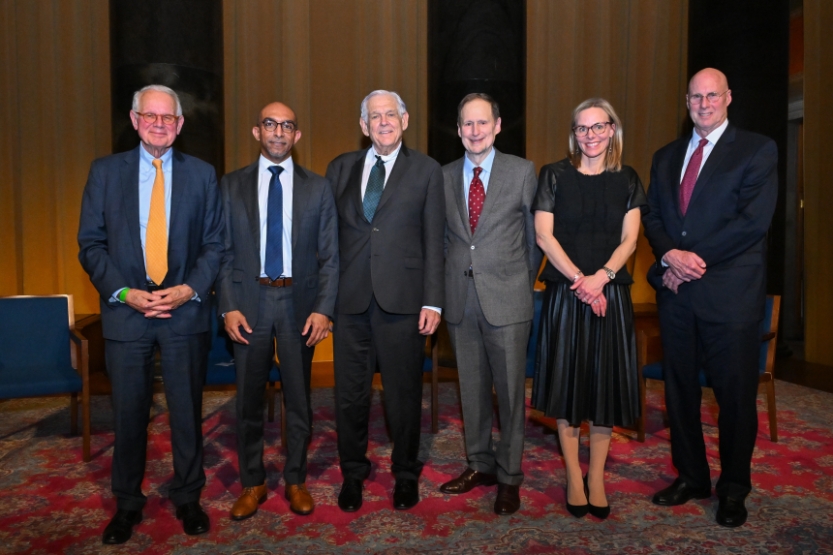
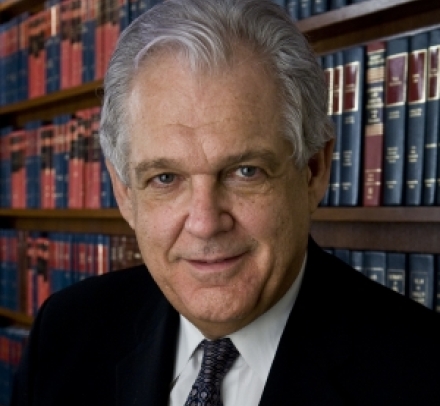
Professor George A. Bermann Honored at Columbia Arbitration Day 2026
The two-day conference featured a testimonial dinner celebrating the influential figure in international arbitration.
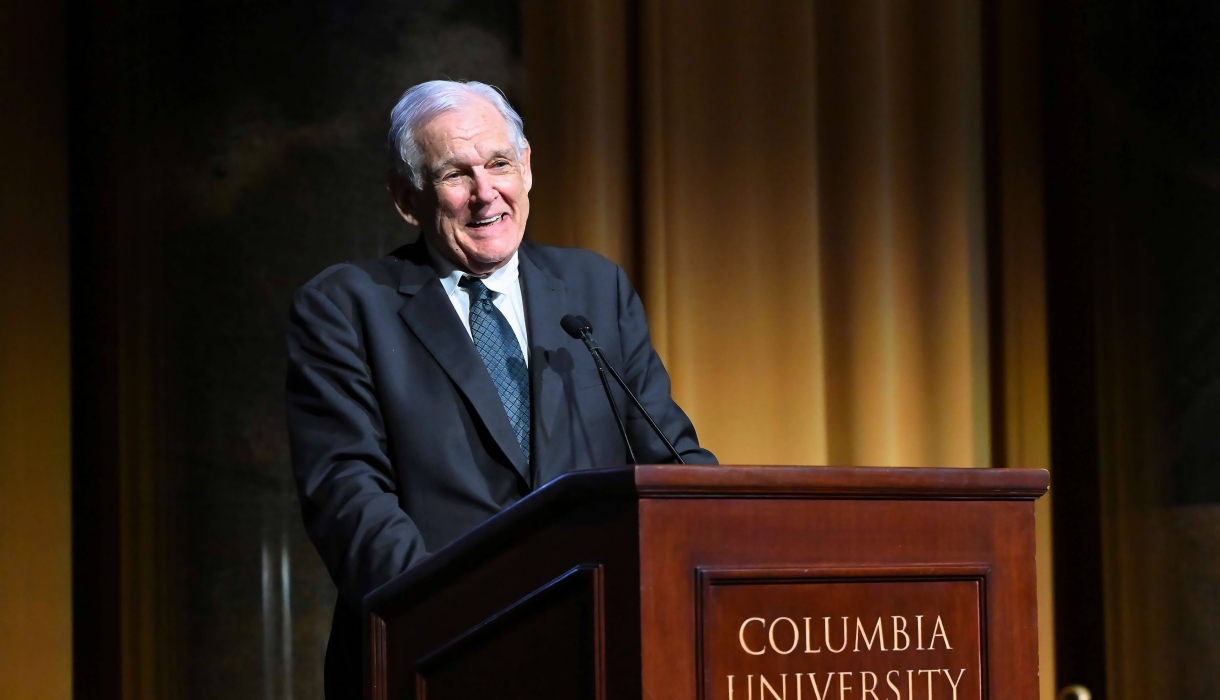
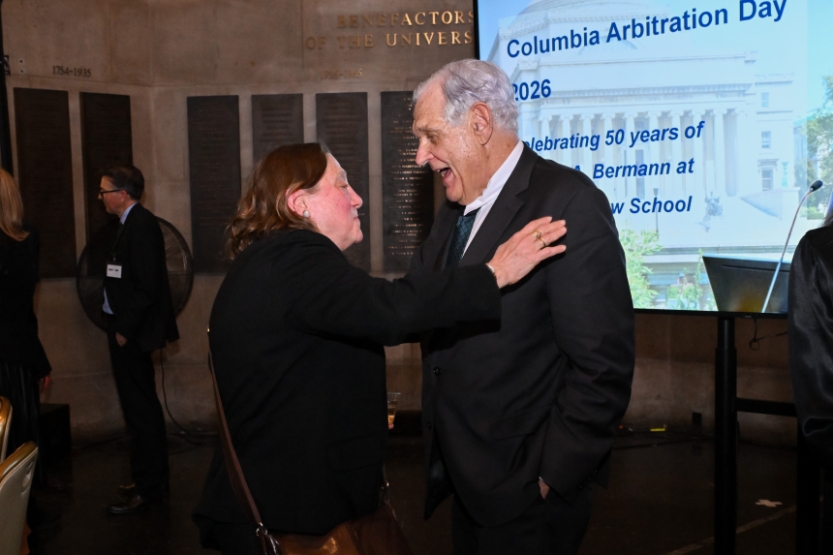
Columbia Law faculty, students, alumni, and practitioners from around the world saluted legendary scholar and teacher George A. Bermann ’75 LL.M., Walter Gellhorn Professor of Law and Jean Monnet Professor of European Union Law, at a special dinner held as part of Columbia Arbitration Day 2026. This year’s conference, organized by Columbia Law School’s International Arbitration Association, paid tribute to Bermann’s 50 years of teaching at Columbia Law School. A world-renowned authority on comparative law, transnational litigation, and international arbitration, Bermann has trained generations of students who have gone on to work in the international arbitration arena.
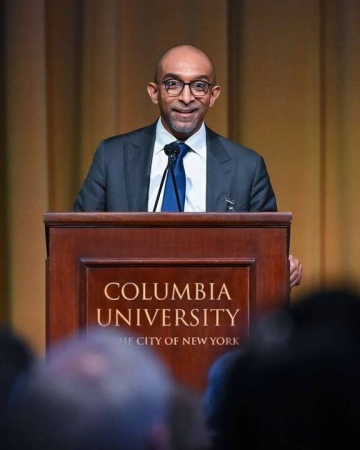
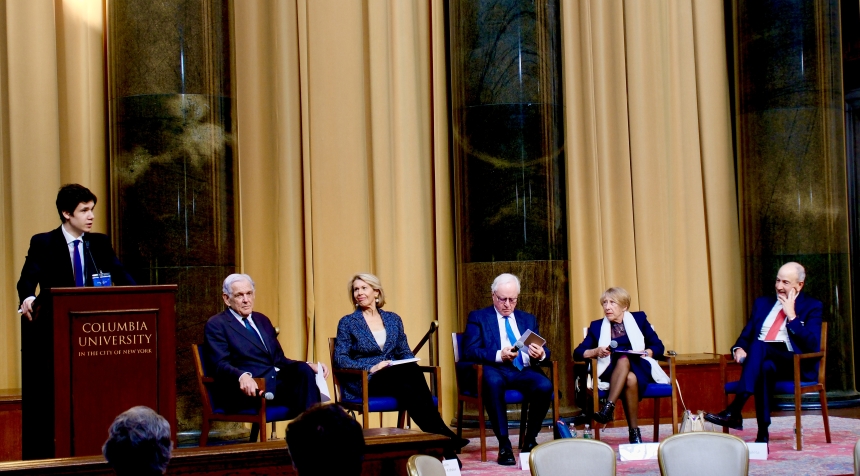
Daniel Abebe, Dean and Lucy G. Moses Professor of Law, provided opening remarks at the dinner on March 30 and praised Bermann’s “incredible range” as an academic. “In many ways, his work has shaped the architecture of international arbitration, making it more coherent, more legitimate, and more integrated across all systems,” said Dean Abebe. “He’s a synthesizer, someone who brings doctrine, practice, and comparative insight into a single, highly influential body of work.”
Bermann’s legacy at Columbia Law includes founding the European Legal Studies Center and Columbia Journal of European Law, as well as serving as co-editor in chief of The American Review of International Arbitration. He was the chief reporter for the American Law Institute’s Restatement of the Law, The U.S. Law of International Commercial and Investor-State Arbitration—a 12-year project that was completed in 2019. He is also a founding member of the governing body of the International Chamber of Commerce International Court of Arbitration.
Gregarious and Generous
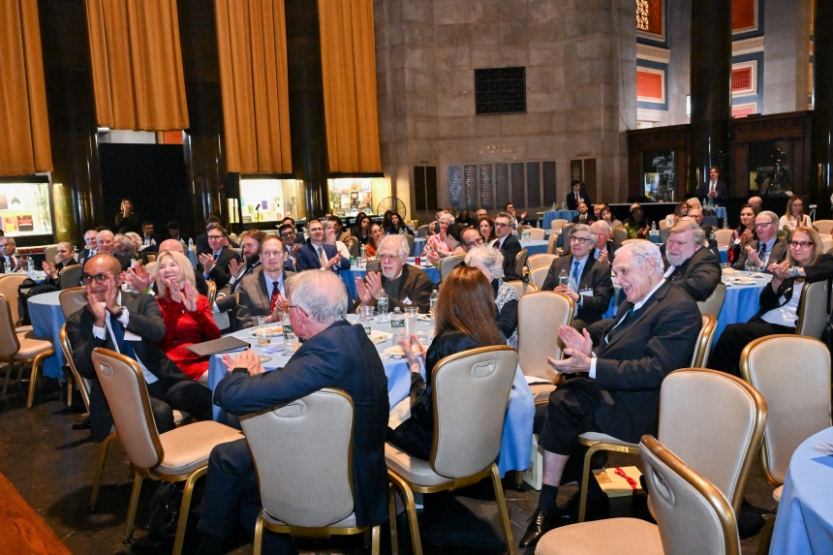
More than 200 guests attended the dinner in Low Memorial Library, where some of Bermann’s longtime faculty colleagues lionized him as a scholar, mentor, interlocutor, and friend. “He’s unmistakably gregarious, with a genuine delight in engaging others,” said the Dean. “He gives his time and attention freely. He mentors with care and attention. He celebrates the successes of others as if they were his own. It is this human dimension—alongside his extraordinary professional accomplishments—that defines his legacy and makes him such a cherished member of our community.”
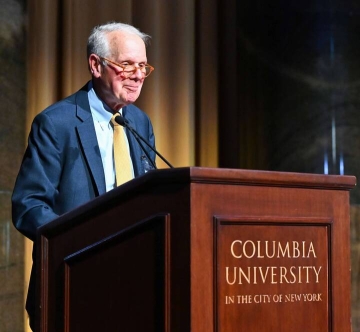
Merritt Fox, Arthur Levitt Professor of Law, recalled meeting Bermann on their first day as students at Yale Law School—where they lived in adjoining dormitory rooms—in 1968. “George’s intelligence was obvious from the start,” said Fox, who remembered being impressed that Bermann was a prize-winning Latin student in high school and a Marshall Scholar after graduating from Yale College. Throughout their long friendship, Fox said he has appreciated Bermann’s consistent “joyful good nature, manifested by his quick smile and his real human presence.”
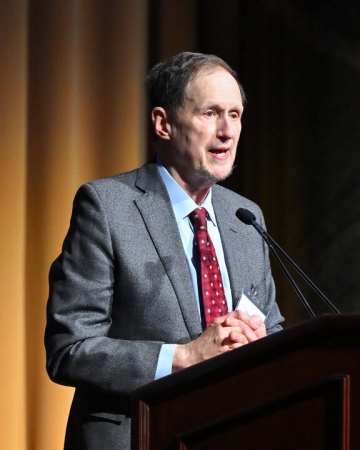
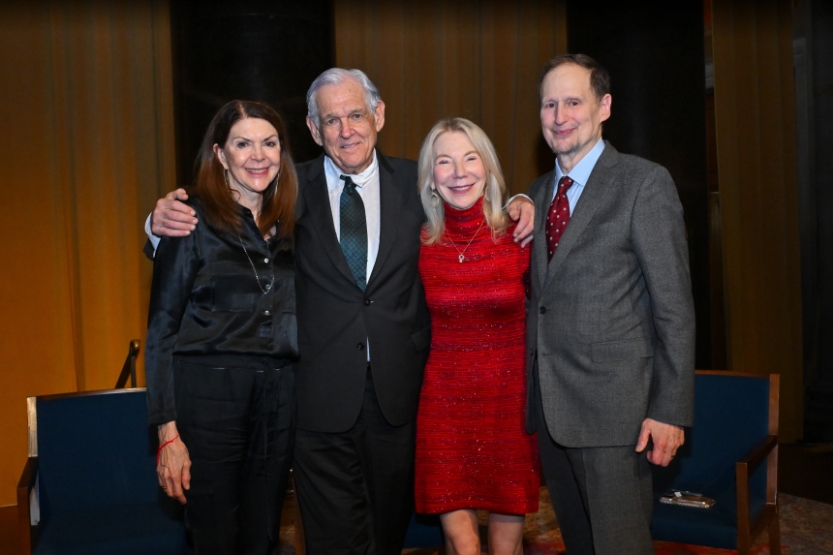
University Professor Michael Doyle described the close bond he and his wife, Amy Gutmann (the former president of the University of Pennsylvania and former U.S. ambassador to Germany), share with Bermann and his wife, Sandra Bermann, Cotsen Professor in the Humanities and Professor of Comparative Literature at Princeton University. He characterized Bermann as “the consummate cosmopolitan,” who excels in every aspect of his professional life. “George’s teaching welcomes and inspires students from every country,” he said. “His writing draws on the scholarship of the U.S., Europe, and the world beyond. His arbitral practice may be focused in Paris, but its reach, too, is global.”
Doyle also noted that he considers Bermann as the third grand pillar of a line of transnational law scholars that began with Columbia’s Philip Jessup, evolved to a famous quint (Wolfgang Friedmann, Louis Henkin, Oscar Schachter, Hans Smit, and Richard Gardner), and then “rose again with the arrival of George to Columbia.”
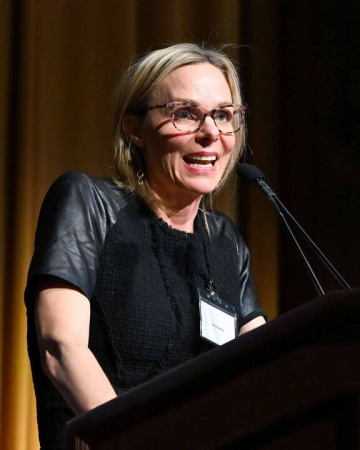
Anu Bradford, Henry L. Moses Professor of Law and International Organization, said she is indebted to Bermann for inviting her to be the co-director of—and eventually take over—the European Legal Studies Center. “And George, you gave me the greatest gift by handing me the European Union law class that I have been teaching since I joined the faculty in 2012,” she said. “I have taught from George’s casebook since Day 1, and I still do.”
Bradford added that their bond extends beyond shared intellectual interests. “In many ways, you are like a fellow European to me,” said Bradford, who is a citizen of both Finland and the United States. “I sometimes need to remind myself that you are not a European. … You understand the values, you understand the culture, and you are emotionally invested in the success of the continent,” Bradford continued. “And, especially in times like these, where the transatlantic relations are where they are, I think it’s really important that I know I can talk to somebody in this faculty who feels the depth of the pain as a fellow transatlanticist, who has the commitment and faith that Europe will not just face its challenges but will thrive and also succeed, and who is really invested in that outcome. So I very much thank you for that.”
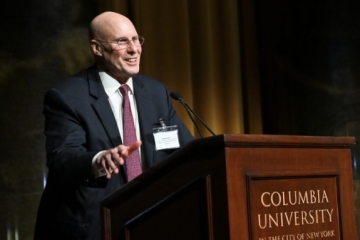
Bradford read a tribute from Katharina Pistor, Edwin B. Parker Professor of Comparative Law, and Robert Smit ’86, Edwin B. Parker Professor of Professional Practice, read a letter from Petros C. Mavroidis, Edwin B. Parker Professor of Foreign & Comparative Law. Smit also introduced a student-produced video featuring encomiums from “George’s fan club around the world,” including academics and leading international arbitrators.
Drawn to Academia
When it was Bermann’s turn to address his colleagues, friends, and acolytes, he talked about his unique academic origin story. In 1974, after a few years in practice at Davis Polk & Wardell, he enrolled in an advanced degree program at the Law School, drawn by its roster of acclaimed scholars. “Columbia Law School was nothing short of an international and comparative law paradise for me,” said Bermann, who knew he wanted to become an academic in those fields. At the same time, he was invited to join the faculty, and then the Law School promptly sent him overseas to study for two years at the Sorbonne and Conseil d'État in Paris, the University of Munich, and the Max Planck Institute for Comparative Public Law and International Law in Heidelberg, Germany.
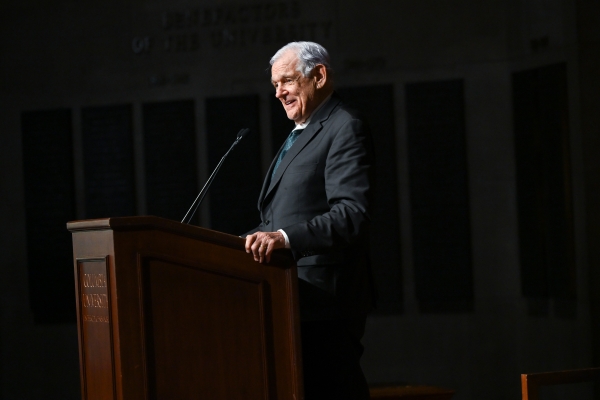
“It’s astounding that I could be hired overnight, sent abroad for two years, considered a professor without even being one,” he said. “Only after those two years had passed would I reenter the classroom, not as a student but as a teacher.”
Bermann said that he was initially drawn to academia by the prospect of research and writing—not teaching. “That part of the job at the outset truly tested my self-confidence, especially in the days when very few years separated me from my students, which is obviously no longer the case,” he said. “But I can stand before you today to tell you … it’s unquestionably the classroom that most moves and inspires me and kept me at Columbia long, long, long after I could and should have retired.”