Faculty Experts on the Supreme Court’s Tariff Decision
At a recent Lawyers, Community, and Impact event, Columbia Law School faculty discussed the ramifications of the Supreme Court’s Learning Resources ruling for presidential power, foreign affairs, and trade.

On March 12, a panel of faculty experts in constitutional law, national security, and the global economy considered the Supreme Court’s recent 6-3 decision in Learning Resources Inc. v. Trump, which held that the International Emergency Economic Powers Act (IEEPA) does not authorize the president to unilaterally impose tariffs.
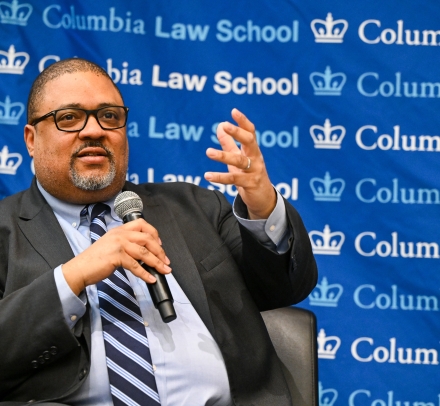
The Lawyers, Community, and Impact event—moderated by Benjamin Liebman, Robert L. Lieff Professor of Law and vice dean for intellectual life, with panelists Anu Bradford, Henry L. Moses Professor of Law and International Organization; Gillian Metzger, Harlan Fiske Stone Professor of Constitutional Law; and Matthew Waxman, Liviu Librescu Professor of Law—unpacked the implications of the decision for the separation of powers, national security, and trade policy.
Major Questions
Metzger discussed the significance of the Learning Resources decision from her perspective as an administrative law scholar and as an authority on the court under Chief Justice John Roberts, who wrote the majority opinion. The chief justice “basically rested his opinion on the major questions doctrine,” said Metzger, who has taught a seminar on The Roberts Court.

The Supreme Court first invoked the major questions doctrine, an administrative law principle, in 2022, establishing that Congress must provide clear authorization before an agency can take actions that would be unprecedented and transformative, and would have great economic or political significance. The doctrine checks executive authority by preventing the executive from using vague statutes to assert sweeping powers. “In this case, the chief concluded that the major questions doctrine was triggered,” Metzger said.
Six of the other justices weighed in separately on the case, including four concurrences and two dissents. “The decision was really an opinion extravaganza!” said Metzger. “That’s particularly notable because this case was supposed to be on expedited consideration. Obviously, we were taking in a whole lot of tariff money, and it was important to get this question resolved, and all of the separate writing in this case was no doubt what contributed to how delayed the court was in getting the opinion out.” (The case was argued on November 5, 2025, and the decision was delivered on February 20, 2026.)
The opinions, Metzger said, reflect the “ongoing disputes” at the court about the major questions doctrine. She noted that Justice Neil Gorsuch wrote the longest concurrence, which was an extended defense of the major questions doctrine as a substantive canon of interpretation. Gorsuch also criticized aspects of the arguments by Justices Amy Coney Barrett, Elena Kagan, Brett Kavanaugh, and Clarence Thomas in their separate opinions. “This is going to be in the administrative law casebook going forward because you could teach a whole lot just from this case,” Metzger said.
Metzger said she does not think the court’s decision can be seen as signaling the court is going to push back significantly against the president. However, she noted that Roberts’ opinion “detailed the kind of chaos that Trump imposed as he was doing the tariffs” by often changing them “the next day or the next week.” This part of the ruling expressed “some degree of frustration with Trump’s behavior,” she said.
Foreign Affairs
Despite the ruling, Trump still has many other emergency powers to address foreign relations and national security issues, said Waxman. “In this case, the Supreme Court held that IEEPA, in particular, doesn’t authorize tariffs, but it does unquestionably authorize a wide range of economic and financial sanctions, asset freezes, restrictions on certain kinds of transactions,” he said. Waxman added that Congress has delegated to the president broad emergency authority regarding the domestic use of the military, defense-related industries, control of telecommunications networks, and national infrastructure. “So I see this as a pretty narrow decision,” he said.

Waxman noted that courts have historically upheld the exercise of the executive’s emergency powers in the national security and foreign affairs realm. “They are very reluctant to ever second-guess the invocation of a national emergency,” he said. “I’m wondering whether this particular president is invoking emergency power in a way that will erode the credibility of the executive branch and produce some jurisprudence that is less deferential to the president.”
He said the courts will likely apply greater judicial scrutiny in cases where the president’s claim of emergency powers is based on crises that may lack validity. “Overreach by the executive branch could actually leave the presidency weakened by the end of the Trump presidency,” he said.
Trade and Foreign Policy
According to Bradford, some trade scholars think that the sweeping nature of the tariffs prompted the court to rule the IEEPA statute inapplicable. She said that what made these tariffs “so significant is that they were imposed not just on adversaries but on allies as well.”

But Bradford does not foresee the decision impacting the Trump administration’s trade and foreign policy conduct. “In anticipation of the ruling, the administration made it very clear that the tariffs are here to stay,” she said. “They will just find another legal basis to go forward with them.”
The Trump administration can continue to impose tariffs, she said, by invoking Section 122 of the Trade Act of 1974, which allows for tariffs of up to 15% to fix balance-of-payment issues for up to 150 days. With the United States worried about deficits, “that is now the most natural legal basis for tariffs that the administration turned to,” she said. “It’s an easier route because it does not require investigation by any other administrative agency. If you have other legal bases, you may first need the Commerce Department or U.S. trade representative to carry out an investigation and conclude that there’s a basis for taking action. But Section 122 allowed them to move fast.”
Trump can also justify tariffs, she said, through Section 301 of the trade act, which the president used during his first administration to invoke tariffs against Chinese importers. “That is imposed when there’s a foreign act that burdens the U.S. economy, something unreasonable, something discriminatory,” she said. “It is seen as taking up a little bit more time because you need to have an investigation first, but there’s also an exception that if you need a more expedient process, then it could also be done within a few days.”
As for how Europe reacted to the Learning Resources decision, Bradford offered this opinion: “I think there certainly was a sense of relief that this was a welcome decision,” she said. “But the transatlantic relationship is not anything like it was before. There’s very little you can rely on. So one Supreme Court decision, which is followed by other legal bases for tariffs, doesn’t fundamentally change how Europeans expect this administration to conduct itself.”
She said Europeans do not foresee “the chaos” ending anytime soon. “Businesses cannot invest when there’s no stable set of expectations of what the tariff will be next week, next month, or next year,” she said. “I think the biggest tariff of all is uncertainty.”
About Lawyers, Community, and Impact: Launched in 2016, the series invites Columbia Law experts to talk about the most pressing issues of our time and brings deeper context and perspective to the work Columbia Law community members do both inside and outside the classroom.