Faculty Experts on Generative AI, Legal Education, and the Future of the Profession
At a Lawyers, Community, and Impact event held on November 10, Columbia Law School faculty discussed how they are using artificial intelligence (AI) in their scholarship and in the classroom, and its impact on the practice of law.

Generative AI is affecting every sector of the legal profession. As part of his broader strategy to prepare students to lead in rapidly evolving settings, Daniel Abebe, Dean and Lucy G. Moses Professor of Law, recently established a faculty-led task force charged with providing recommendations for enhancing the Law School’s curriculum in the area of generative AI. At a Lawyers, Community, and Impact (LCI) event moderated by Dean Abebe in November, the professors on that task force—Talia Gillis, Benjamin L. Liebman, Eric Talley, and Rebecca Wexler—spoke about AI’s impact on legal education and legal practice, and AI as a subject of their scholarship.
“It’s our responsibility as educators here to make sure that we’re empowering [students] with the tools to be successful in a world that will be increasingly driven by AI,” Dean Abebe told the audience of students. “I’ve come to realize that there is not only going to be a change in law firms, but there will be a change with public interest employers and government employers as well, because there will be an emphasis on using resources efficiently,” he said.
AI in the Classroom

Columbia Law faculty are incorporating AI into their pedagogy, both practically and theoretically. At the event, Professor of Law Talia Gillis, an expert on the law and economics of consumer markets, explained one of the practical ways she has embraced AI to improve her teaching. She said she often uses AI to interrogate what happened during class discussions by uploading her notes, detailing interactions with students, and asking AI if her descriptions of different concepts were clear, particularly if she thinks a conversation could have “gone in a different direction.” AI, she said, “helps me in that process of debriefing the class.

In 2024, Eric Talley, Marc and Eva Stern Professor of Law and Business, taught a J-Term course on machine learning and the law. “The course basically involved [exploring] some of the guts that go into legal AI and what’s happening behind the scenes when you’re making a query of a chatbot or an LLM [large language model],” said Talley, who is an expert on the intersection of corporate law, governance, and finance. More broadly, he would also like to see students develop, by the time they graduate, a lawyerly intuition that helps them to question AI if a response does not seem right. In other words, “how do you sequence the lawyerly spidey sense when you want to use these tools as actively as possible?” he said.

The Chinese legal system, said Benjamin L. Liebman, Robert L. Lieff Professor of Law, vice dean for intellectual life, and director of the Hong Yen Chang Center for Chinese Legal Studies, is moving faster in many ways than anywhere else in the world in terms of embracing AI. In his spring 2026 course Law and Legal Institutions in China, he plans to address how China is using AI. “One of the themes of my course is thinking about ways in which we see China shifting from catching up in terms of its development of the rule of law to becoming a global regulator,” he said. “So we’ll spend some time talking about how China is regulating AI and how that regulation may also shape what goes on outside of China.”
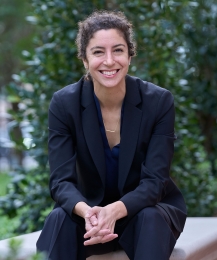
AI has become an essential topic in the Evidence course taught by Rebecca Wexler, Alfred W. Bressler Professor of Law. As she teaches students about rules of evidence—including hearsay, reliability requirements for expert witnesses, and the Sixth Amendment’s confrontation clause (which states that “in all criminal prosecutions, the accused shall enjoy the right … to be confronted with the witnesses against him”)—they learn that the rules apply to humans but not to machine-generated evidence. “This tees up discussions about the proposals for the federal rules of evidence to address potential AI outputs,” she says.
AI and Scholarship
Gillis considers AI the equivalent of a research assistant or collaborator that is available all day (and night) when she is writing. “I’ll give it a chunk of text and ask it to repeat my argument to see if I express myself in a clear way. [For example], am I thinking about the structure of my ideas and conveying them appropriately? I’ll be able to critique my ideas and come up with things that I am missing in a way to improve the text,” she said. “It’s a constant back-and-forth of questions and answers rather than a one-of-a-kind interaction of question and answer.”
Liebman is employing AI for his research on the Chinese legal system, which involves drawing on a dataset of 130 million Chinese court judgments. “We’re still in the early days but really trying to experiment with how we can use ChatGPT to probe this dataset in ways that are much quicker and much more efficient than some methodologies we were using just a couple of years ago,” he said.
For one of her research projects, Wexler is looking specifically at how AI may pose risks to the criminal justice system. Collaborating with a computer scientist, she is assessing whether AI that is incorporated into discovery software could create biases that may result in suppressing exculpatory evidence in violation of criminal defendants’ due process. “We’ve created synthesized datasets to run simulations and try to do a proof of concept that this is a real risk,” said Wexler, who teaches a Technology Law seminar.
AI in Practice
Talley told students that the evolving AI legal landscape offers them untold opportunities. “This is a new area of law that’s being absolutely cracked open right now,” he said, noting that there will be a premium in spotting those fields—“they could be in tax, property, employment law, environmental law”—where AI will have a greater impact, and then trying to be “one of the earlier folks occupying them.”
Gillis, who’s been meeting with Big Law partners to discuss AI, had good career news for students who might be worried that AI will supplant junior associates at law firms. “I’m very happy that the conversation has shifted from AI replacing lawyers to augmenting lawyering,” she said.
Students, she added, must have “a willingness to engage with, and a curiosity about, new technologies” because the technology is rapidly changing and different areas of legal practice require different AI tools. Learning how to have conversations with technologists and firms’ data scientists, Gillis added, is “key to entering the legal profession today.”
About Lawyers, Community, and Impact: Launched in 2016, the series invites Columbia Law experts to talk about pressing current issues and brings deeper context and perspective to the work Columbia Law community members do both inside and outside the classroom.