Manhattan District Attorney Alvin Bragg on Public Service and the Future of Local Prosecution
At a recent Lawyers, Community, and Impact event, Bragg spoke with Dean Daniel Abebe about traditional and innovative approaches to public safety and Bragg’s path to a career in public service.
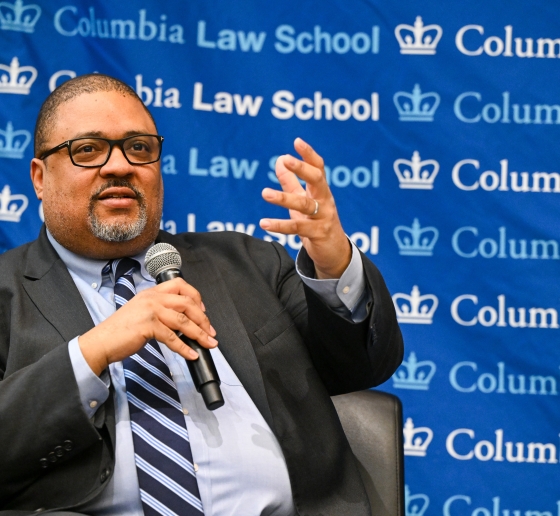
On February 9, Daniel Abebe, Dean and Lucy G. Moses Professor of Law, sat down with Manhattan District Attorney Alvin Bragg for a wide-ranging conversation on jurisdictional issues, alternatives to incarceration, prosecutorial priorities, the importance of responding to community concerns, and the impact of public service.
Held as part of the Lawyers, Community, and Impact (LCI) series, the event, “Public Service and the Future of Local Prosecution,” began with Benjamin L. Liebman, Robert L. Lieff Professor of Law and vice dean for intellectual life, introducing Bragg. Speaking before a packed lecture hall of students and other members of the community, Liebman cited Bragg’s “incredible résumé of public service.” Bragg was first elected Manhattan District Attorney in 2021 and was reelected in 2025. The district attorney’s office currently has 1,700 employees, including 650 assistant district attorneys, and Bragg oversees “one of the most high-profile prosecutorial jurisdictions in the world,” said Liebman.
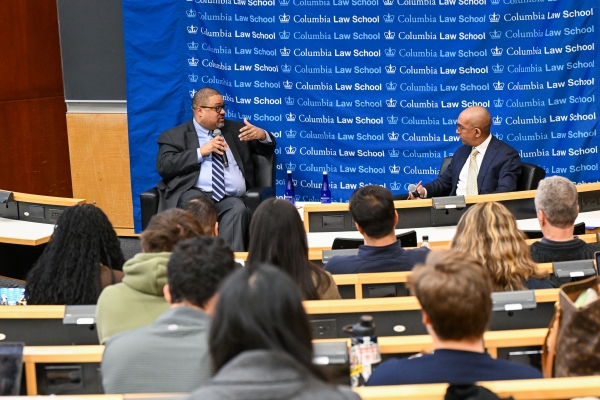
Dean Abebe began the conversation with a question for Bragg about jurisdictional boundaries, particularly within the current context of immigration enforcement. Bragg said that one of his priorities as district attorney has been to enhance community trust. “I’m a lifelong Manhattanite, lifelong Harlemite, and come from part of the borough with a historically fraught relationship with law enforcement. And so one of my main areas of focus has been to develop trust with all the communities we serve.” When local police participate with federal law enforcement on civil immigration actions, he said, “even if intellectually you distinguish between what federal law enforcement is doing and your local law enforcement, it blends, it bleeds, and that trust in government gets eroded.”
Bragg and Dean Abebe share a friendship that began when the two met at Harvard Law School, when Bragg was a 2L and the Dean was a 1L. They discussed their law school experiences, including clinics, courses, moot courts, and other moments that the Dean called “productive discovery.” The Dean also asked Bragg about the path that led him to “thinking about law as not only a vocation but a commitment to public service.” Bragg spoke about his personal experiences both growing up in New York City and with police accountability. “I had three unconstitutional gunpoint stops with the NYPD, and you did not need to take Con Law to know they were unconstitutional,” he said. He also described personally experiencing a number of “traditional public safety issues: a homicide victim on my doorstep, a knife to my neck, a semiautomatic weapon to my head.” Bragg said he was drawn to study law by this “juxtaposition … [of] how we can achieve safety, both traditionally and then also safety from the people who are policing.”
After graduating from law school in 1999, Bragg clerked for Judge Robert P. Patterson Jr. in the U.S. District Court for the Southern District of New York and worked briefly in private practice. He subsequently served as an assistant and later as chief deputy attorney general for New York state. When he joined that office, Bragg chose to work in the public corruption unit. “I felt very strongly about power asymmetry cases, as I call them,” he said. At the time, he was trying to figure out if he had the temperament to be a prosecutor and send people to prison. “I wanted to see if depriving someone of their liberty was something I would be comfortable doing,” he said. Bragg also served as an assistant U.S. attorney for the Southern District of New York.
Under Bragg, the Manhattan District Attorney’s Office takes on an array of cases—from those involving shoplifting and violent assaults to cyber crimes and securities fraud. “Our practice represents the vibrancy of Manhattan,” he said. While he does routinely send people to prison, he said he is also in a position to set policy that recognizes that criminality can have different causes, which require a range of responses and a consideration of community needs.
“Public safety is always going to be [our office’s] North Star, but [we] pair that with a recognition that incarceration is not always what is going to make us safe,” he said. With this in mind, he established the Pathways to Public Safety Division during his first year as district attorney, which assesses individuals for alternatives to incarceration, including by utilizing diversion and evidence-based programming. “Determining when to use [which method] is something we think about every day, and it’s hard,” he said.
Bragg concluded by saying that he hoped his visit would inspire students to pursue careers in public service. “We need people in the arena, and the arena is large,” he said. “We need well-trained, driven people who are going to work in the public interest, broadly construed.” Besides the personal reasons of enjoying public interest work in all its forms, Bragg said that there’s another “great big reason to do it, which is that we help the world.”
About Lawyers, Community, and Impact: Launched in 2016, the series invites Columbia Law experts to talk about pressing current issues and brings deeper context and perspective to the work Columbia Law community members do both inside and outside the classroom.