Faculty Experts on Immigration, Federalism, and the Supreme Court
At a Lawyers, Community, and Impact event, faculty discussed recent legal challenges and court rulings that influence the framework of immigrants’ rights and enforcement.

Columbia Law faculty who are experts in immigration law and federalism explored the implications of recent Supreme Court cases on citizenship and immigration at a Lawyers, Community, and Impact event held on April 5.
The discussion—moderated by Benjamin L. Liebman, Robert L. Lieff Professor of Law and vice dean for intellectual life, with Jessica Bulman-Pozen, Betts Professor of Law, and Elora Mukherjee, Jerome L. Greene Clinical Professor of Law—focused primarily on Trump v. Barbara, which seeks to block a January 2025 executive order that would bar birthright citizenship for babies born in the United States if their parents are in the United States temporarily or without legal status. The case was argued at the Supreme Court on April 1.
When the executive order was issued, “there was almost unanimous thought that this was a crazy argument,” said Liebman. That it became a case before the Supreme Court “is a sign of how much the ground has shifted,” he said.
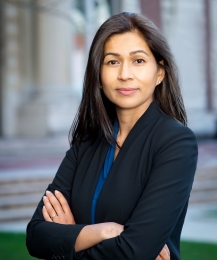
“Birthright citizenship is core to our national identity and who we are as a people,” Mukherjee said. “The executive order is completely at odds with the history of the 14th Amendment, the text of the 14th Amendment, more than a century of Supreme Court precedents, two federal statutes, executive branch practice, and the reliance interests of Americans over generations.”
Both Mukherjee and Bulman-Pozen agreed that the Supreme Court is likely to decide against the president’s order. “I think the Supreme Court—whereas it’s been a rubber stamp for the Trump administration in many immigration contexts—I don’t think it’s going to be a rubber stamp here,” Mukherjee said.
“The challengers are likely to succeed in this suit,” said Bulman-Pozen. “The text, as well as the history, of the 14th Amendment confers birthright citizenship in pretty unmistakable terms that have long been accepted.”
If the executive order is upheld, Mukherjee said, it will affect every baby born in the United States and their parents, “because a person who’s giving birth and the other parent will need to prove what their citizenship status is, what their immigration status is, and what their baby’s status should be. And these are not easy questions to answer. Immigration paperwork … is notoriously complex, and hospitals, in the delivery room, are just not equipped to make these determinations.”

The Trump administration’s argument in the case did not attempt to overturn United States v. Wong Kim Ark, the 1898 case that established birthright citizenship for children of noncitizens, Bulman-Pozen said. Instead, the administration sought to introduce the concept of “domicile” as a factor in determining citizenship, “an idea that there has to be some kind of permanent, continuous residence by the parents of a child born in the United States for that child to have birthright citizenship,” Bulman-Pozen said. That is “against the historical tradition and also not reflected in the text of the amendment.”
Lower courts issued nationwide injunctions that halted the executive order on constitutional grounds. But in Trump v. CASA Inc., a case the administration brought to appeal one of those injunctions, the Supreme Court ruled in June 2025 that lower courts could not issue universal injunctions that prohibit enforcement of executive actions beyond the plaintiffs before the court because that remedy was not available to the courts in the founding era. In the CASA decision, the Supreme Court left open other mechanisms for challenging executive action, including class actions.
As a result, the American Civil Liberties Union and partner organizations brought a class-action lawsuit—Trump v. Barbara—which is a “more challenging” procedure than obtaining a universal injunction, Mukherjee pointed out. “Working up a class action like Barbara takes way more time and planning and making sure that you dot all your i’s and cross all your t’s and find the right plaintiffs before you can proceed,” she said.
The attempt to end birthright citizenship, even if unsuccessful, will have a lasting effect, the faculty members said. “To have this fringe and radical reading of the 14th Amendment espoused by the highest person in our executive branch, and to have it defended repeatedly in courts across the country by the executive branch, raises real questions about what the future of our nation might look like, even if the challengers win,” Mukherjee said. “Overwhelmingly, many noncitizens are terrified about living their daily lives in the United States.”
“Having this executive order out there as part of a broader project of constructing what it is to be an American or not be an American … is very forceful even if it’s rejected by the court,” Bulman-Pozen said.
Additional Immigration Cases Before the Court
Mukherjee, who directs the Immigrants’ Rights Clinic, highlighted additional cases before the Supreme Court that will also affect immigration. On April 29, the court heard arguments in Mullin v. Doe to determine whether the administration can strip temporary protected status (TPS) from immigrants to the United States from Haiti and Syria.
“TPS is a very stable form immigration relief,” Mukherjee said, for people “who have been living in the United States, often for decades, who are entirely law abiding, who’ve come out of the shadows and made their presence affirmatively known to the U.S. government because they can’t return to their home countries because their home countries have been wrecked by humanitarian problems or civil wars or environmental disasters.”
Another case before the court, Noem v. Al Otro Lado, will decide whether border agents can turn asylum seekers away at the border without a screening interview to determine if they have a well-founded fear of future persecution in their countries of origin.
“Unfortunately, that oral argument [on March 24] did not go well from the perspective of immigrants’ rights advocates and immigrant communities who will be affected by this decision,” Mukherjee said. “It seems unlikely that the case will be resolved in favor of asylum seekers who are seeking protections in the United States.”
About Lawyers, Community, and Impact: Launched in 2016, the series invites Columbia Law experts to talk about the most pressing issues of our time and brings deeper context and perspective to the work Columbia Law community members do both inside and outside the classroom.