100 Years of Arguments: Inside the Harlan Fiske Stone Moot Court Competition
The first final arguments of the Harlan Fiske Stone Moot Court Competition took place in 1926. In honor of that milestone, competitors, directors, and judges reflect on the competition and its enduring impact on careers and connections.

“May it please the court.”
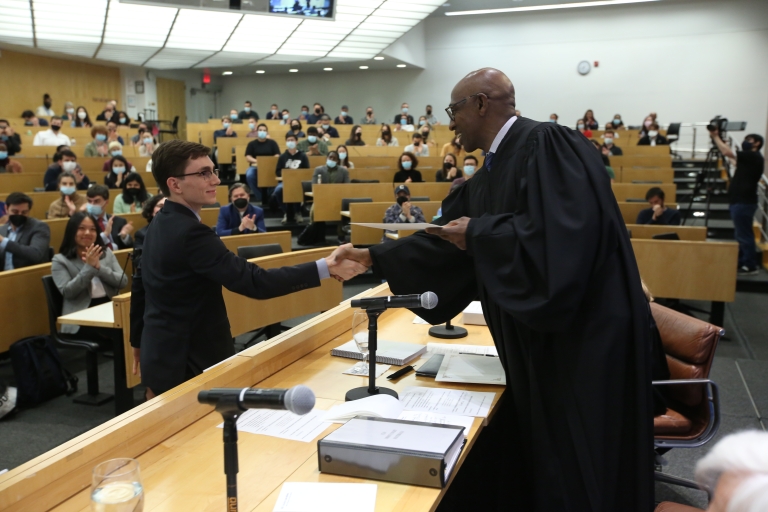
When they appeared before four federal judges on April 13, the two teams of Columbia Law School students competing in the final round of the 2026 Harlan Fiske Stone Moot Court participated in a century-old tradition. The prestigious competition—which gives students experience writing, briefing, and arguing a case before an appellate court and caps the Law School’s Paul, Weiss, Rifkind, Wharton & Garrison Moot Court Program—was started in the 1924–1925 academic year by the Story Inn, a chapter of the legal fraternity Phi Delta Phi.
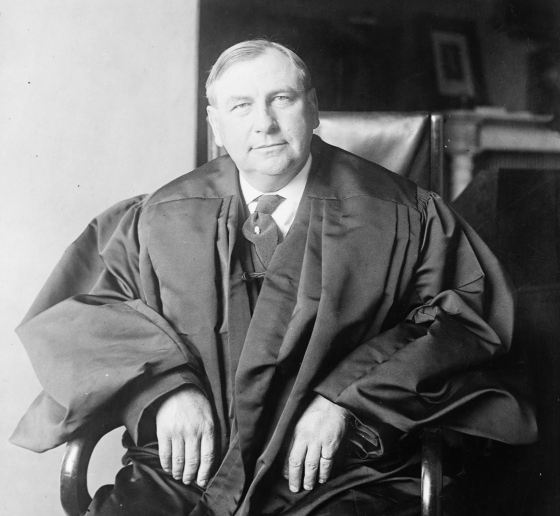
The first final arguments took place in 1926, after which the competition was named in honor of Harlan Fiske Stone 1898, the former Columbia Law School dean who was appointed to the Supreme Court in 1925 and was a member of the Story Inn while a student at the Law School. (Read more about Harlan Fiske Stone, below.)
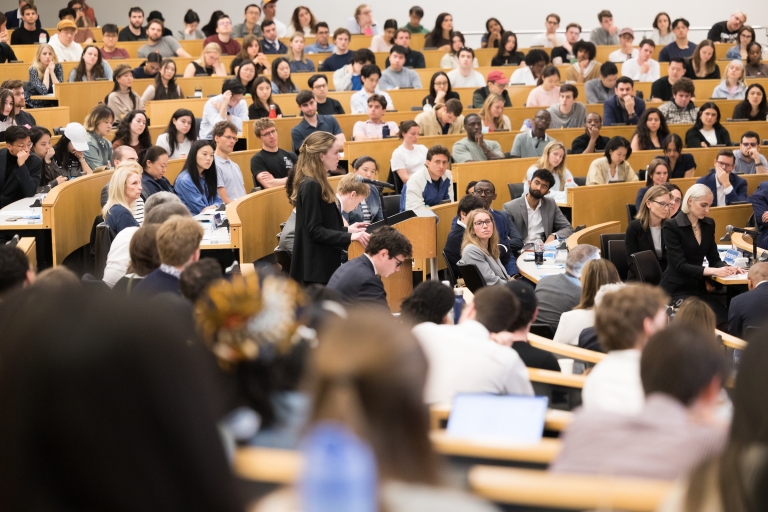
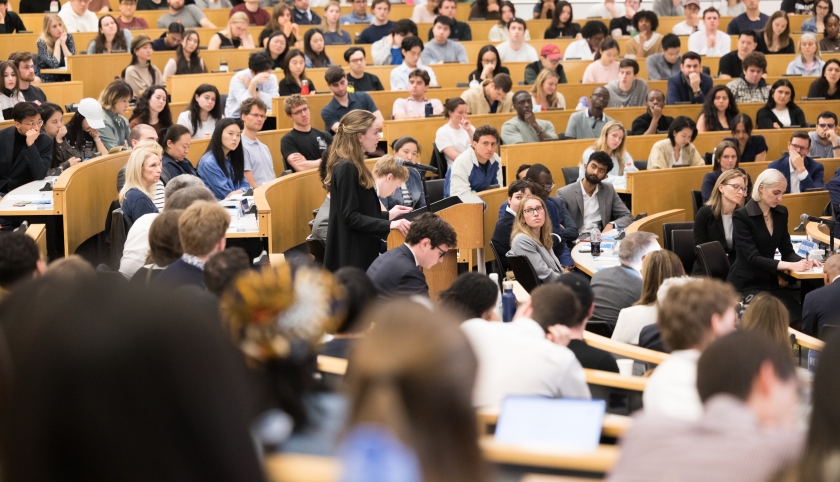
For Stone moot court directors and participants, the final is the culmination of months of work and provides unrivaled preparation for future legal careers. For the judges, the Stone competition is an opportunity to guide the next generation of advocates.
“It’s called the practice of law because you have to practice it. And there’s no better practice being an oralist or writing briefs than doing moot courts,” says Judge Myrna Pérez ’03 of the U.S. Court of Appeals for the 2nd Circuit, who judged the 2023 competition finals. “It gives you a prime opportunity to practice the real-world skills that you’re going to have to utilize in order to be a litigator.”
“The students blew me away. I knew they would be creative. I knew that they would be smart. I knew they would be prepared, and they even exceeded all of those expectations.”
—Judge Myrna Pérez ’03
Nino Dickersin ’23, an assistant district attorney in Brooklyn, was a finalist in 2022 and director of the Stone competition in 2023. “This week, I’ve been in court every single day,” he says. “If I had not had the opportunity in law school to argue in front of judges—both as a Stone finalist in front of professional federal judges and throughout the competition in front of experienced lawyers playing the role of judge—I don't think I would be as confident in my current job.”
Writing a brief and arguing in the Stone competition is “very skills focused, and it’s something that is incredibly useful in one’s actual practice,” Dickersin adds. “It’s education that I really benefited from. Moot Court is an incredibly valuable program—it should really be considered at the core of what Columbia Law does with respect to teaching people how to practice.”
“The Stone competition really does prepare you for practice,” agrees Sophia Farber Bernhardt, executive director of Legal Writing and Moot Court Programs. “The partnership prepares you for practice; the argument prepares you for practice; the mooting process prepares you for practice. The level of responsibility also prepares you for practice: Students can’t get outside help, so they’re really responsible from the beginning to the end for the Stone competition brief—and they are responsible to each other as partners. That also echoes practice—the ‘buck stops with me’ responsibility.”
Creating the Case
Before the competition comes the problem—and the problem of finding the problem. The Stone directors spend months creating each competition’s case, which must include two central legal questions that have not been unanimously settled by courts. The directors invent the fictitious record of the case, whether civil or criminal. This year’s record, for a criminal case problem, included indictments, a trial transcript, a sentencing report, and all relevant court documents. The directors also write a bench memo for the competition judges outlining the legal issues involved. (Watch more about the process of writing the problem above.)
“Stone problems tend to be complicated. They tend to be difficult. That’s what makes it a great program,” Dickersin says. “The problem has to be something that courts are struggling with but that some courts haven’t resolved. You want a body of case law that speaks to what you’re talking about, but you don’t want it to be a settled issue. And on top of that, you have to do it such that your partner, the co-director, can also fit in an issue that they’re interested in.”
The issue at the heart of the 100th anniversary case centered on hostile text messages, which is “an interesting, modern question,” says this year’s Stone Co-Director Sophia Cronin ’26, who wrote the case with Co-Director Marina S. Dolgova ’26 during the summer of 2025—while also working full-time as a law firm summer associate. Appellate courts have ruled differently on whether text messages should automatically be considered interstate communication in criminal cases. And circuit splits make great moot court cases, several Stone directors say.
“I’m always really happy when I see a circuit split,” says Jillian Williams ’21, a litigator at Arnold & Porter in Washington, D.C., who was director of the 2021 Stone competition. Since graduating, Williams has also served as a judge for several Stone preliminary rounds. “I love when there are no right answers because it just gives students the opportunity to be as creative as possible” in making their arguments in briefs and oral advocacy, Williams says. “They can look to scholarship; they can look to other courts; they can look to history; they can, if they want to, look to international law as an example.”
But beware the intervention of the Supreme Court. This year’s co-directors had to find a new legal issue in a hurry when the Supreme Court decided in June 2025 to hear Rico v. United States, which addressed conflicting circuit opinions on the fugitive tolling doctrine and how it applies to supervised release. The co-directors had planned to include the doctrine in their case.
“The Supreme Court stole my issue!” Cronin says.
As a result, “we were working nonstop for weeks to identify something else relevant to the first issue so that we could keep on track,” Dolgova says. “You have to find two perfect issues that look good together, make legal sense, and are something that a defendant in the real world would actually go through.”
Facing the Bench
Competing in the Stone moot court final is scary, exhilarating, and a lot of work, say the lawyers who have done it.
“Every time you stand up and speak publicly, it’s nerve-racking. Every time you put a big investment into your brief, to have that judged and evaluated by other people, that’s nerve-racking as well,” Dickersin says. “The opportunity to have ownership and responsibility for something that is yours and put it out there and have other people evaluate it, to really dig into a problem and understand it in great detail. I don’t think there’s anything else quite like that.” (Watch more about the competition process above.)
The experience of arguing before the Stone judging panel is unequaled, Bernhardt says. “It’s intense to be arguing in front of federal judges when you’re just a student, and you’re in a huge room full of people,” she says. In fact, the Stone moot court may be more intimidating than the finalists’ future court appearances in their early careers. “For most people, their very first oral argument wouldn’t be this,” Bernhardt says. Typically, “there aren’t going to be 400 people watching.”
“Although we were all terrified, you do want to be tested. You’ve prepared, and you want a hot bench: judges who know the record and who will challenge you.”
—Mark Belnick ’71, former Stone competitor and longtime preliminary round judge
Alexandra Carter ’03, Everett B. Birch Innovative Teaching Clinical Professor in Professional Responsibility of Law, competed as a Stone finalist in 2002 and recalls “feeling super nervous, but super excited to do it,” she says. “Thinking about my own brief for so many months and hours helped me understand what good legal writing was.”
Carter won the Lawrence S. Greenbaum Prize for best oral advocacy in the final. The experience gave her new confidence, she says. “I looked at myself differently. I thought, I can perform under pressure; I can perform on a big stage. And when I have something to say that I care about, I have a big voice, and I can use it.”
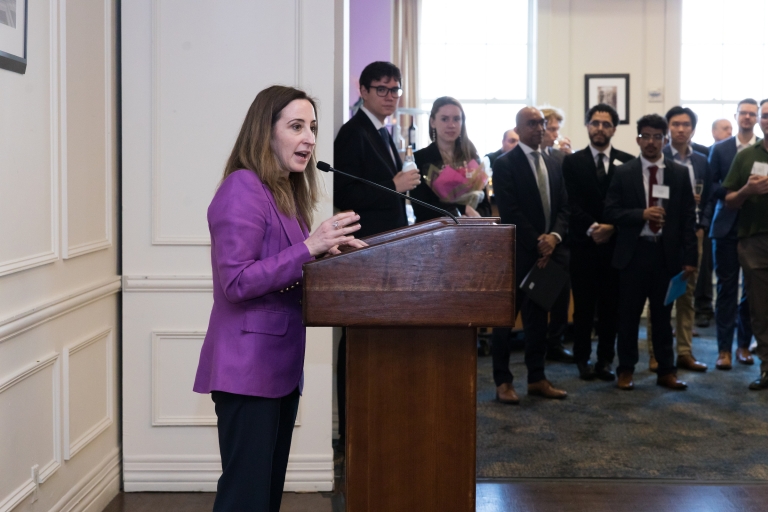
Vanzetta Penn McPherson ’74, a retired federal magistrate judge in Montgomery, Alabama, served as executive director of the Moot Court Executive Board in her 3L year. The board oversees moot court programs at the Law School under faculty supervision and organizes the First-Year Moot Court as well as the Harlan Fiske Stone Moot Court. McPherson says that participating in Stone moot court polishes proficiencies and is a critical supplement to doctrinal training. “Preparing the brief and arguing the case hones your writing and verbal presentation skills. It forces you to prepare yourself to speak professionally,” McPherson says. “The major goal of law school, in my judgment, is to teach you how to think. Moot court, as a clinical component, helps you to practice being a lawyer before you are a lawyer. And that’s immeasurably helpful.”
Before the Argument
The students who make up the executive board work closely together, says Williams, who served on the board in 2021, and so do the participants. “The Stone competition is the greatest opportunity that you will likely have on campus to try oral advocacy at the highest level,” Williams says. “But more than that, it’s also, especially if you're a 3L, one of the last opportunities that you can have to have fun with your friends. And I know that doing a brief and multiple rounds of oral argument may not sound like fun to everyone, but you have a partner, and you work with them potentially all year long just getting better and better at refining your arguments. Folks who decided to participate had the most fun getting to know their partner or working with someone that they already knew in a new way.”
McPherson agrees. “The collaborative experience is important because wherever you go after law school, you’re going to have to collaborate—even in a solo practice.”
Working on the competition can make for close friendship—and more. “Yes, I am still in touch with my moot court partner,” says Beatrice Franklin ’14, a partner at Susman Godfrey. “We’ve been married for eight years.”
Franklin competed in the first two rounds of the Stone competition with her then-boyfriend (now-husband), Kevin Mead ’14. For the final—in which Franklin won both best brief and best oral advocate—her co-counsel was the couple’s close friend, Benjamin Cornfeld ’14. The trio went to the beach for spring break; Franklin and Cornfeld spent the vacation preparing their oral argument. “Our friends were enjoying the beach, and we were tossing questions back and forth and working on our outlines,” she says.
Judging the Argument
For Stone alumni who return as judges, the experience offers a bit of time travel: remembering their own time as competitors and getting a look at future courtroom talent. And being a Stone judge, like being a competitor, takes work.
“When I prepare to judge, it’s just like when I prepared for oral appellate arguments. I’m studying the record. I’m learning the cases,” says former Stone competitor Mark Belnick ’71, a retired litigator who now regularly judges Stone preliminary rounds. “What you want as a judge is to be faithful to the student advocates. … I remember, as a student advocate myself, although we were all terrified, you do want to be tested. You’ve prepared, and you want a hot bench: judges who know the record and who will challenge you.” (Watch more about the judging process above.)
Williams, who wrote the 2021 Stone problem as director, says that judging the competition now is good intellectual exercise. “Judging every year gives you a great opportunity to see what you can learn in a short period of time,” says Williams, who judged a Stone semifinal round this year. “The students have had all semester or all year to think about this, but [as a judge], you have had maybe a week to think through the issues. And so that’s a fun exercise. It’s like super sudoku.”
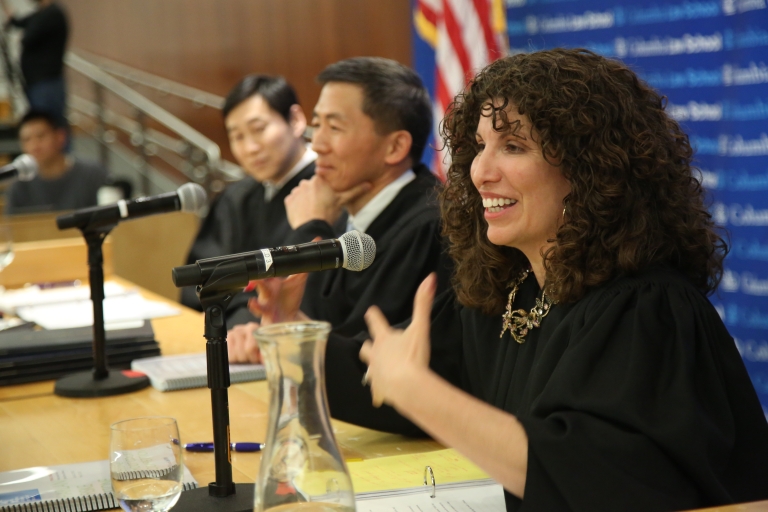
Pérez says judging the Stone final was her way to give back to the Law School. “I’m so very grateful for everything that Columbia did for me. I was a Lowenstein Fellow, which meant that my Columbia Law School education was provided for free as long as I did qualifying work. I made amazing friends. I had terrific teachers. And I feel like every day, Columbia Law School is giving me value. And I felt like the least I could do for the school that has done so much for me is to judge a moot court competition.”
Getting together with other jurists to judge the Stone competition finals in 2023—her panel included California Supreme Court Justice Goodwin H. Liu and Judge Michael H. Park of the U.S. Court of Appeals for the 2nd Circuit—was “a great time,” Pérez says. But the competitors were the focus.
“The students blew me away,” she says. “I knew they would be creative. I knew that they would be smart. I knew they would be prepared, and they even exceeded all of those expectations. It was a really fun experience for me to see what a great job that future alumni of the school that I’m so proud of would be doing out in the world.”
The Next 100 Years
While writing the problem for the 2026 competition, Cronin and Dolgova dived into the moot court archives, which contain legal records created for previous competitions as well as programs from prior finals. “It was pretty cool to think that these people left their mark on the school, and we’re leaving our mark on the school in our own way, by writing this [problem] that a lot of people have played with throughout the year,” says Cronin. “It’s really fun to have made that contribution.”
Over the course of a century, Stone problems have focused on hot-button topics—including abortion and transgender rights—but arguments have been both rational and civil, Bernhardt points out. “From the perspective of now being in an age where you want people to be able to have difficult conversations and talk about hard things and argue about hard things, [the Stone competition] has really shown that people can argue passionately on some of the toughest issues, and it’s OK,” she says.
Franklin, who clerked for Justice Ruth Bader Ginsburg ’59 on the Supreme Court, says the Stone competition remains relevant regardless of its age because the fundamentals of lawyering have changed very little in a century.
“I think it’s lovely that Stone moot court has been happening for a hundred years. What litigators do is write briefs and try to persuade courts and juries that their client’s position is right. That’s what I do today; that’s what Ruth Bader Ginsburg did when she was an advocate 50 years ago. Alexander Hamilton was one of our nation’s first superstar advocates, and, fundamentally, he did the same thing,” Franklin says. “The core activity is that we try to persuade people with our words, whether they’re written or spoken. And for 100 years, Columbia Law students have been prepared to do just that.”