
Student Spotlight: Coley Hungate ’26
Hungate is a finalist in the 2026 Harlan Fiske Stone Moot Court Competition.
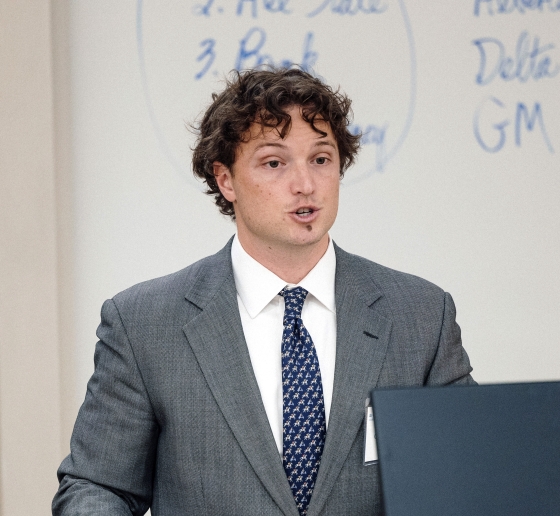
Coley Hungate ’26 understands competition. He played tennis as an undergraduate at the University of Florida when its team won the 2021 NCAA national championship and went on to coach professional players on the men’s and women’s tennis tours before coming to Columbia Law. Now a finalist in the Harlan Fiske Stone Moot Court Competition, Hungate reflects on how his background as an athlete and his interest in oral advocacy have influenced his experience.
Hometown: St. Petersburg, Florida
Education: B.A. in economics, University of Florida
At Columbia Law: president, Federalist Society; executive articles editor, Columbia Journal of Law & Social Problems; legal extern, U.S. Attorney’s Office for the Southern District of New York, Center for Appellate Litigation, and U.S. Postal Service Law Department; judicial intern, Judge Benjamin J. Beaton of the U.S. District Court for the Western District of Kentucky; 2L summer associate, Sullivan & Cromwell; research assistant to David M. Schizer, Harvey R. Miller Professor of Law and Economics and Dean Emeritus; teaching assistant to Thomas W. Merrill, Charles Evans Hughes Professor of Law
What’s Next: Hungate will join Gibson Dunn in Washington, D.C., before embarking on two federal clerkships: the first with Judge Rebecca L. Taibleson of the U.S. Court of Appeals for the 7th Circuit; the second with Judge Richard J. Sullivan of the U.S. Court of Appeals for the 2nd Circuit.
How did your background in competitive tennis shape your approach to moot court?
The competitive aspect of mooting is really fun. When you’re competing in any capacity, there are nerves. I’ve spent a lot of time working on being comfortable and confident on the tennis court, and I’ve brought some of those routines into law school. I have an app on my phone that plays beats and tones that put me into certain mindsets and states. I always listened to it before my matches to try and put myself into a state of mental certainty. I’ve also used that app before exams, and now before moots, here at law school, and I think that’s been really helpful.
What made you decide to go to law school?
Law school wasn’t on my radar until my junior year of college. I took a legal research and writing class because I needed the credit, and it sounded interesting. The final assignment was to write a legal research memo, and I really enjoyed it. I liked the historical aspect of it. Legal opinions show how the law developed over time. Applying that precedent to something new is compelling.
What brought you to Columbia Law?
I chose CLS because I don’t think there’s a better place to spend three years of law school than in New York City. I also like the size of the class and meeting people with a lot of interesting backgrounds.
What prompted you to sign up for the Harlan Fiske Stone Moot Court Competition?
I never did mock trial or moot court as an undergraduate. But when I did the foundational moot court as a 1L, I really enjoyed getting up there and arguing. After the Stone competition is over, I’ll be a judge for this year’s foundational moot court. It feels like a fun way to wrap up my time here, since that competition is where I got the bug for this. I could see myself working in the U.S. Solicitor General’s Office or otherwise being an oral advocate professionally. I don’t want to be the kind of lawyer that’s just sitting behind a computer. Whether it’s motion practice, being a trial lawyer, or being an appellate lawyer, I like the idea of being active.
How has the Columbia Law community supported you throughout the moot court process?
Everyone who my Stone partner, Jason, and I have asked to participate in a practice moot for us has said yes. This is remarkable because everyone is really busy, but they’ve found time for us. And when we practice, Jason and I each go up for 30 minutes instead of the 15 minutes that the competition calls for. When you have four or five judges peppering you with questions for 30 minutes straight in a practice round, you’re already used to being up there for a long time when you go up for 15 minutes.