Students Confront Criminal Case at 2026 Harlan Fiske Stone Moot Court Finals
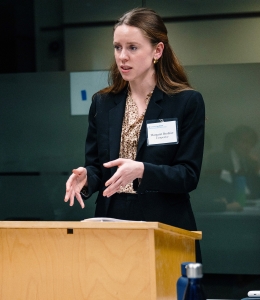
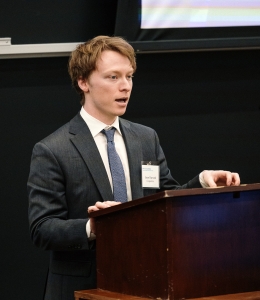
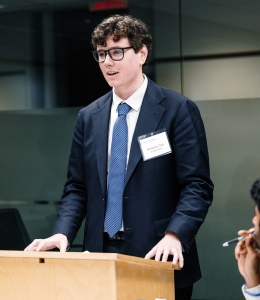
The yearlong competition culminated with finalists Margaret Broihier ’27, Jason Harward ’26, Coley Hungate ’26, and Benjamin Tutt ’27 arguing before a panel of distinguished jurists. Tutt won the prize for best oral presentation, and Hungate won for best final-round brief.

For just over an hour, the four student finalists in this year’s Harlan Fiske Stone Moot Court Competition—Margaret Broihier ’27, Jason Harward ’26, Coley Hungate ’26, and Benjamin Tutt ’27—presented arguments to a panel of judges, testing not only their legal knowledge but also their preparation, flexibility, and presence under pressure from a hot bench.
The final arguments were the culmination of a three-round elimination competition in appellate advocacy. This year, 85 students entered the competition. In the first qualifying round, held during the fall semester, students briefed one of two issues on behalf of either the appellant or the appellee and presented their positions in oral arguments before panels composed of alumni practitioners and professors. On the strength of their brief and oral argument scores, 24 competitors advanced to the spring semifinal round. There, they again briefed and argued a side of the same case. The two teams with the best overall results in the semifinal round presented their final arguments before an overflow crowd in Jerome L. Greene Hall on April 13.
Written by the competition’s student co-directors, Sophia Cronin ’26 and Marina S. Dolgova ’26, this year’s case, United States of America v. Meredith Grey, asked whether the use of the internet to transmit iMessages is sufficient to establish that the messages traveled in interstate commerce for the purposes of a federal criminal conviction under 18 U.S.C. § 875(c). A second question looked at whether the district court erred by sentencing the defendant to a three-year term of supervised release that included a prohibition against using the internet “as a means of expressive communication,” with limited exemptions.
“Seeing our problem come to life in front of such a large audience felt surreal,” said Cronin.
The student advocates in the final round argued the fictitious criminal appeal in the U.S. Court of Appeals for the 6th Circuit—Harward and Hungate on behalf of the defendant-appellant; Broihier and Tutt for the United States. The students delivered their arguments before a panel of four chief judges: Steven M. Colloton of the U.S. Court of Appeals for the 8th Circuit, Albert Diaz of the U.S. Court of Appeals for the 4th Circuit, Mary H. Murguia of the U.S. Court of Appeals for the 9th Circuit, and David J. Barron of the U.S. Court of Appeals for the 1st Circuit.
A Rapid-Fire Exchange on Interstate Commerce
The first issue turned on how to interpret the phrase “in interstate commerce.” Grey, the defendant, was convicted in the district court of sending threats to her neighbor over iMessage, which transmits messages through internet servers in many different locations. The court focused on whether, without proof that servers had carried Grey’s messages across state lines, the United States could establish federal jurisdiction.
The pace of questioning from the judges left both advocates with little room for their prepared remarks; Tutt and Hungate met this courtroom challenge and quickly adapted.
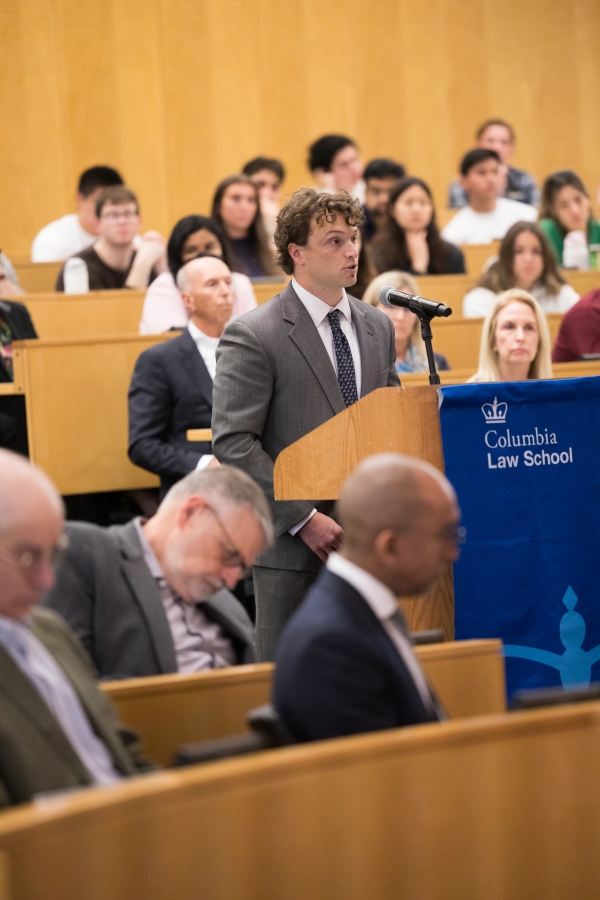
Hungate argued for Grey that the statute, 18 U.S.C. § 875(c), requires proof that the messages actually crossed state lines, and the government’s evidence showing merely that the messages traveled over the internet was insufficient to meet this burden. That drew sustained questioning from the judges, who asked whether Hungate’s position stood in the reality of modern communication. Would a strict reading of the statute nullify congressional intent by making prosecutions impractical, they asked, when the path of an internet message is difficult to trace?
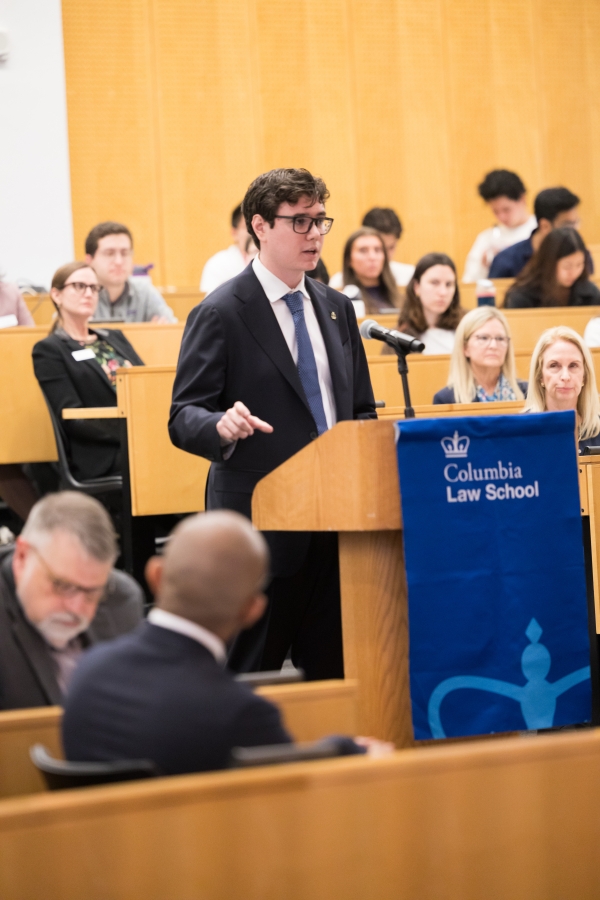
Tutt, arguing for the United States, faced a different challenge. He argued that use of the internet alone is enough to satisfy the statute’s interstate commerce requirement. The panel asked whether a jury in a criminal case could rely on general assumptions about how the internet works in the absence of specific proof.
The Limits of Judicial Discretion
The second issue moved the court’s focus to questions of judicial discretion. As part of Grey’s sentence, the district court prohibited Grey from using the internet “as a means of expressive communication” for a three-year period of supervision following her release from prison. That restriction became the center of a discussion about how to regulate speech in the modern era.
One argument that Grey raised was emotional as well as legal: Her adult son lived abroad, and she relied on the internet to communicate with him. This became a focal point for the real-world implications of the sentence and its potential restrictions on her speech.
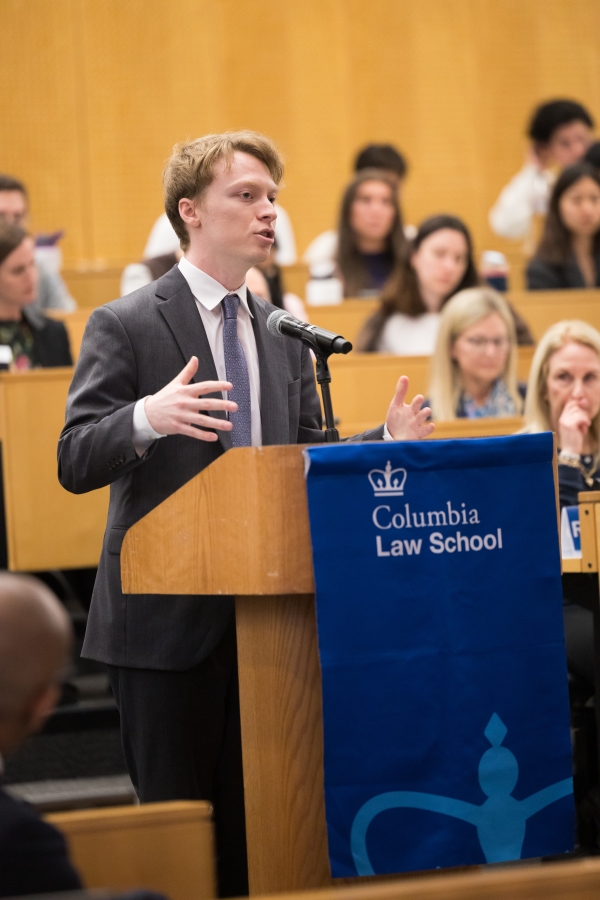
Harward, advocating for Grey, argued that the condition restricting Grey’s use of the internet during the period of supervised release was overly broad and not sufficiently tailored to the conduct that led to her conviction. The judges turned to the practical considerations of Harward’s argument and probed whether a narrower set of restrictions could adequately protect the public while allowing Grey to maintain normal, modern forms of communication.
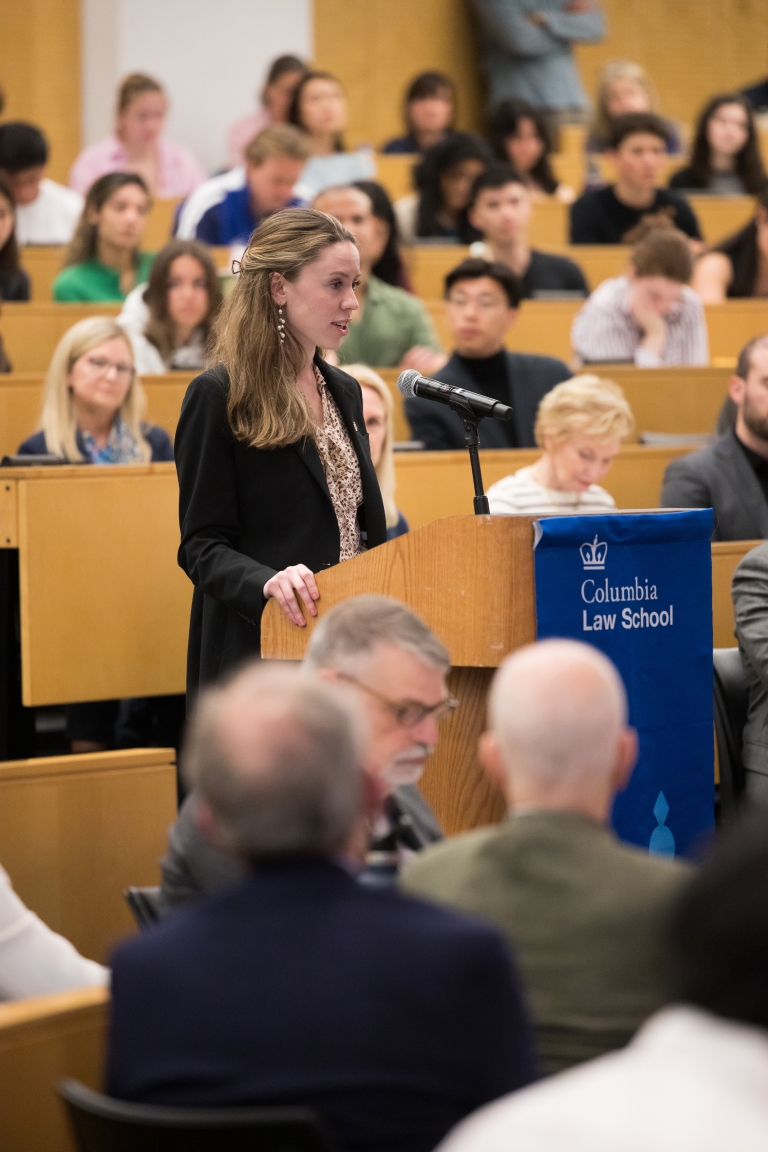
The government, represented by Broihier, emphasized that Grey’s offense was directly connected to her use of the internet. Broihier also leaned on the abuse of discretion standard as an avenue to uphold the sentence. The panel’s questioning focused on whether the use of a particular tool in committing a crime is enough to justify broad restrictions on that tool after conviction.
Recognizing Excellence
The finalists received a standing ovation from the audience at the conclusion of the arguments. As the four student advocates accepted congratulatory handshakes, hugs, and praise from friends, faculty, and family, the judges retired to an anteroom. Following lengthy deliberations that Chief Judge Colloton described as “not an easy or clear choice,” he spoke for the panel and awarded the Lawrence S. Greenbaum Prize for best oral presentation to Tutt, who represented the government in the first issue. Hungate, who represented Grey in the first issue, received the award for best brief. (Judges do not issue a decision on the fictional case.)
“I won’t disclose any vote counts or dissenting opinions or anything of that sort,” Chief Judge Colloton quipped, “but I do want to say that we were impressed across the board by the advocacy, by the preparation of the students, and by their presentations.”
“You have a newfound crowd of groupies,” added Chief Judge Diaz.
The quality of the arguments themselves stood out to Chief Judge Murguia. “The common thread you’ll hear from most judges is preparation, and then the articulation, and to be able to respond to the judges. … There were a lot of questions—some that you may have anticipated and some that you didn’t—and I thought you all handled that very well.”
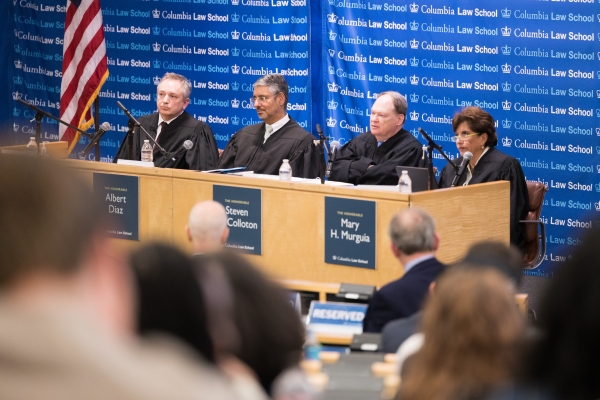
The panelists concluded by expressing their hopes for the future advocates: “You all have a talent for this,” Chief Judge Barron said. “A lot of people depend on lawyers to have those talents put forward for a good purpose. I hope you don’t leave thinking this was just a moot; it’s a chance to see that you have those skills that you can use for people who need them desperately. We look forward to you using those skills.”
Reflections From the Co-Directors
While watching the arguments, Cronin and Dolgova, the two co-directors, said they were thoroughly engaged in the proceedings. “I almost forgot to raise the time card twice because I was focusing on mentally answering judges’ questions,” said Dolgova, who, in Stone tradition, was also serving as bailiff. “The finalists did a phenomenal job addressing very tough questions.”
“It was really fun to see the judges and students tease out the nuances of our case and tackle the big themes we were hoping would be addressed, such as the scope of government power, the intersection of criminal justice and individual liberties, and federalism,” said Cronin.
The two co-directors also enjoyed their benchside seats at the finals. “I loved sitting in the front row,” Cronin said. “We had the best seats in the house!”
The three-round Harlan Fiske Stone Moot Court Competition—part of the Paul, Weiss, Rifkind, Wharton & Garrison Moot Court Program—is run by Executive Director of Legal Writing and Moot Court Programs Sophia F. Bernhardt, Director of Legal Writing and Moot Court Programs Amanda Sen Villalobos, Paul J. Kellner Professor of Law Daniel Richman, and the moot court board: Cronin and Dolgova, along with Executive Director Ezeudo Maduka ’26 and Managing Directors Courtney Chan ’26, Margaret Chang ’26, and Amber Duan ’26; Specialized Moot Court Directors Sydney Myers ’26 and Cody Huyan ’26; Director of the First-Year Moot Court Program Kaylie Chen ’26; Director of Community Programs Matthew Dowling ’26; and Program Administrator Jahmal Ojeda.