
Student Spotlight: Jason Harward ’26
Harward is a finalist in the 2026 Harlan Fiske Stone Moot Court Competition.
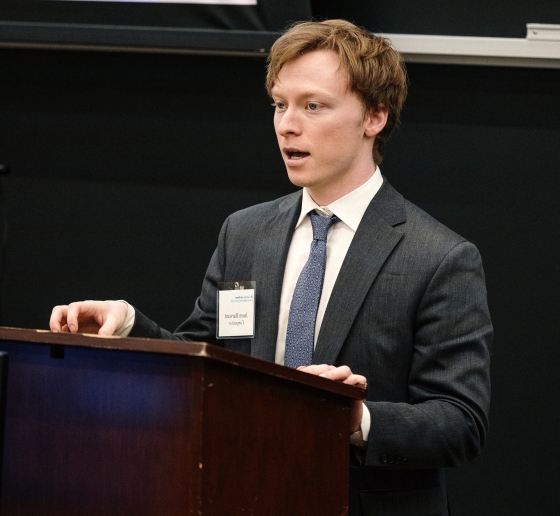
Jason Harward ’26 developed his interest in the law as a journalist. After earning an undergraduate degree from Northwestern University, he spent a year in South Dakota reporting on lawmakers, policy debates, and the machinations of state government, which drew him to legal studies. Now a finalist in the Harlan Fiske Stone Moot Court Competition, Harward discusses his experience as a small-town reporter, working with his moot court partner, and learning from his law professors.
Hometown: Los Angeles
Education: B.S. in journalism, Northwestern University
At Columbia Law: president, Federalist Society; note editor, Journal of Law & Social Problems; legal extern, U.S. Attorney’s Office for the Southern District of New York; teaching fellow for Christina D. Ponsa-Kraus, George Welwood Murray Professor of Legal History; teaching fellow for Jane C. Ginsburg, Morton L. Janklow Professor of Literary and Artistic Property Law, research assistant for Thomas W. Merrill, Charles Evans Hughes Professor of Law
What’s Next: Harward will clerk for two federal judges: Judge Andrew L. Brasher of the U.S. Court of Appeals for the Eleventh Circuit and, later, Judge Stephen R. Clark of the U.S. District Court of the Eastern District of Missouri.
What was your journey from journalism to law school?
I took the LSAT in my junior year of college and had the sense that I was going to end up in law school, but I wanted to work as a journalist for a year first, particularly to cover a state legislature. I didn’t really want to work for a big paper because I wanted the freedom to write about what I was interested in, so I ended up at the Mitchell Daily Republic in South Dakota. While I was there, I got to interview prominent politicians, but also lawyers who were lobbyists for their clients, and I covered some interesting environmental law issues. There are definitely transferable skills between being a journalist and a lawyer.
What do you recall about watching the Harlan Fiske Stone Moot Court Competition as a 1L?
I remember when I went to Stone as a 1L, just thinking the finalists were very polished and knew the case very well and being impressed with how you can get to a level of mastery with either a legal issue or a subject more broadly. It’s interesting getting full circle but still not really seeing myself like that.
What’s been your favorite part of the Harlan Fiske Stone Moot Court Competition?
The Columbia Law community has been very willing to help me and my partner, Coley, prepare. It’s very fun getting to try out new things in each practice argument. And it’s been great to work with Coley. It’s rare to get to work with someone in so many different facets of law school, and I am really glad we got to have this as the capstone. He’s detailed and creative and makes things fun.
Other than participating in the Harlan Fiske Stone Moot Court Competition, what’s been a highlight of your time at Columbia Law?
I’ve enjoyed my relationships with professors. I’ve been lucky enough to take administrative law and do some research for Professor Tom Merrill, and I end up in his office quite a bit, just talking about law and other things. I think one of my favorite ways to spend time this last semester before graduating is just wandering around the upper floors where the faculty offices are and dropping in. It feels as though the professors have a sort of open-door policy.
You have two federal clerkships lined up after graduation. What do you hope to gain from those experiences?
It will be nice, over the two years, to see a lot of different issues and dynamics. The district court, I’ve heard, has quite the learning curve. The criminal docket will be the most interesting part to me because if any cases are going to go to trial, it’ll probably be those. And then you get to see jury selection, jury instructions, the more high-stakes, evidentiary issues. The work for the circuit court will be much more based in research and writing. At the appeals court, the criminal law issues are often a substantive reasonableness sentencing appeal, which is the issue that the Stone competition is covering, so I suppose I have a head start.
What do you like to do outside of law school?
I enjoy word games, skiing, and historical nonfiction.