
Student Spotlight: Benjamin Tutt ’27
Tutt is a finalist in the 2026 Harlan Fiske Stone Moot Court Competition.
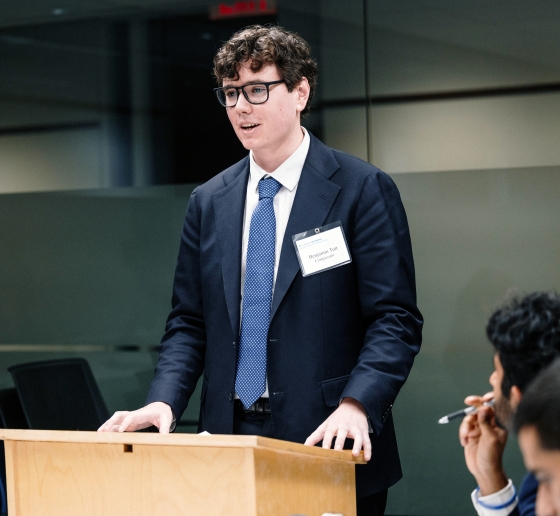
Benjamin Tutt ’27 was drawn to the law because he was interested in the intersection of abstract theory and real-world legal problems. Now a Harlan Fiske Stone Moot Court finalist, he talks about pursuing a career in financial and commercial litigation, and how participating in moot court has made him a better advocate and legal thinker.
Hometown: Texas, and suburbs of Washington, D.C.
Education: B.A. in philosophy, politics, and economics, University of Oxford
At Columbia Law: finalist, National Native American Law Association (National NALSA) Moot Court; editor-in-chief (elect), Columbia Business Law Review; legal writing fellow, Columbia Law Writing Center; executive board member, National NALSA; legal intern, Southern District of New York and Southern District of Texas; research assistant for Clare Huntington, Barbara Aronstein Black Professor of Law; teaching assistant for John Oberdiek, visiting professor of law
What’s Next: Tutt will spend his 2L summer at Davis Polk & Wardwell and plans to pursue a career in litigation with a focus on financial and commercial law.
What brought you to law school?
In high school, I was a big debate-team kid. I loved talking and arguing. I’ve always known I wanted to go to law school, and I thought a degree in politics, philosophy, and economics would be a great way to prepare for legal studies. But when I got to Oxford, I realized I wasn’t just interested in the courtroom advocacy part of law—I liked thinking about abstract issues like contracts, finance, and economic regulation. My interests shifted toward the academic part of the law school curriculum as opposed to just standing and talking in the courtroom—which is, ironically, what I’m doing for the Harlan Fiske Stone Moot Court Competition.
You have had two federal court internships. How have they strengthened your readiness to practice?
They’re the best sort of experience you can get in law school, in my opinion. Just the sheer variety of issues that come up in federal court is astounding and the amount of practice you get in research and writing and editing is unbeaten. And, of course, both judges I’ve worked for have been absolute superstars. I have so much respect for them. They’re both smart, dedicated to their job, and great role models.
What made you sign up for the Harlan Fiske Stone Moot Court Competition this year?
Last year, I opted to do the National NALSA Moot Court. I did quite well and made it to the national finals. It was one of my favorite experiences in law school and showed me I wanted to be a litigator and not a transactional attorney. One of my close friends— Margaret—was interested in doing Stone, so I pestered her into signing up. Margaret and I get along and have similar work styles, so I’ve really enjoyed mooting with her.
What have you learned from the competition so far?
I’ve learned that you really can’t edit a brief enough. There’s no amount of revision and rethinking and retooling that’s too much. In order to allow time for that process, you need to get the brief done earlier, so you can let it sit and think about your argument and get some distance from it before editing with a fresh set of eyes.
Why are you interested in pursuing a career in litigation after graduation?
I really like financial law, but I also really love standing in a courtroom on my feet and answering questions. And so I think litigation is the right place for me: Thinking about the craft of arguments and how to answer a judge’s question are things I’ve come to love in law school, and I don’t want to give those up moving forward.
What are some of your interests outside of law school?
In 2024, I completed a six-month motorcycle-backpacking trip across the U.S.— that was a bit different from law school, but I enjoyed getting to travel and see other parts of the country. I was training for a marathon this spring, but it ended up conflicting with preparing for the Stone finals. So, I’m hoping to get back to that this summer. My friends and I like watching old movies, and try to organize movie nights whenever we get a chance—we’ve also become semireligious Jeopardy! watchers. I’ve also adopted my cat, Blackstone, since starting law school. He’s my main audience for practicing my moot court argument openings on.