Graduation 2026: Entering the Profession With Pride and Purpose
Columbia Law School’s Class of 2026—including J.D., LL.M., E.LL.M., and J.S.D. students—celebrated their achievements along with their family and friends at a Class Day ceremony featuring a keynote address by former U.S. Solicitor General Donald B. Verrilli Jr. ’83.
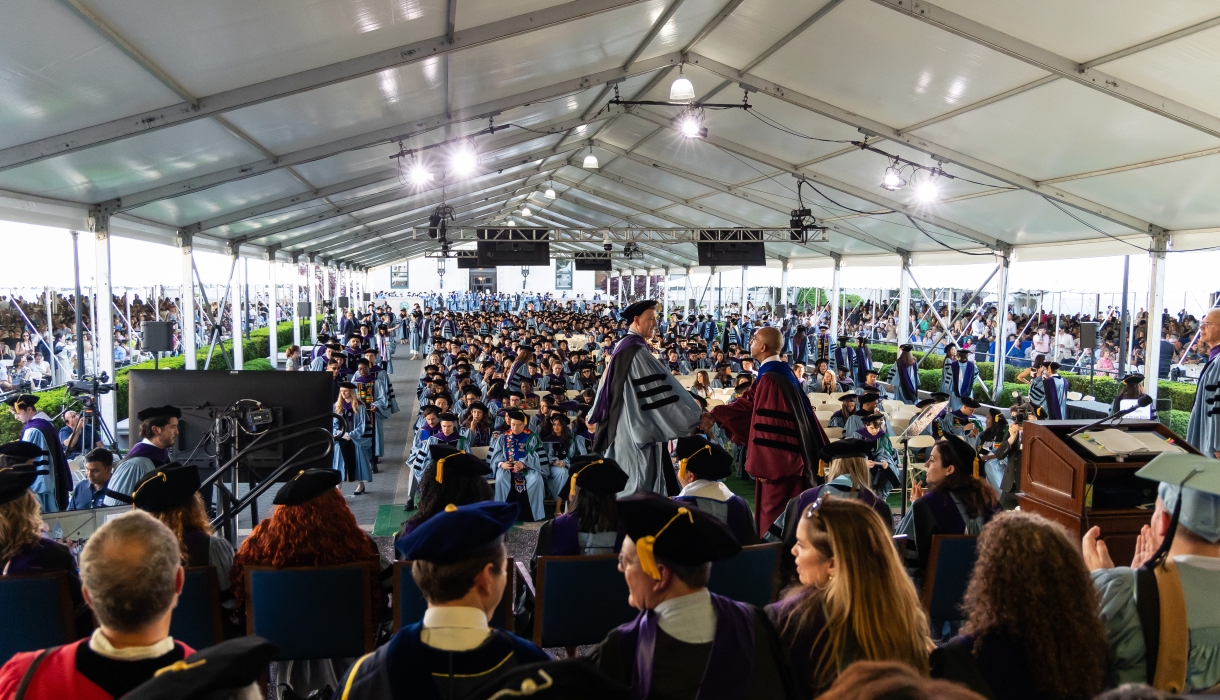
Beneath enormous white tents that shielded them from the bright and blazing sun, more than 4,000 guests cheered on Columbia Law School’s Class of 2026 at the Class Day ceremony held on Columbia University’s Morningside campus on Sunday afternoon, May 17. The event honored the accomplishments of more than 800 J.D., LL.M., E.LL.M., and J.S.D. candidates.
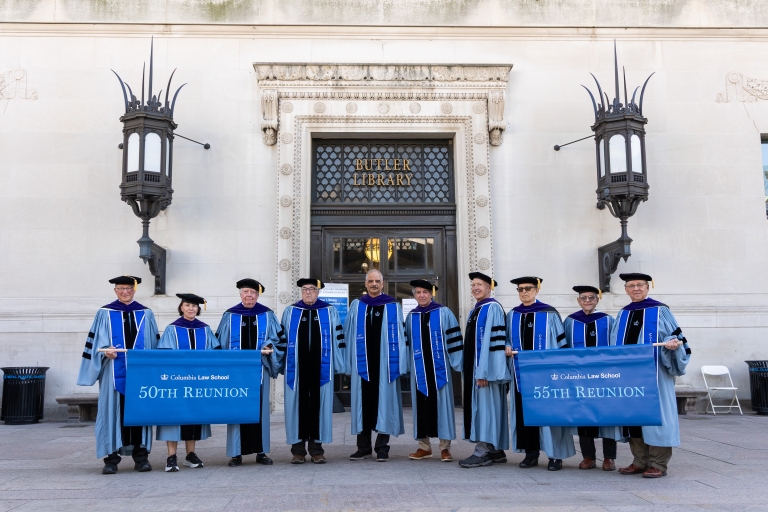
Representatives of the 50th and 55th reunion classes led the Class Day procession (a Columbia Law School tradition) to the triumphant tones of “Pomp and Circumstance.” They were followed by graduating students; Daniel Abebe, Dean and Lucy G. Moses Professor of Law; keynote speaker former U.S. Solicitor General Donald B. Verrilli Jr. ’83; and faculty and senior administrators.
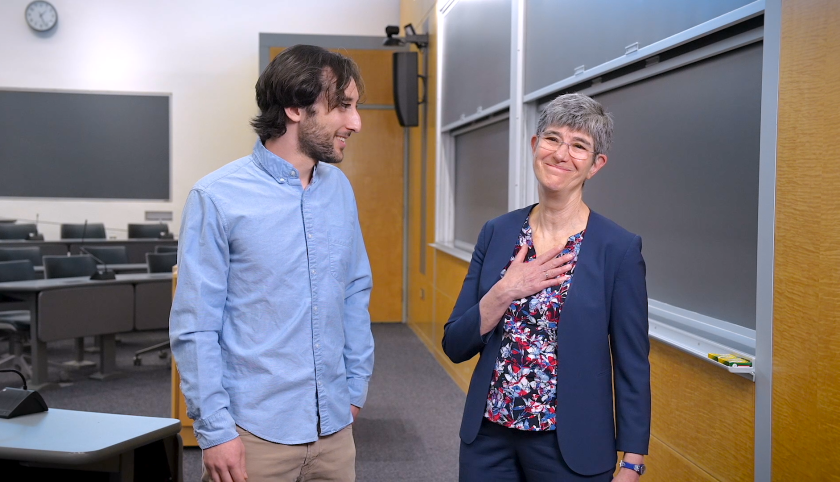
The ceremony opened with a video, in which members of the Class of 2026 shared how their classmates and their professors enriched their time at Columbia Law School, and welcome remarks by Student Senate President Celeste Woloshyn ’26. “To our families and friends in the stands: I suspect that in addition to the pride you’re feeling, you may also be feeling a weight being lifted,” she said. “You fielded late-night calls and texts filled with existential panic about what kind of lawyer we should be (or, at least, where we should spend our 2L summer). You felt the thrills of our successes and the heaviness of our disappointments, and you got us through it all. This day belongs to you, as much as it does to us.”
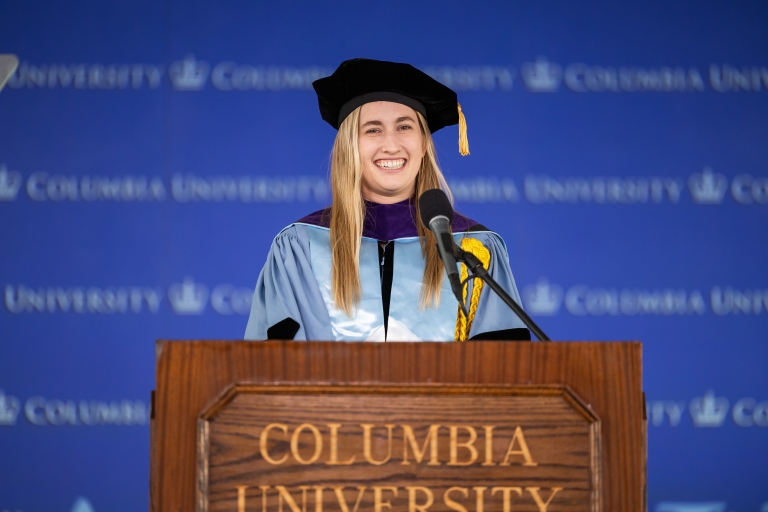
Dean Abebe: Look Inward With Clarity; Look Forward With Conviction
Woloshyn also introduced Dean Abebe, whom she called a “hardworking and caring” leader who is responsive to students’ concerns.
“Today, we come together to celebrate one of the academy’s great traditions,” said the Dean. “We don these flowing robes and velvet hats. We process across the stone walkways of this historic campus. And we call our students forward by name so that we can recognize them for their many achievements. These graduation rituals endure not simply because they are old or formal or symbolic,” he continued. “They endure because they mark something deeply human: an opportunity for introspection in a moment of transition.”
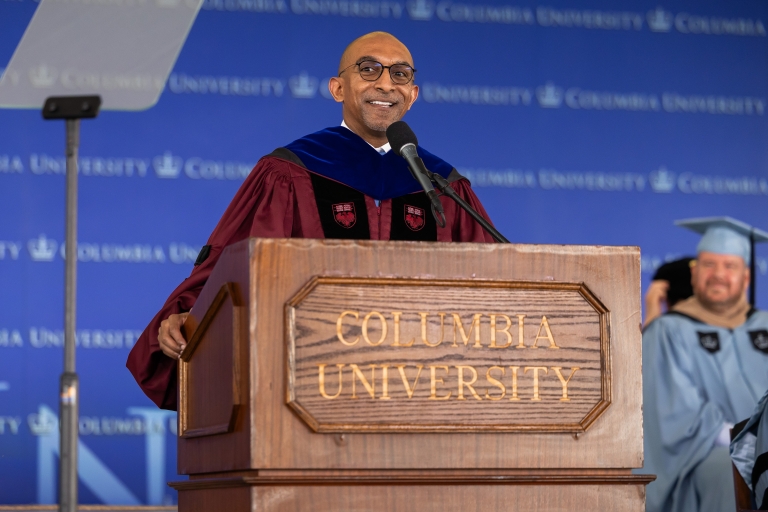
As the class prepares to embark on legal careers in a rapidly changing world, the Dean told them, “Your success will be reflected in the institutions you strengthen, the clients you serve, the causes you advance, and the legacy you create for those who come after you. Your success is—and always will be—part of our success, too. And we will continue to support you and cheer you on with immense pride.”
He urged the graduates to bring the characteristics they displayed on campus out into the world. “The seriousness, empathy, and commitment you have demonstrated during your time at Columbia Law School are qualities that our world desperately needs. Your responsibility now is not simply to remain grounded in those values but to exemplify them for others,” the Dean said.
He ended with this wish for the class: “As you move on from Columbia Law School, I hope you will look back with fulfillment, look inward with clarity, and look forward with conviction.”
Student Speakers: Build Bridges and Come Together
Melissa De La Torre ’26, graduation committee co-chair, introduced the J.D. class speaker, Shaquille Profitt ’26, calling him “a true leader—and, with three federal clerkships ahead, his commitment to public service speaks for itself through his actions.”
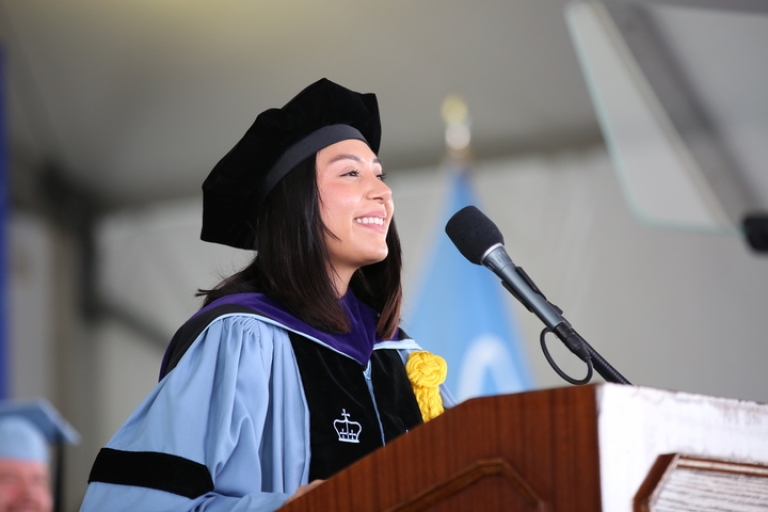
Profitt spoke of the different paths and reasons that initially brought each member of the Class of 2026 to Columbia Law School and referenced his own experience immigrating to the United States from Guyana 20 years prior. “Each of us carries a story shaped by sacrifice and written by people who chose to put us in a position to succeed, to make us the central characters in our own life journey,” he said. “That shared understanding—of what it means to leave, to hope, and to place faith in systems that promise protection—has shaped how we experienced these past three years. At certain moments, the sense of instability gave way to something undeniably unreal, as the distance between what we were being taught and what we were witnessing began to erode. We questioned what it meant to uphold the rule of law when institutional accountability felt tenuous, when Supreme Court decisions changed long-held doctrines overnight.”
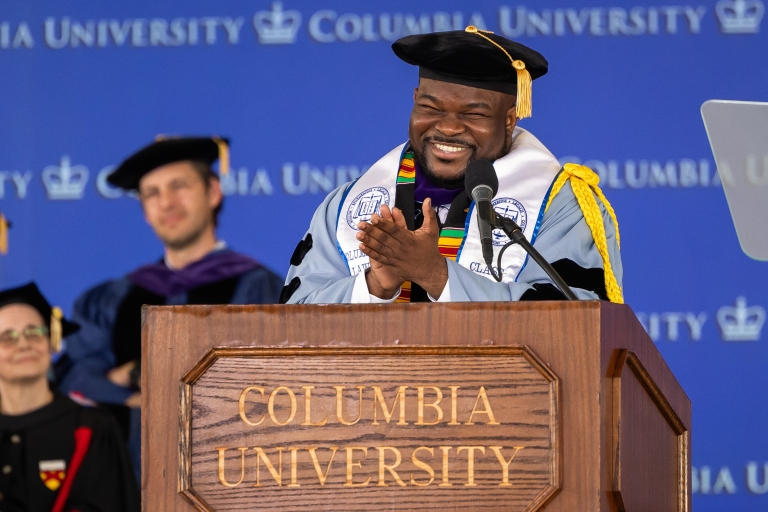
He finished his speech with his hopes for the future: “There will be people whose lives are steadier because we showed up, whose voices were heard because we spoke up, and whose futures bent, even slightly, toward justice because we refused to look away. That is the responsibility we now carry. That is the legacy we leave.”
Mary M. Suberu ’26 LL.M., graduation committee co-chair, introduced the LL.M. speaker, Beatrice Olivieri ’26 LL.M., who, Suberu said, left her job, friends, and family in Italy “to challenge herself, to immerse herself in a different manner of culture, to trade the cobblestones at Rome for the subway system of New York City. And that, frankly, is either very brave or a sign of an extremely high risk tolerance.”
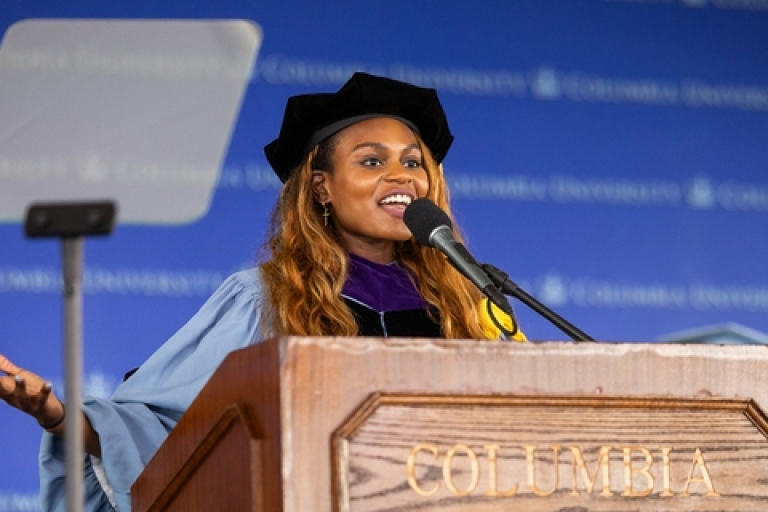
Olivieri said that the LL.M. class built a community that embraced the differences in their languages, legal systems, cultures, and perspectives. “In doing so, we created something rare: a space where everyone could belong without having to become the same. And somewhere between late nights in the Li Lu Law Library, cold calls, lunches in Lenfest Café, and conversations that stretched far beyond the classroom hours—strangers became friends and friends became family.”
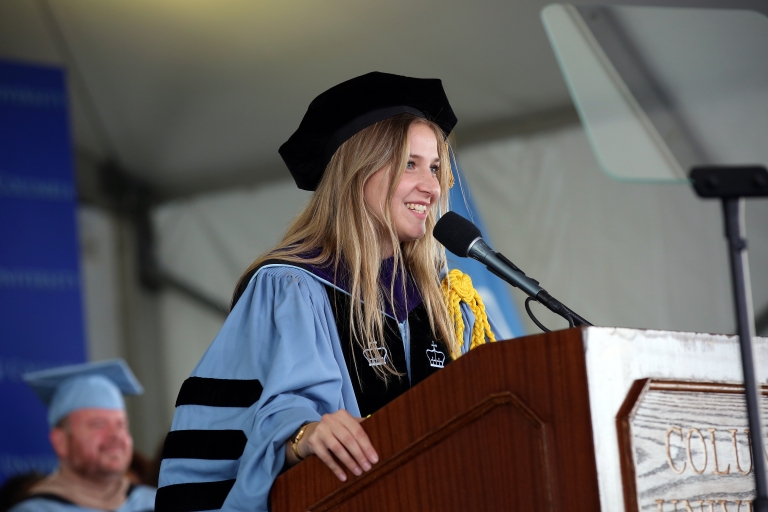
She also spoke of the impact the LL.M. class can have in “a world that feels, in many ways, even more uncertain than it did a year ago. … We return to courtrooms, firms, governments, and communities where the role of law is being tested and where our voice and our judgment will matter.”
Reese Prize Winner Olatunde Johnson: Watching Students Soar
G. Shannon Frampton ’26, graduation committee co-chair, presented Olatunde Johnson, Ruth Bader Ginsburg ’59 Professor of Law, with the Willis L.M. Reese Prize for Excellence in Teaching, an honor bestowed annually by the graduating class; this was the second time Johnson received the award. “From Day 1, she challenged us to approach the law critically, creatively, and with an eye toward justice,” Frampton said, adding that students also appreciate Johnson’s “chic fashion, witty humor, and unwavering commitment to accurate French pronunciation.” Johnson “genuinely believes in our ability to effect change,” Frampton added. “Through her public advocacy, she models intellectual courage and clarity in times of upheaval, reminding us of the power of the scholarly imagination.”
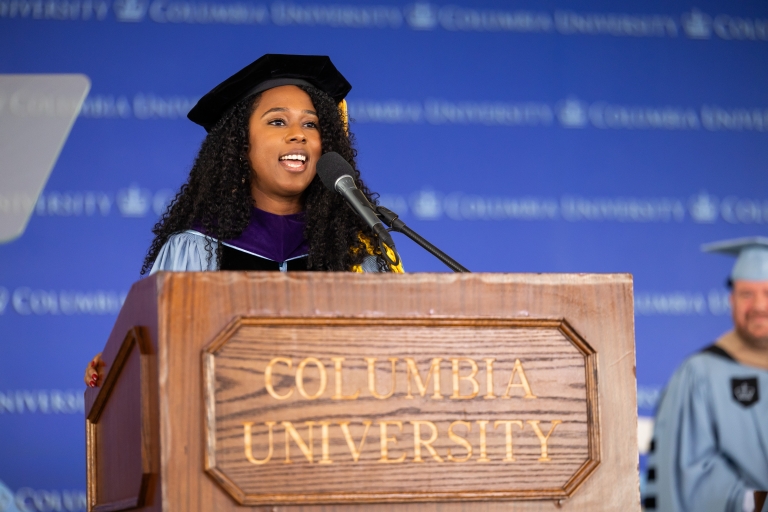
Johnson said she was grateful to receive the prize and have the opportunity to address this year’s graduates. “We rode the waves of legal turbulence together,” she said of their three years together. “Cases that we, your professors, said would never be overruled, fell. Administrative regulations we assigned in your classes disappeared before you could even read them, as if into thin air. We told you some agencies were independent, insulated from politics, and then we watched them break apart, be broken apart. … We have had to learn a new legal language together, responding to the emerging reality while maintaining our commitment to the enduring values of the rule of law.”
Johnson said she would remember this class most, though, for “the turbulence that occurred closer to home. The world did not stop so that you could study quietly. … Our world has experienced terrorist attacks, wars, and famine. And we experienced protests on our campus. New York City surrounded us in rage. … We yelled for causes we believed in; we yelled at our classmates and our colleagues. We were skilled debaters, hitting every point. And often, we still failed to persuade. Forgetting to listen and hear. We held each other in care. And we were utterly careless—exposing each other to a cruel world.”
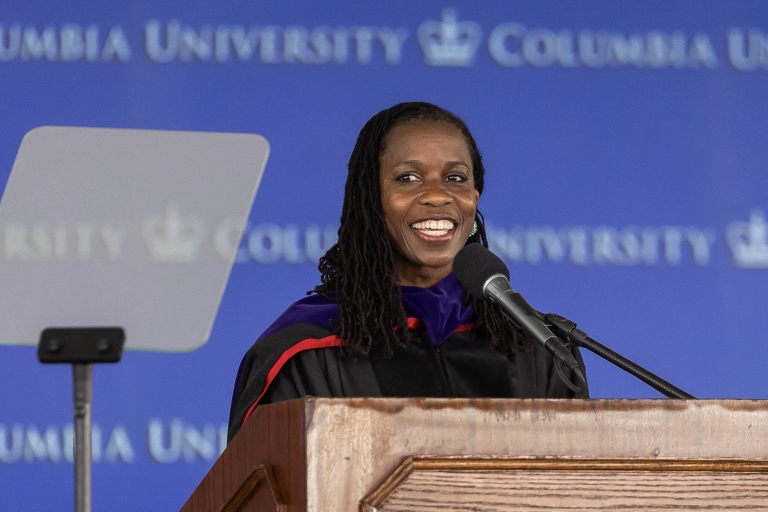
For this, she told the class, “We will also need to learn how to say sorry. For the rupture. For forgetting to hold each other in grief. I am hopeful we’ll repair, that we’ll forgive. You give me hope that we will.”
Former U.S. Solicitor General Donald B. Verrilli Jr. ’83: Courage Matters
Amado Aztlán Castillo ’26, graduation committee co-chair, introduced Verrilli, “a speaker who can share how we can use our legal education to ensure that everyone has equal justice under the law.” As U.S. Solicitor General from 2011 to 2016, Verrilli’s arguments before the Supreme Court on behalf of the federal government “led to momentous societal change,” Castillo said, “including those resulting in landmark decisions upholding the Affordable Care Act and recognizing marriage equality.”
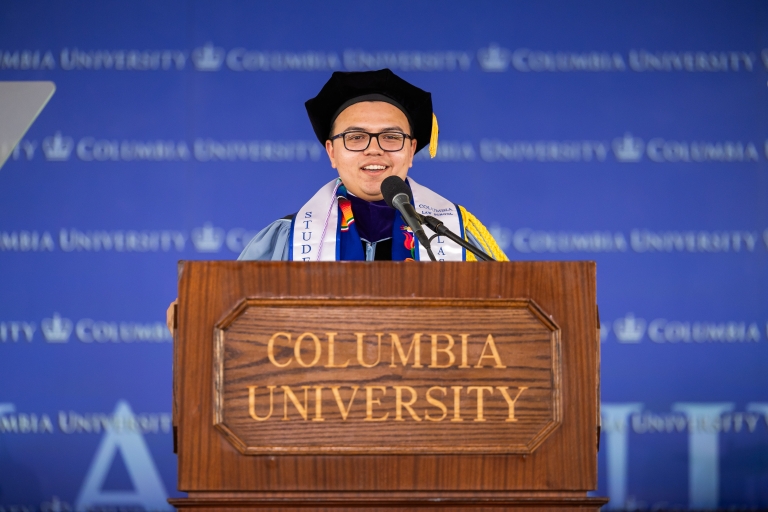
Verrilli recalled that his first appearance as Columbia Law’s graduation speaker, in 2012, occurred just a few weeks after he had struggled very publicly during oral arguments in the Affordable Care Act case, but one graduate stopped to thank him “for fighting so hard to protect health care for all of us.”
“I turned a corner with those words,” he said. “I came to understand that what really matters is that I fought for what I believe in.”
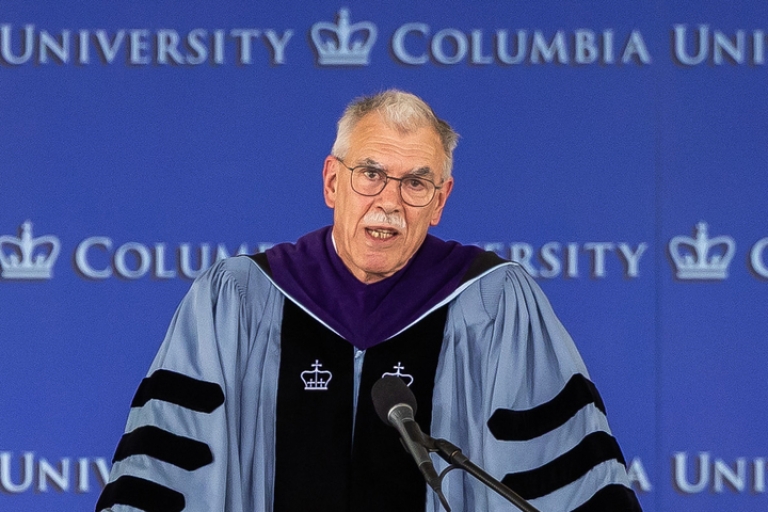
Verrilli, who is also a lecturer in law, acknowledged that this year’s graduates are entering the legal profession at a crucial moment in the history of the United States. “The independence of the Justice Department now seems to be a thing of the past,” he said. “The very foundations of our constitutional democracy seem to be quaking. This is our reality now.”
With that in mind, he urged them to have courage and advocate for what they believe in. “Courage matters most in moments like these because courage is kryptonite to authoritarians,” Verrilli said. “In times like these, you do get to see what people are really made of. You see who stands up to protect their neighbors. You see who stands up for what is best about America, who insists we are better and stronger and more beautiful as a country when we embrace the diversity of everyone who contributes to making us great.”
He concluded by telling the graduates to celebrate their accomplishments—briefly. “You’ve earned a breather. You deserve it. I hope you take it,” he said. “But then I hope that you get to work. Because your generation has got a lot of work to do to secure the blessings of liberty for your posterity. And I can’t wait to see you do it.”
Across the Stage and On to the Celebration
To cheers from the assembled families and friends, the graduates crossed the stage and received ceremonial diplomas and congratulations from Dean Abebe and Verrilli. After all the names were called, Andrea Cristina Saavedra ’06, associate dean of registration and student services, presented the Class of 2026 and sent them on their way to rousing applause.
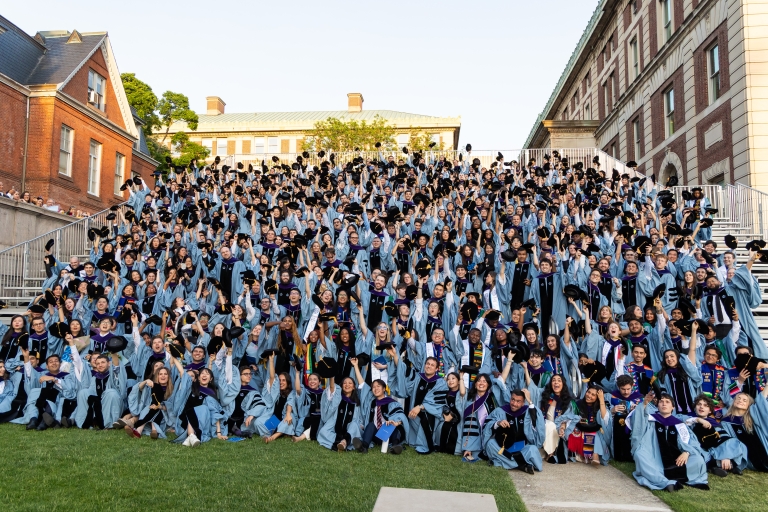
The graduates’ degrees were officially conferred at the University Commencement on May 20. At that event, the Columbia Alumni Association (CAA) recognized Jonathan D. Schiller CC ’69 LAW ’73 as an Alumni Medalist for more than 10 years of distinguished service building the Columbia community. Elora Mukherjee, Jerome L. Greene Clinical Professor of Law, received the Faculty Service Award, recognizing extraordinary and creative voluntary service that has contributed significantly to the university’s inclusion and belonging efforts.