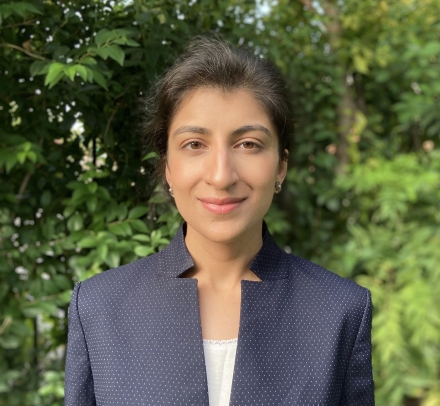
Columbia Law School Launches the Center for Law and the Economy, Led by Professors Lina Khan and Lev Menand
The center will connect students, scholars, and policymakers to study how law structures economic power in America.
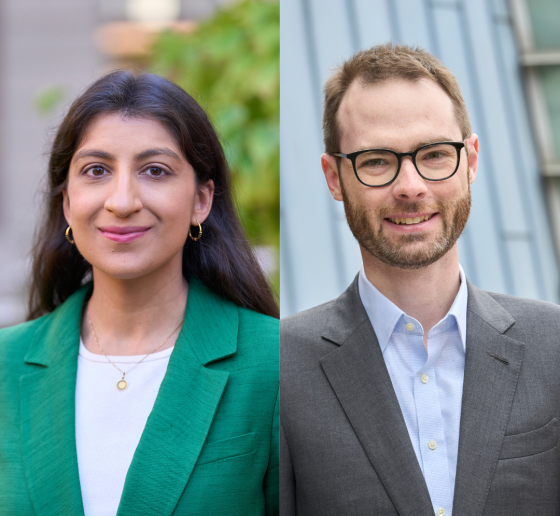
Today, Columbia Law School announced the establishment of the Center for Law and the Economy, led by Associate Professors of Law Lina Khan and Lev Menand (pictured). The center will be dedicated to advancing the study, practice, and implementation of laws and policies that structure the U.S. economy.
“We see major gaps in both the legal research and training needed to tackle pressing questions of economic governance,” said Lina Khan, director of the Center for Law and the Economy. “We also see tremendous interest from law students, and the center will help harness that interest and develop the scholarship and expertise needed to advance this work across key areas of economic law and policy.”
“The United States today has a major shortfall of knowledge and expertise in economic law and institutions,” said Lev Menand, director of the Center for Law and the Economy. “This shortfall significantly constrains our ability to solve pressing economic and social problems. Sometimes, it contributes to acute harms, as we saw in 2008 when the financial system broke down. Other times, it impedes our ability to address emerging challenges, such as greening the grid. The center is focused on remedying this shortfall. We hope to accelerate the production of knowledge and to advance policy thinking across a range of legal areas involving the economy, taking a holistic and dynamic approach to the relationship between law, institutions, and economic activity.”
“The field of public economic law could not be more important in our times, and the new center will put Columbia at the forefront of scholarship and policy work in the area,” said Tim Wu, Julius Silver Professor of Law, Science and Technology at Columbia Law School, and an intellectual leader in the center’s work.
The Center for Law and the Economy will have two key missions. The first is to serve as a hub for work that fills major gaps in scholarship and policy research on the laws and tools that shape, structure, and govern economic activity. The center will bring expertise to advance work spanning public economic law, including in antitrust, administrative law, banking law, consumer protection, corporate governance, financial regulation, and tech policy, among other areas. Drawing on top government experience, the center’s fellows will focus on developing timely research that can move from scholarship into practice. The center’s Project on Public Economic Law will support students and scholars as they prepare for careers in legal academia, and it will host the Public Economic Law Colloquium to convene scholars and teach students pursuing this work.
The second part of the center’s mission is to educate, train, and support current students through its Law and Economy Student Network. Students from around the United States will have the opportunity to participate in events with leading scholars and policymakers; contribute to timely, original scholarship and policy projects; and submit work for annual awards. Through the network, the center will help train the next generation of legal and economic scholars and policy leaders and position them to advance careers in public service.
“The Center for Law and the Economy, under the leadership of Professors Lina Khan and Lev Menand—two groundbreaking scholars and experienced public servants—will provide a vital platform for studying the laws and policies that shape our economy,” said Daniel Abebe, Dean and Lucy G. Moses Professor of Law. “The center’s commitment to advancing research and providing opportunities to engage with influential scholars, practitioners, and policymakers embodies Columbia Law School’s mission to prepare our students for leadership at the highest levels.”
Center Directors and Affiliates
Lina Khan served as the 57th chair of the Federal Trade Commission from 2021 to 2025, where she prioritized reinvigorating antitrust and consumer protection enforcement, blocking illegal mergers, and addressing the harms Americans face from monopolistic abuses, surveillance, and deceptive practices. She has written extensively about public economic law, including in antitrust, antimonopoly, consumer protection, and the law of networks, platforms, and utilities.
Lev Menand is a scholar of money and banking, public utility law, and public administration. He directs the Project on Public Economic Law at Columbia Law School, has served in various capacities at the Department of the Treasury and the Federal Reserve Bank of New York, and has written extensively on central banking and monetary system design.
Tim Wu is a leader in the revitalization of American antitrust and has taken a particular focus on the growing power of the big tech platforms. In 2021, he was appointed to serve in the White House as special assistant to the president for technology and competition policy. He has published several books on economic power, including The Age of Extraction: How Tech Platforms Conquered the Economy and Threaten Our Future (2025).
Khan, Menand, and Wu will be joined at the Center for Law and the Economy by experienced policy advisors, technologists, attorneys, researchers, and scholars.
- Seth Frotman is a senior fellow at the center and a lecturer in law at Columbia Law School. He is focused on rethinking central aspects of administrative law and the role of the courts in the administrative process. He previously served as general counsel and senior advisor to the director of the Consumer Financial Protection Bureau and is teaching a course on Consumer Protection Law and Policy.
- Hannah Garden-Monheit is a senior fellow working on the future of administrative law and economic governance across federal, state, and local governments. She previously served as the Federal Trade Commission’s director of the Office of Policy Planning and as special assistant to the president for economic policy and director for competition council policy in the White House.
- Doha Mekki is a senior fellow focused on the future enforcement of public economic laws, including antitrust and consumer laws and economic crimes. Her current projects examine the common law roots of U.S. antitrust law and frontier issues in algorithmic collusion. She previously served as principal deputy assistant attorney general and later as acting assistant attorney general of the U.S. Department of Justice’s Antitrust Division.
- Erie Meyer is a senior fellow focused on the intersection of tech, surveillance, and economic fairness, as well as on projects to rebuild and modernize state capacity. She previously served as chief technologist and senior advisor to the director of the Consumer Financial Protection Bureau. She was a co-founder of the U.S. Digital Service at the White House.
- Joel Michaels is the inaugural fellow in Public Economic Law. Working at the nexus of public finance and financial regulation, his academic scholarship has analyzed industrial policy, federal budget law, and the distributive impacts of bank capital regulations. He previously served as a senior advisor at the U.S. Department of the Treasury.
- Sarah Miller is a senior advisor and supports all aspects of the center’s strategy and operations. She previously served as senior advisor and chief of staff to Federal Trade Commission Chair Khan.
- Robin Moore is a fellow who is focused on consumer and competition law and policy. She previously served as principal deputy general counsel of the Federal Trade Commission.
- Stephanie Nguyen is a senior fellow focused on building durable state capacity to investigate and address the rapidly expanding use of surveillance and artificial intelligence technologies, including their implications for pricing. She previously served as chief technologist at the Federal Trade Commission, where she founded and led the agency’s first Office of Technology.
- Shaoul Sussman is a senior fellow focused on projects examining the atextual dimensions of contemporary antitrust law and the historical origins of antimonopoly law. Sussman is currently working on an antitrust casebook alongside Professors Tim Wu, Zephyr Teachout, and Lina Khan. He is a founding partner at Simonsen Sussman and previously served as associate director for litigation in the Bureau of Competition at the Federal Trade Commission.
Center Programming and Supporters
In the coming months, the Center for Law and the Economy will begin convening public events, publishing papers and reports, and offering programming and other opportunities for students. Learn more and stay connected.
The Center for Law and the Economy at Columbia Law School thanks the following foundations and organizations for their support: the Ford Foundation, the Marguerite Casey Foundation, Omidyar Network, the Hewlett Foundation, the Nathan Cummings Foundation, and the Knight Foundation Federal Alumni Fellowship Fund at The Miami Foundation, which received support from the John S. & James L. Knight Foundation.