Meet Marwah ‘Mari’ Ismail ’28: A 2025 Recipient of the Paul & Daisy Soros Fellowships for New Americans
The Columbia Law 1L is excited to explore the intersection of religion, identity, and the law.
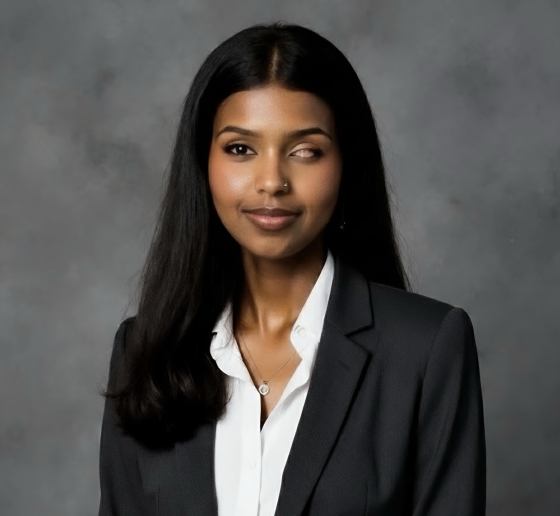
When Marwah “Mari” Ismail ’28 considered applying for the highly selective Paul & Daisy Soros Fellowships for New Americans to help pay for law school expenses, she doubted the viability of her candidacy. Each year, the fellowship program receives more than 2,600 applications from immigrants or the children of immigrants from around the world, and it ultimately awards up to $90,000 in graduate school funding to just 30 outstanding recipients. The effort, she says, seemed like “a shot in the dark.”
Despite the long odds, Ismail saw opportunity in facing her fear head-on. “Go for it,” she says she told herself. “Do it. Let them tell me ‘no.’”
She was later shocked when the Paul & Daisy Soros Fellowships program called to tell her she was a finalist and, after a series of “intense” interviews, a winner of the prestigious fellowship that acknowledges the recipient’s “potential to make significant contributions to the United States.”
Winning the 2025 award, she says, “changes everything.” She is using the funding to cover her living expenses while studying at Columbia Law, where she is a Bridge to Opportunity Scholar.
In choosing Columbia Law School, Ismail says she was drawn to the opportunity to study law in New York City and to situate herself at the forefront of legal and institutional advancement. She was eager to engage directly with the legal, financial, and policy spaces shaping national and global conversations. “Columbia Law’s clinics, externships, and breadth of academic resources also stood out,” she says, by offering the flexibility to explore a wide range of legal interests as she continues to navigate her career path. Now in her 1L year, that decision has “felt reaffirmed,” she says. “I have found the academic environment at Columbia Law intellectually energizing, and I have developed meaningful relationships within my class and section.”
Raised in Minnesota by her mother, Ismail earned a bachelor’s degree from Emory University, which she attended as a QuestBridge Scholar. She majored in religion, minored in Italian studies, and graduated summa cum laude. This was no small feat: In her junior year, Ismail was diagnosed with a rare eye cancer, which caused her to lose an eye. (She delivered a TEDx talk on her medical journey in 2024.) Ismail returned to Minnesota for treatment but remained a full-time student by taking her classes online.
Ismail’s undergraduate studies strengthened her growing interest in the law. “Religion and the law are very intertwined,” Ismail says. “I took a course about religion in the news. We talked about current events and how religion tied in, and it opened my eyes.” Her minor also helped her connect with her own history: Ismail’s family is ethnically Somali, and she chose to root her Italian studies in the history of Somalia, a country once colonized by Italy. She focused her senior thesis on the Somali Civil War and shifting cultural stances. “I picked up on different injustices,” she says, “how quickly rights can be destroyed, and how long it takes to provide them.”
Inspired by these academic and personal interests, she decided to concentrate her career on law, policy, and politics, a choice further sparked by her summer internships in the offices of United States Sen. Amy Klobuchar and Minority Leader Congressman Hakeem Jeffries. During her time in Klobuchar’s office, Ismail worked with constituents who contacted the office with immigration concerns. “I saw the levels of discrimination that can occur within the immigration system and the legal system in general,” she says.
Now at Columbia Law, Ismail is starting her second semester, enjoying life “in the greatest city ever,” and appreciating her classes—even, surprisingly to her, a first-semester Contracts class, taught by Jody Kraus, Alfred McCormack Professor of Law. Kraus, Ismail says, presented case law and legal theory through a philosophical lens, which reminded her of her favorite religion classes at Emory. She has also found meaningful mentorship in her Property class, where Michael Heller, Lawrence A. Wien Professor of Real Estate Law and vice dean of academic affairs, has helped guide her through her transition into legal study. She also praises the Law School’s strong alumni network, along with its broad legal curriculum, flexible structure, and pro bono opportunities. “Law school is definitely difficult,” she says. “But the mentorship and teaching environment have made it possible for me to thrive intellectually.”
While she is “still very much in the growing and learning phase” of navigating her career trajectory, she says she is excited to build upon her academic and legal interests, and her professional experiences, so she can “impact whatever space and community I’m in for the better.”