The 2025 Stone Circle Luncheon: ‘Wisdom, Perspective, and Enduring Bonds’
The event brought together Columbia Law School alumni who graduated 50 or more years ago and featured a keynote from Professor Jeremy Kessler.
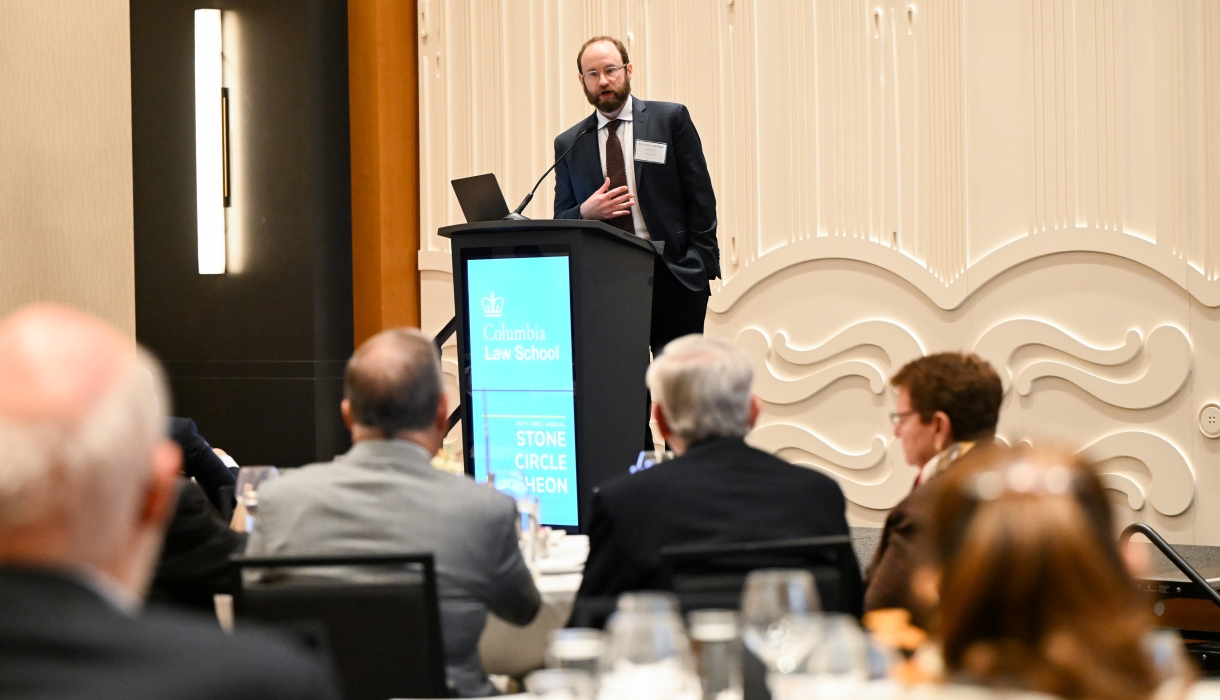
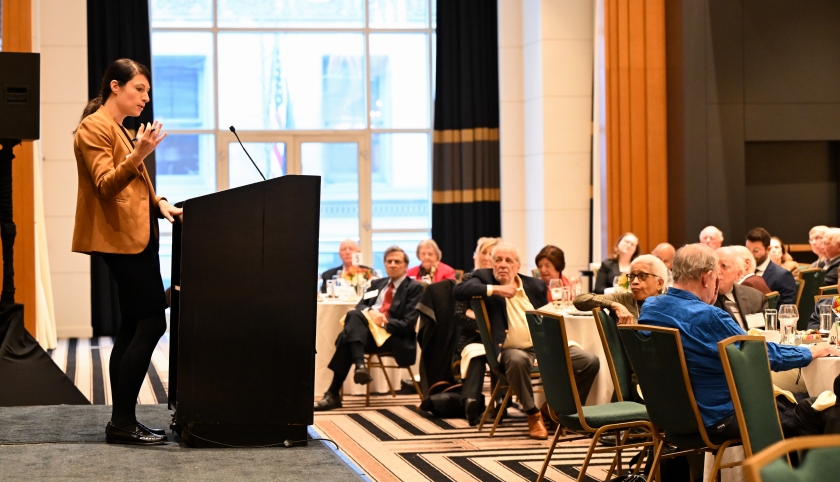
Alumni who graduated in 1975 or earlier reconnected at the 51st annual Stone Circle Luncheon, held at the Sofitel New York on October 27. The approximately 80 alumni attendees also heard from Jeremy Kessler, Stanley H. Fuld Professor of Law, who gave a lecture about his recent research project on social media platforms and the First Amendment.
In his opening remarks welcoming the Class of 1975 as the newest members of the Stone Circle, Daniel Abebe, Dean and Lucy G. Moses Professor of Law, reflected on the lifelong value of a Columbia Law School education. “Each year, this event reminds us of the deep ties that connect Columbia Law graduates across decades,” he said. “You return with wisdom, perspective, and enduring bonds that enrich our entire community.”
Dean Abebe also introduced Kessler—a legal historian, First Amendment expert, and co-director of the Law School’s Legal History Workshop and the university’s Workshop on Knowledge and the State—who outlined a problem that he called “the most vexing in current First Amendment law”: the application of traditional free speech norms to social media platforms. In a unanimous 2017 Supreme Court decision, Justice Anthony Kennedy described social media as “the modern public square,” equivalent to a public street or park. But, Kessler explained, “Justice Kennedy’s analogy ignored the fundamental difference between modern and traditional public squares because social media platforms are privately owned and do not have to abide by the First Amendment. They are free to exclude or sanction speakers on the basis of the viewpoints those speakers express.”
In the traditional public square, the state or the federal government is the relevant operator. “And the government almost never excludes or sanctions speakers on the basis of viewpoints expressed. This is known as the norm against viewpoint discrimination,” Kessler said, adding that “most judges, scholars, and litigators consider it the most basic and inviolate of First Amendment norms.”
When social media platforms suspend a user or suppress posts because of hateful or simply unorthodox points of view, “the platform is violating the norm against viewpoint discrimination,” Kessler said. “But it’s not violating any law, and, least of all, the Constitution.”
Kessler said that his research project “takes off” by investigating the history of the norm against viewpoint discrimination, which is less than 50 years old (the phrase first appeared in a law review article in 1979 and a judicial opinion in 1983, he said). In earlier decades, some forms of what would now be considered viewpoint discrimination were allowed because they were considered to be essential to the maintenance of public order; for example, federal and state laws that discriminated against pro-communist and anti-draft points of view. Kessler also provided a brief history of the Supreme Court’s invocation of the norm against viewpoint discrimination “in response to the rising influence of public-sector unions and politically progressive nonprofits” that “were using their influence with public administrators to silence the speech of their politically conservative and for-profit corporate opponents.” The involvement of public administrators was sufficient to transform the censorship into unconstitutional state action. But, Kessler argued, the court’s focus was on the efforts of private groups to curate the “analog” public square.
He then circled his remarks back to the digital realm, discussing a Texas law passed in 2020 that prohibits social media platforms from engaging in viewpoint discrimination by removing content based on the author’s point of view; the state’s Republican lawmakers intended the bill to protect conservative opinions expressed online.
“If the Texas statute … reflects the beginning of a long-term legal strategy, its success may depend on convincing the court that social media platforms are only able to curate users’ messages because government actors have empowered them to do so,” Kessler said. He mentioned that Section 230 of the Communications Decency Act (which immunizes websites from liability for removing objectionable content) and informal but ongoing bargaining between the platform operators and federal regulators reveal ways that the platforms and the government are entwined. “Perhaps these forms of private-public collaboration will be sufficient one day to transform social media censorship into unconstitutional state action,” he said.
At the conclusion of his remarks, Kessler fielded a series of penetrating questions from members of the audience, who were eager to engage with his scholarship. The interaction reflected the concept of ongoing connection between the Stone Circle alumni and the Law School that the Dean had earlier referred to as “a lifelong bond—to one another and to the school.”
The Stone Circle Luncheon began as an informal gathering of alumni who attended Columbia Law School during the deanship of Harlan Fiske Stone 1898, from 1910 to 1923. Stone later became chief justice of the United States. The luncheon became an annual event in 1974.