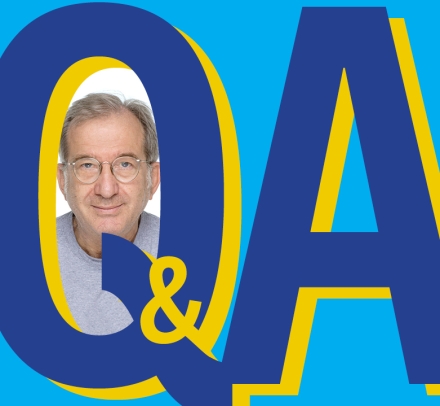
Timothy M. Reif ’85: Solving Trade Law’s Puzzles
The U.S. Court of International Trade judge has spent his career focused on public service that crosses political divides.

The artwork in the chambers of Judge Timothy Reif ’85 at the U.S. Court of International Trade in New York reflects three aspects of Reif’s life: his family history as the son of a World War II refugee; his love of photography, with prints by Inge Morath, Gordon Parks, and Roy DeCarava; and his admiration for some of his political heroes, including Robert F. Kennedy, John Lewis, and Eleanor Roosevelt.
But another photo nearby, of Carla Hills, U.S. trade representative during the George H.W. Bush administration and Reif’s former boss, is emblematic of Reif’s long-held belief in being a public servant who works across the political divide.
Reif’s career has included roles in all three branches of government. After working for Hills, whom he calls a mentor, he served more than a decade as chief international trade counsel for the U.S. House Ways and Means Committee. He returned to the trade representative’s office as general counsel during the Obama administration. And in 2019, he was appointed to the United States Court of International Trade by President Donald Trump.
By that time, he had long since decided on the virtue of talking across divides, whether to Chinese trade officials or up and down the Capitol Hill hierarchy. “I am completely of the view that you meet with people with whom you disagree, and you are straight with them,” he says. “Respectfully straight.”
Trade Matters
Over the course of his career, Reif says he has seen the dynamic of debates on trade issues evolve from regional concerns—agrarian states versus manufacturing hubs—to partisan arguments. The shift, he says, was spurred by the adoption of the North American Free Trade Agreement (NAFTA) in 1992 and the creation of the World Trade Organization in 1995. Those trade agreements required the U.S. to negotiate international standards on issues like copyright protections, environmental protections, and fair working conditions, “very much like the domestic regulatory battles for legislation that had been going on since the New Deal,” Reif says, “which then really sharpened the political divide.”
He recalls leaving the USTR office in Washington, D.C., one summer night in 1991 and seeing posters on the street depicting a bloody-fanged monster called “GATT-zilla.” The posters were protesting a decision by the General Agreement on Tariffs and Trade (GATT, the precursor to the World Trade Organization) to overrule a U.S. embargo on canned tuna, a ban intended to reduce dolphin deaths caused by tuna fishing.
“What we were doing [in the USTR office] was now front-page news,” Reif says. “People who had no interest in trade were interested in it because they were interested in conservation.” The realization reinforced his choice of trade as a legal specialty. Trade “matters to people,” he says. “It matters to working people, it matters to farmers, and—it matters.”
Plus, he adds, “the issues are incredibly interesting. They’re always multilayered, never black and white. Every issue is, in a way, like a puzzle. How do you … put the pieces together to come up with the best piece of legislation? Or how to put them together to file the strongest WTO case or to come up with the best trade agreement?”
He also says he always thinks about trade in terms of economics. “Is it going to help working people? Is it going to work for American farmers or industry?”
On the U.S. Court of International Trade, “the puzzle is just the law,” Reif says. “But it’s still a puzzle.”
In a rare occurrence, one piece of the puzzle, a trade issue that Reif and two fellow international trade court judges ruled on in May 2025, went all the way to the Supreme Court. In its ruling on the case, V.O.S. Selections Inc. v. The United States of America, the panel held 3-0 that the International Emergency Economic Powers Act did not authorize the president to impose tariffs, a decision upheld by an appeals court and ultimately, by the Supreme Court, 6-3, (in Learning Resources v. Trump) in February 2026.
Speaking before the Supreme Court decision was announced, Reif noted that extensive litigation over the actions of the Trump administration, and public reaction to judicial decisions generally, has exacerbated perceptions of judges as partisan players. “All the judiciary has is credibility. It’s all we’ve got,” he says. The practice, in media coverage of judicial decisions, of routinely mentioning which president appointed the judge in a case, has caused “enormous damage” to the perception of judges as nonpartisan interpreters of the law.
“It’s an incredibly dangerous moment,” Reif adds. “But all that those of us who are in office can do is to do the job: We get a law, and with the best of our intellectual abilities, we apply it. And the chips—and the rest of it—fall where they may.”
Doing Good
For Reif, there was no other career path but public service. Born in New York City, he was deeply inspired by his father, classical composer Paul Reif, who fled Vienna after its takeover by Nazi Germany, made his way to New York, and joined the United States Intelligence Corps in 1942, serving in North Africa. The younger Reif decided to pursue a law degree and become a lawyer, he says, “because I thought that’s what you did if you wanted to go do good things.” He enrolled at Columbia Law after attending Princeton University, where he earned a Bachelor of Arts and Master of Public Administration.
In law school, he studied antitrust and trade regulation with Dwight Professor of Law Harvey J. Goldschmid (1940-2015). When Goldschmid won a teaching award, Reif introduced him at the ceremony. “It was maybe the proudest moment of my entire Columbia career,” Reif says, adding that Goldschmid “was just incredible, and he had such an impact on me and on my teaching.” (In addition to his position as an adjunct at Columbia Law School, Reif has taught at Princeton and Georgetown.)
After graduating from Columbia Law in 1985, Reif joined Milbank Tweed Hadley & McCloy as an associate. “I loved my time in private practice,” he says, “but nothing, nothing beats working in a building with the American flag flying from it.”
Beyond his role as judge, Reif has spent time unraveling another legal challenge: He continues his family’s decades-long effort to reclaim artworks by Egon Schiele that belonged to his father’s cousin, the composer and cabaret performer Fritz Grünbaum, who was killed by the Nazis during World War II. Reif’s mother, Rita, pursued the restitution of the paintings, and since her death, Reif and his cousins have continued the case and have identified and reclaimed more than a dozen Schiele works. Proceeds from the sale of the restituted works have funded the Grünbaum Fischer Foundation, which provides scholarships to artists from communities and backgrounds that are underrepresented in their fields.
At a 2023 press conference announcing the restitution of seven works to his family, Reif said the recovery “reminds us once again that history’s largest mass murder has long concealed history’s greatest mass robbery.”
In many other families victimized by the Nazis, he adds, no one survived to reclaim looted possessions—or the stolen items, though no less treasured, are not as identifiable as a Schiele. “What they owned, some precious steel candlesticks or what have you, weren’t distinctive enough to be able to trace … let alone [be able to] demonstrate that the family was entitled to it,” he says. “I feel incredibly fortunate.”
Reif also continues to unravel trade law puzzles for students in the Columbia Law classroom, where he is an adjunct professor of law: In spring 2026, he is co-teaching a seminar on Tariffs and Trade Wars. Co-teaching—his usual practice—gives students two perspectives, Reif says, and the teachers learn from each other as well as from their students. Students have no preconceptions, so “they will ask the really hard questions,” he says, quoting the maxim, “If you teach, by your students you’ll be taught.”