Professor Monica Hakimi on ‘Today’s Wars and Tomorrow’s Order’
Delivering the annual Clifford Chance Thought Leadership Lecture, Hakimi cautioned that the international legal system is in crisis and said that tomorrow’s lawyer-leaders will have opportunities to build something new.
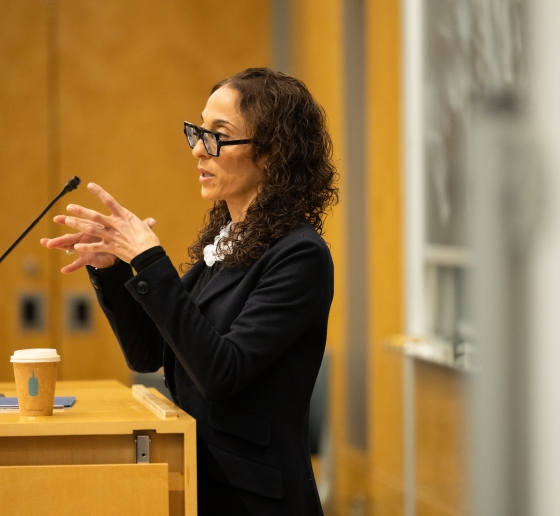
Monica Hakimi, William S. Beineke Professor of Law, who is an expert in public international law and the use of force, spoke candidly about the state of the international legal system when she delivered the 2026 Clifford Chance Thought Leadership Lecture at Columbia Law School on January 28.
“The international legal system that was established at the end of World War II and then developed and adapted in the decades since is breaking down,” she told the audience of Columbia Law students. “It is probably near systemic collapse at this point.”
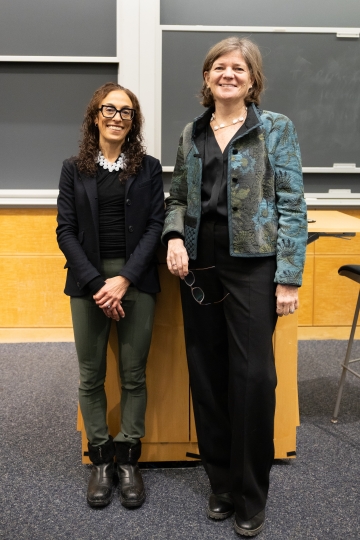
Hakimi is co-editor in chief of the American Journal of International Law, the premier scholarly publication focused on international law. In her lecture, titled “Today’s Wars and Tomorrow’s Order,” she said that conflicts like those in Ukraine and the Middle East are inflection points that will shape the future world order. They also reflect and accelerate trends that call into question the basic normative tenets of the post–World War II ecosystem, including that states: 1) should be the principal units for political organization in the world, 2) should refrain from coercively intervening in the affairs of other states for their own national gain, 3) should promote human dignity when feasible, and 4) should work together to address issues of common concern.
“During the post–World War II period, multilateralism flourished; states together used international law on virtually every aspect of modern governance,” she said. Hakimi cited a long list of global issues that states addressed collaboratively during this period. For example, they used international law to settle their national borders; define the terms for trade; create communal areas in the Arctic, on the high seas, and in outer space; address environmental degradation; share knowledge and technology; limit the proliferation of nuclear, biological, and chemical weapons; reduce corruption; and establish international institutions, courts, and tribunals.
However, Hakimi said, not every state has been equally committed to upholding the normative tenets of the post–World War II order in every circumstance. This has led to difficult questions about how states should address fissures and tensions. For example, “international law never established satisfying answers to the question of what to do, and who should do it, when a state commits atrocities against its own people,” she said. “Should no one outside the state be permitted to act on behalf of the victims, naming and shaming the perpetrators, or by using economic or, in extreme cases, military coercion for support?”
She said that multinational organizations—such as the United Nations, the World Trade Organization, and the International Criminal Court—have limited and diminishing power and support. For many years, she said, the United States contributed substantial funding to multilaterals, encouraged their use, and followed their guidelines. “[Now] the United States is withdrawing much of its support for, if not actively working to debilitate, many of these institutions, including the U.N.,” she said. She added that other countries have also “decided that pushing back against the institutions makes sense because these institutions have not adequately responded to their needs.”
Hakimi listed some of the urgent questions that need to be answered to sustain an international legal order, including: How can human dignity best be realized in a diverse and compromised world, and which international issues are best addressed in large-scale multilateral venues and which are more localized?
Lawyers, she urged, must step up to help address the challenges. “The job of a lawyer is to raise difficult questions that others are unable to see or willing to ask, to help analyze the competing principles inherent in any large-scale social project, and then to identify the possible paths forward,” she said.
“This is where you all come in,” she told the Columbia Law students in the audience. “We need serious, thoughtful leaders who can look at the world, who can see the problems we confront, and who have the analytical capacity and skills not only to fight, when fighting seems like the move, with the legal tools that are available, but also to find compromises and concessions.” Lawyers, she said, also need to “explain why those compromises and concessions make sense or are justifiable relative to the alternatives, given that the world is far from perfect.”
Hakimi told students to think of today’s challenges as opportunities. “For all of the problems that this world possesses,” she said, “it is an exciting time to be studying law; law is a tool for analysis, innovation, growth, and change.”
The annual Clifford Chance Lecture Series addresses issues of diversity in the legal field and is made possible by the Clifford Chance Thought Leadership Initiative on Diversity at Columbia Law School.