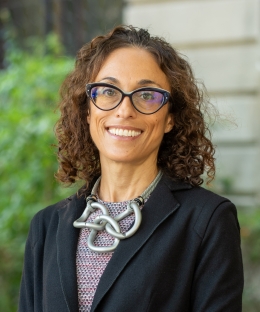
Monica Hakimi
- William S. Beinecke Professor of Law
Education
J.D., Yale Law School, 2001
B.A., Duke University, 1997

J.D., Yale Law School, 2001
B.A., Duke University, 1997
Monica Hakimi is the William S. Beinecke Professor of Law at Columbia Law School and one of the preeminent scholars of international law of her generation. She recently completed a term as Co-Editor-in-Chief of the American Journal of International Law, the leading peer-reviewed journal in the field. She is also the recipient of the 2024 Humboldt Research Award, one of Germany's most distinguished honors for scholars outside of Germany, awarded annually to a small set of researchers to recognize their outstanding contributions to their fields.
Hakimi's scholarship draws on both legal doctrine and theory to ask foundational questions about international law — how it operates, what purposes it serves, and how it should be understood on its own terms. Her work spans different areas of public international law, including the use of force, humanitarian law, and human rights law. It has appeared in the American Journal of International Law, the Harvard International Law Journal, the Michigan Law Review, the Yale Journal of International Law, and the European Journal of International Law, among other venues. Several of her articles have been selected as featured pieces accompanied by invited responses from prominent scholars, a distinction that reflects the significance and originality of the contributions.
Her major theoretical project challenges the widely held assumption that international law exists primarily to enable cooperation. Across a series of articles, Hakimi has argued that international law operates through conflict and contestation as much as it does through cooperation, and that a clear-eyed account of the field requires abandoning conventional assumptions about law's role in the international order.
Hakimi has also been one of the most prominent scholarly voices on the geopolitical crises of the present moment. Her co-authored article "Russia, Ukraine, and the Future World Order" was among the first major scholarly engagements with Russia's invasion and has received considerable attention among scholars, government officials, and policymakers. Her subsequent work — on the prohibition of the annexation of territory, the decline in U.S. support for international law, and the global crisis in governance authority — addresses questions of the first order of importance for the future of the field.
In addition to her research, Hakimi is co-author (with Jeffrey L. Dunoff and Steven R. Ratner) of International Law: Norms, Actors, Process: A Problem-Oriented Approach (6th ed. 2025), one of the most widely used international law casebooks in American legal education. She is an Adviser to the American Law Institute's Restatement (Fourth) of U.S. Foreign Relations Law and serves on the Advisory Board of the Max Planck Encyclopedia of International Law and on the U.S. Department of State Advisory Committee on International Law.
Before joining Columbia, Hakimi was the James V. Campbell Professor of Law at the University of Michigan Law School, where she served as Associate Dean for Faculty and Research and Associate Dean for Academic Programming. She has held visiting and research appointments at the KFG Berlin-Potsdam Research Group, Interdisciplinary Center Herzliya, the University of Tokyo, and Benjamin N. Cardozo School of Law.
Prior to entering the academy, Hakimi served for four years as an Attorney-Adviser in the Office of the Legal Adviser at the U.S. Department of State, working on issues relating to state responsibility, nuclear nonproliferation, international investment disputes, and international civil aviation. She clerked for Judge Kimba M. Wood on the U.S. District Court for the Southern District of New York.
Hakimi received her B.A. summa cum laude from Duke University and her J.D. from Yale Law School.
Books
Articles, Essays, and Book Chapters
A norm that prohibits states from forcibly annexing foreign territory is “foundational” to modern international law, says the Columbia Law expert on public international law and the use of force. So why is territorial conflict spreading, and what could stop it?