
In Memoriam: Professor Emeritus Ronald J. Gilson
The scholar whose influential work changed the way law schools approach the study and practice of transactional law dies at 80.

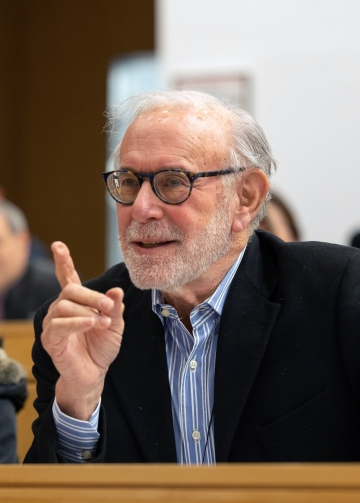
Ronald J. Gilson, an expert on law and economics who taught at Columbia Law School for more than three decades, died on October 12, 2026, at 80. His scholarship on the role of transactional lawyers—and their inadequate preparation by law schools at the time—led to the development of a new course that would become a model for law and business schools around the world.
Over his nearly half-century academic career, Gilson, who was Marc and Eva Stern Professor Emeritus of Law and Business at Columbia Law, co-authored two major casebooks on corporate finance and corporate acquisitions and published nearly 100 articles in law and economic journals.
“Through a rare combination of intellectual ambition, analytical rigor, and prior experience as a practicing lawyer, Ron was able to bridge the divide between theory and practice perhaps more successfully than any academic of his generation,” said Daniel Abebe, Dean and Lucy G. Moses Professor of Law. “It is clear that Ron’s influential scholarship has left an indelible imprint, both for those who study the law and those who practice it.”
An Academic Influencer
Gilson is perhaps best known for two of his earliest academic papers: “Value Creation by Business Lawyers: Legal Skills and Asset Pricing,” Yale Law Journal, 1984, which examined the role of transactional lawyers, and “The Mechanisms of Market Efficiency,” co-authored with Reinier H. Kraakman, Virginia Law Review, 1984, which challenged previously held assumptions about market behavior.
In “Value Creation,” Gilson set out to answer a simple question: What do transactional lawyers really do? He argued that business lawyers, whom he viewed as transaction cost engineers, must add value or people would not continue to hire them. To do so, he said, lawyers must expand the size of the pie on the table rather than simply ensure that their client receives a bigger piece of an existing pie. “We can thus add one condition to the proposition that business lawyers have potential to add value to a transaction,” he wrote. “The increase must be in the overall value of the transaction, not merely in the distributive share of one of the parties. That is, a business lawyer must show the potential to enlarge the entire pie, not just to increase the size of one piece at the expense of another.”
The paper also criticized legal education at the time, which Gilson felt failed to adequately prepare business lawyers for their careers. “The opportunity now exists,” he wrote, “to change this unfortunate state of affairs and to cause business law education, for the first time, to link theory directly to practice.” Gilson’s thinking on the subject was informed not only by his research but also by his experiences in legal practice; from 1972 to 1979 he was a partner and associate at Steinhart, Goldberg, Feigenbaum & Ladar, a corporate law firm in San Francisco.
After Gilson joined the faculty at Columbia Law School, a new course—that would later be known as Deals—arose out of the ideas about transactional lawyering presented in his “Value Creation” paper. Law schools and business schools across the country and around the world subsequently incorporated this course into their curricula, with the goal of preparing lawyers for practice by providing them with skills to problem solve for a variety of real-world transaction types.
Since “Value Creation” was published more than four decades ago, scholars have continued to discuss the propositions Gilson posed; it has been the subject of many journal articles and academic panels. In 2021, Gilson and other law professors discussed the paper in a conversation hosted by University of Virginia School of Law, where his work was described as “highly imaginative and pathbreaking.” University of Pennsylvania Carey Law School Professor Michael Knoll, one of the participants, said that Gilson’s paper “began a theoretical and empirical literature to understand the work of transactional lawyers.”
At an AALS panel convened in 2014 to commemorate the 30th anniversary of Gilson’s article, Elizabeth Pollman, then associate professor of law at Loyola Law School, Los Angeles, examined the article’s influence and the “remarkable staying power” of his ideas, recognizing Gilson’s pioneering impact on the work of other academics. “As John Quincy Adams said, ‘If your actions inspire others to dream more, learn more, do more and become more, you are a leader,’” she said in remarks for the “Value Creation by Business Lawyers in the 21st Century” panel. “By this measure, and no doubt by others, Professor Gilson has surely been a leader.”
Gilson’s other seminal work, “Mechanisms of Market Efficiency,” reconsidered previously held beliefs about market behaviors, and, like “Value Creation,” inspired other thought leaders. That paper became “part of the canon of modern corporate law scholarship, one of a handful of articles that has profoundly influenced the way we think about the field,” wrote Donald C. Langevoort, Thomas Aquinas Reynolds Professor of Law at Georgetown University Law Center in The Journal of Corporation Law (2003). He added, it “provoked hard thinking about market mechanisms among a generation of scholars, and helped set in motion a progressive research program still on-going.”
Beyond these two pioneering early pieces, Gilson continued to produce influential work spanning decades of teaching and scholarship. In 2017, he won the Allen & Overy Prize for best paper in the European Corporate Governance Institute’s Working Paper Series for “From Corporate Law to Corporate Governance,” later published as a chapter of The Oxford Handbook of Corporate Law and Governance. At the awards ceremony, Luca Enriques, an Oxford University Law School professor who served as editor of the Working Paper Series, called Gilson’s paper “a masterful review of 50 years of legal and finance scholarship on corporate governance.” Enriques said the paper built upon “Professor Gilson’s own influential work in the area” and “provides a complete and thoughtful picture of what corporate governance in its various interdisciplinary dimensions is and why it matters in today’s business world.”
A Beloved Colleague
Born in 1946, Gilson graduated from Washington University in St. Louis with an A.B. in 1968 and immediately attended Yale Law School, where he was a note and comment editor for the Yale Law Journal. Following law school, he clerked for Chief Judge David L. Bazelon of the U.S. Court of Appeals for the District of Columbia and then spent seven years at Steinhart, Goldberg, Feigenbaum & Ladar before joining the faculty of Stanford Law School in 1979.
As part of an effort to bolster the corporate law faculty at Columbia Law School, Dean Barbara A. Black ’55 recruited Gilson to Morningside Heights. He arrived in 1991 as a visiting professor and then joined the Law School faculty as Marc and Eva Stern Professor of Law and Business in 1993. For the rest of his academic career, he split his time between Columbia Law and Stanford Law, where he was Charles J. Meyers Professor of Law and Business, Emeritus.
Gilson launched Columbia Law School’s Deals course (originally called The Economics of Complex Transactions) in 1994 with Victor P. Goldberg, Jerome L. Greene Professor Emeritus of Transactional Law, and Daniel Raff, who was a visiting professor. “The motivation for the course was our perception of a great imbalance in the law school curriculum, which was weighted heavily toward litigation, particularly appellate litigation,” wrote Goldberg in a 2020 Willamette Law Review article. “While a substantial number of our graduates were becoming transactional lawyers, there was hardly anything available to prepare them for that practice.”
At the Law School, Gilson specialized in the study of corporate governance, law and economics, corporate finance, capital markets, complex contracting, mergers and acquisitions, and securities regulation. He was a fellow of the university’s Center on Capitalism and Society and served on the advisory board of the Richard Paul Richman Center for Business, Law, and Public Policy, a joint venture of Columbia’s Law School and Business School. Gilson was also a fellow of the American Academy of Arts and Sciences. At the European Corporate Governance Institute, he led the Global Corporate Governance Colloquia, a group of 12 universities in Asia, Europe, and the United States that produces research on law, economics, and finance.
Gilson is survived by his wife, Nina Gilson, and children, Cassie Gilson and Rebecca Gilson Wara CC ’94.