2025 Harvey R. Miller ’59 Lecture Focuses on Absolute Priority in Bankruptcy Restructuring
The annual lecture honors the late Columbia Law School lecturer, alumnus, and influential bankruptcy lawyer.
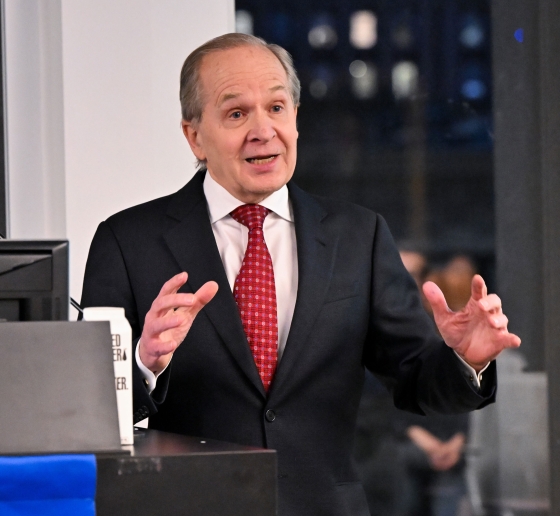
The “long, dark shadow” of absolute priority—a century-old rule dictating who gets paid first in a bankruptcy reorganization—continues to influence today’s complex corporate reorganizations in both substance and procedure, said Douglas G. Baird, Harry A. Bigelow Distinguished Service Professor of Law at the University of Chicago Law School, who delivered this year’s Harvey R. Miller ’59 Lecture in October.
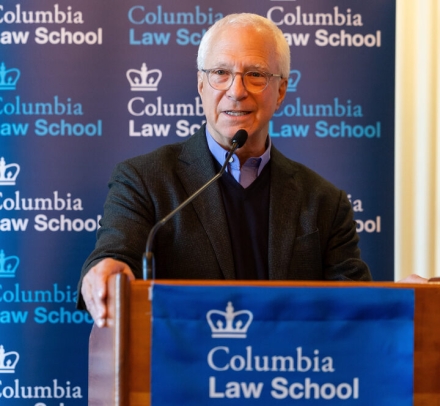
His talk, which examined the evolution and influence of absolute priority, was the fourth in the annual series established by Weil, Gotshal & Manges, where Miller, a Columbia Law alumnus and teacher, established the bankruptcy practice. During his 40-year career at the firm, Miller worked on some of the most notable and historic bankruptcy cases in U.S. history. He was “a legend in the field of corporate bankruptcy law,” said Daniel Abebe, Dean and Lucy G. Moses Professor of Law, in remarks opening the event in Jerome L. Greene Hall’s Case Lounge. For example, during the 2008 financial crisis, Miller orchestrated the reorganization of General Motors and the speedy sale of parts of Lehman Brothers to Barclays. “His legacy of excellence, mentorship, and innovation will continue to inspire generations of legal professionals,” Dean Abebe added.
In her introductory remarks to the students, alumni, faculty, staff, and invited guests in attendance, Ronit Berkovich, co-chair of Weil’s restructuring department, praised Miller’s ability “to lead through complexity with clarity and conviction. He understood that bankruptcy was about more than financial recovery; it was about people, about preserving jobs, and about navigating uncertainty with purpose.”
Baird, who is chair of the National Bankruptcy Conference, explained the history of absolute priority, which entitles senior creditors to be paid in full before junior investors receive anything. He traced its origins as defined by Supreme Court Justice William O. Douglas 1925 in Case v. Los Angeles Lumber Products Co., Ltd., through congressional bankruptcy law reform in 1978, to today, when “lawyers manage negotiations among sophisticated investors fighting for control of giant corporations.” Baird also said that “absolute priority casts a shadow that covers the entire restructuring landscape,” permeating every facet of Chapter 11 practice even as its contours shift over time. That shadow, he added, creates “an environment in which everyone knows they’re a lot better off if they reach a deal with each other [rather] than go to a bankruptcy judge and insist on their legal rights.”
Baird was a fitting addition to the series, which has welcomed retired bankruptcy court judge Robert D. Drain ’84 and restructuring expert Jim Millstein ’82 among its speakers. Berkovich aligned Baird’s academic scholarship with the work of Miller, saying that Baird “bridges the academic and the practical. … His insights help us make sense of the challenges we face in real time as we advise our clients, and his clarity of thought continues to guide generations of restructuring professionals.”