
For the Record: A History of the Law Library Through Artifacts and Treasures
A special exhibition in the Li Lu Law Library’s Milton Handler Rare Books and Manuscripts Room traces the path of Columbia Law School’s origins to the present day.
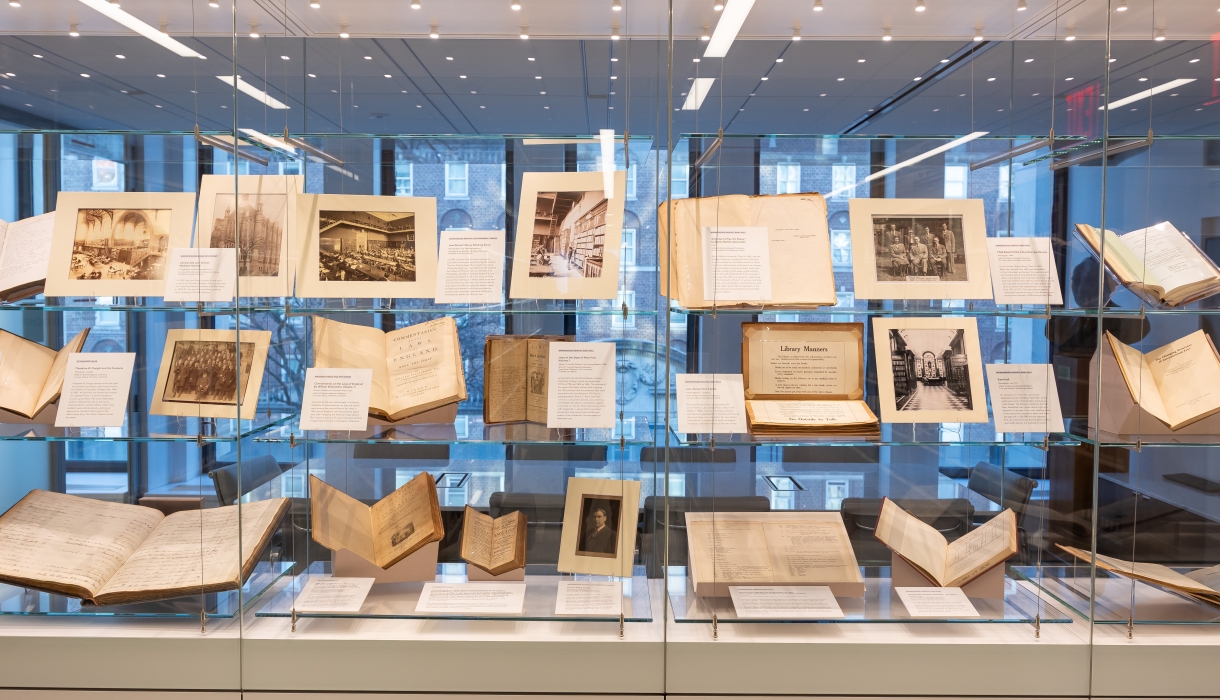
Columbia’s Law Library has been at the heart of the intellectual life of the Law School since its founding in 1858. Over the decades, the library has been housed in numerous locations around New York City, and its wide-ranging collection has evolved alongside the Law School itself.
For the Record: A History of the Law Library Through Artifacts and Treasures, designed to coincide with the opening of the Li Lu Law Library, celebrates this history. The special exhibition features a curated selection of rare artifacts and treasures, drawn from the Arthur W. Diamond Special Collections of the Law Library and Columbia University’s Rare Book & Manuscript Library, that illuminates the shared history of Columbia Law School and the Law Library, and a community long devoted to the pursuit of knowledge, justice, and academic excellence.
Below, see more about each artifact included in the exhibition. Artifacts are divided into six sections representing the location the Law School and Law Library occupied when the artifact was created or acquired.
1859–1873: 37 Lafayette Place
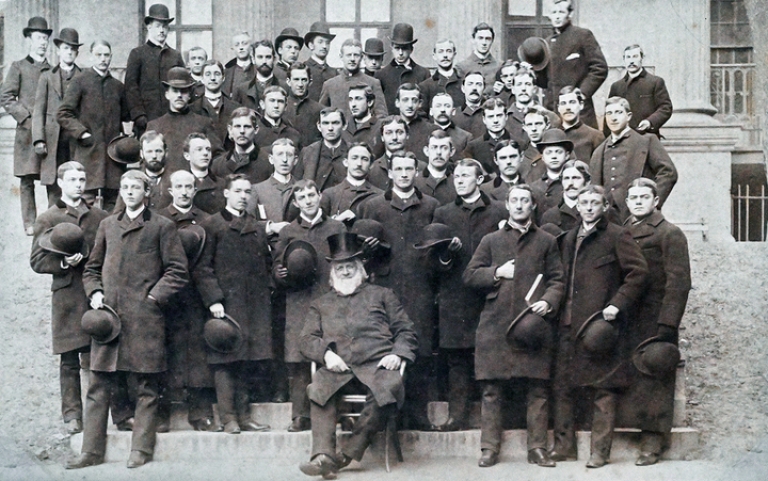
Theodore W. Dwight and His Students
photograph, undated
Theodore W. Dwight served as the first Dean of Columbia Law School, then known as the Law School of Columbia College, from 1864 to 1891. At the time, the school was located at 37 Lafayette Place in a former residence of John Jacob Astor. The Lower Manhattan location offered proximity to the courts, financial district, and law offices where most students were simultaneously working as apprentices. Students had access to the Astor Library (now the Public Theater) across the street.

An Introductory Lecture, Delivered Before the Law Class of Columbia College, New York, on Monday, November 1, 1858, by Theodore W. Dwight, Professor of Law
New York, By the Authority of the Trustees, 1859
This volume contains the first lecture delivered to law students at Columbia by Theodore W. Dwight, who was appointed Professor of Municipal Law in 1858. Dwight delivered his inaugural address at the New-York Historical Society building, located at the corner of 11th Street and Second Avenue, where the school was briefly housed until 1859. Dwight went on to become the Law School’s first dean (1864–1891). During his tenure, Dwight introduced an innovative mode of legal pedagogy known as “The Dwight Method.” In lieu of the prevailing office apprenticeship as a means of legal education, Dwight developed a formal educational approach incorporating lectures, examinations, recitations, quizzes, moot trials, and Socratic dialogue with students.
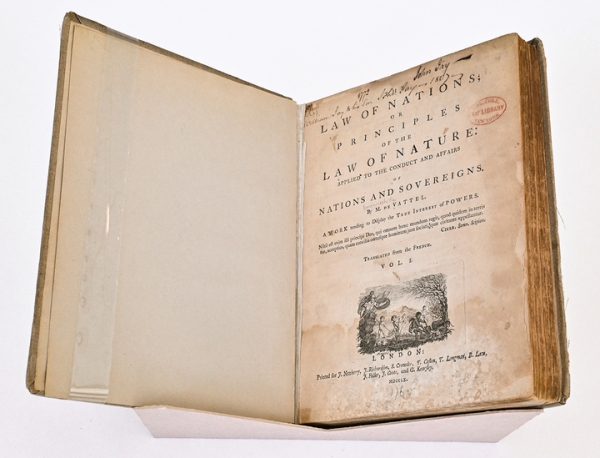
The Law of Nations, or Principles of the Law of Nature, Applied to the Conduct and Affairs of Nations and Sovereigns, by M. de Vattel. Volume 1.
London: Printed for J. Newberry [etc.], 1760
One of the first major collections acquired by the Law School library was donated by John Jay II, who graduated from Columbia College in 1836. Jay was the grandson of John Jay, the first chief justice of the United States, who graduated in 1764 from King’s College (the precursor to Columbia). The 650 volumes in the collection (including the book on view) came to the Law School from the libraries of John Jay and his relatives in 1860.
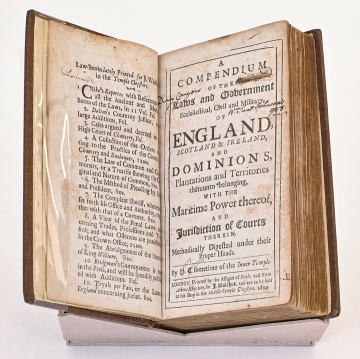
A Compendium of the Laws and Government Ecclesiastical, Civil and Military, of England, Scotland & Ireland and Dominions, Plantations and Territories thereunto belonging, with the Maritime Power thereof, and Jurisdiction of Courts therein: Methodically Digested under their
Proper Heads, by H.C. (Henry Curson)
London: Printed by the assigns of Rich. and Edw. Atkins, esquires, for J. Walthoe ..., 1699
The library of William Samuel Johnson, a signer of the U.S. Constitution who served as the third president of Columbia College (1787–1800), was donated to the school in 1859. The collection contains several volumes dating to the 17th century, including the book on display.
1873–1883: 8 Great Jones Street
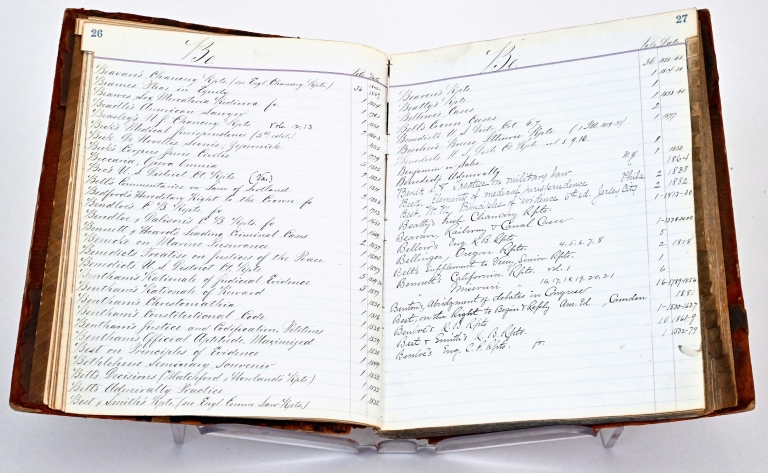
Catalog of Law Library Collection
1879
The Law School grew rapidly in its early years, and by the time it was established in its Great Jones Street location, the school was enrolling classes of more than 150 students. The two-year course of study focused on municipal law, contracts, real estate, equity jurisprudence, commercial and admiralty law, tort law, criminal law, evidence, pleading, and practice.
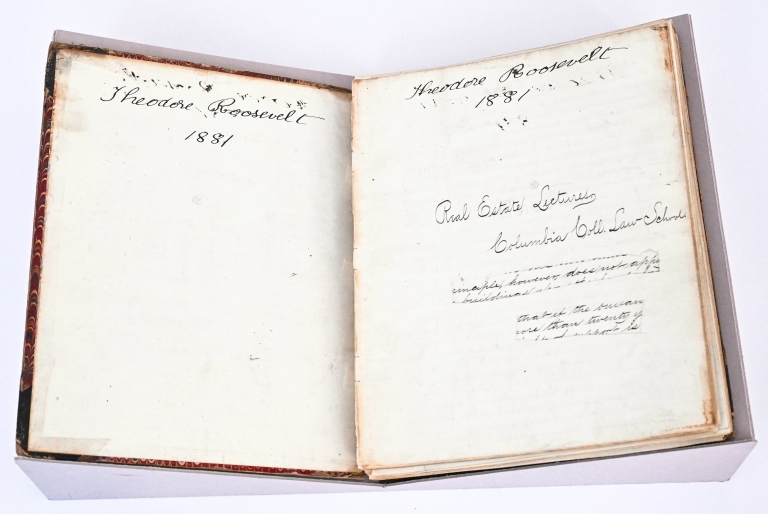
Student Notebook of Theodore Roosevelt
1881
Theodore Roosevelt, the 26th president of the United States, was a student at the Law School from 1880 to 1881. He left the Law School before graduating to serve in the New York State Assembly. He was awarded an honorary LL.D. in 1899, while he served as the 33rd governor of the state of New York.
1883–1897: Madison Avenue and 49th Street
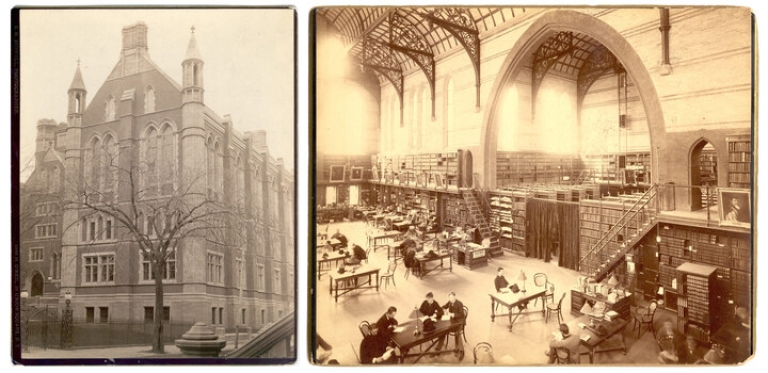
Law School and Library, Madison Avenue
Photographs, undated (reproductions)
In 1883, the Law School moved to the main campus of Columbia College, which at the time was located at Madison Avenue and 49th Street. In 1890–91, the Law School’s library catalog listed holdings of 25,000 volumes.

Columbia Law Register
1875–1891
Hong Yen Chang, Class of 1886, the first Chinese graduate of the Law School and the first Chinese American admitted to practice law in the United States, is one of the signatories in the student register for the 1884–1885 academic year. In 2021, the Law School’s Center for Chinese Legal Studies was renamed the Hong Yen Chang Center for Chinese Legal Studies (张康仁 中国法律研究中心).
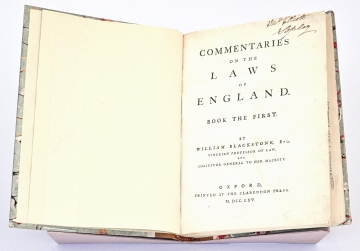
Commentaries on the Laws of England, by William Blackstone. Volume 1.
Oxford: Printed at the Clarendon Press
1765
Acquired by the Law School early in its history, Blackstone’s Commentaries, as they are known, were among the most influential law texts in 18th century England, and they played a significant role in shaping the American legal system. This volume is just one of many important artifacts of legal history housed in the special collections.
1897–1910: Morningside Heights, Low Memorial Library
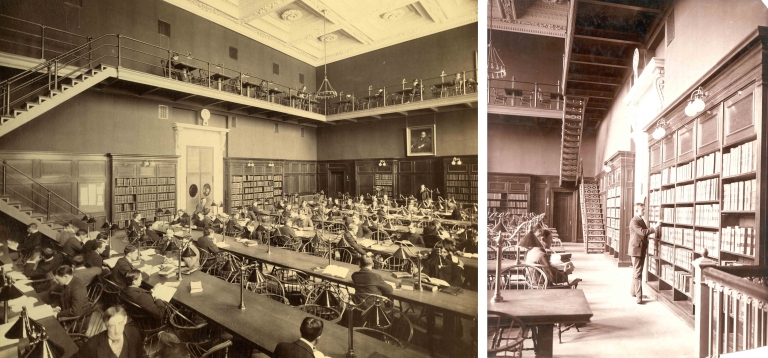
Law School Library Reading Room
Photographs, circa 1904 (reproductions)
In 1897, the Law School moved uptown to Columbia University’s new Morningside campus. The Law School shared the majestic University Library Building (now Low Memorial Library) with the School of Political Science, the School of Philosophy, and the university’s library. The Law School was located in the north wing, with the ground floor serving as a library stack room and the main floor as a reading room surrounded by open stacks for the most popular books. Library facilities were shared, providing law students access to the university’s extensive holdings in international, public, and Roman law.
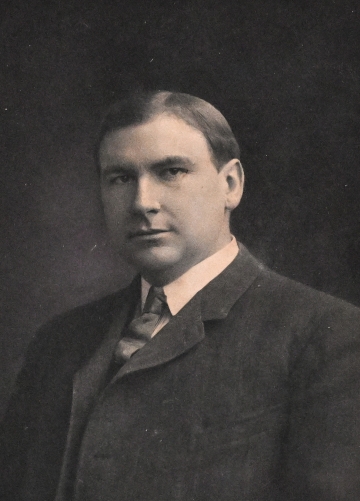
Harlan Fiske Stone
Photograph, circa 1899
Harlan Fiske Stone, Class of 1898, was an influential figure in the histories of Columbia Law School and the United States. He began teaching at the Law School the year after he graduated, around the time he posed for the rare photo displayed, and served as dean from 1910 to 1923. In 1924, he was appointed attorney general of the United States, and the following year he joined the U.S. Supreme Court as an associate justice. He served as chief justice of the United States from 1941 until his death in 1946.
1910–1961: Morningside Heights, Kent Hall
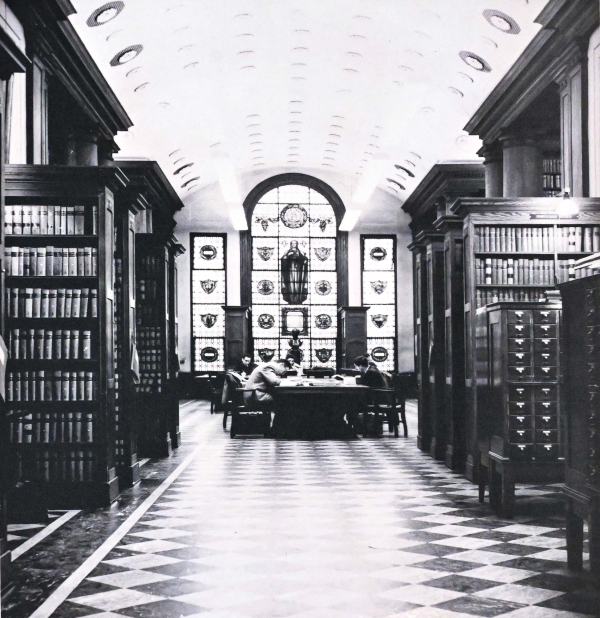
Kent Hall
Photograph, circa 1910
On October 31, 1910, the Law School dedicated its own building, Kent Hall, on the northwest corner of Amsterdam Avenue and 116th Street. The library, located on the main floor, benefited from good natural light and featured 12 alcoves in the main reading room, 10 alcoves at the mezzanine level, and stack storage with a 100,000-volume capacity. The Law Library’s large stained glass window depicts the goddess of justice.
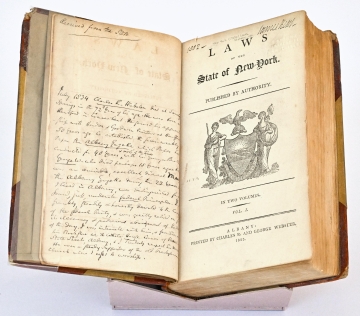
Laws of the State of New-York, Volume 1
Albany: Printed by Charles R. and George Webster, 1802
James Kent was the first professor of law at Columbia College, where he taught from 1793 to 1798 and 1823 to 1826. This volume of the Laws of the State of New-York is among the 750 volumes from his collection that were donated to the Law School in 1911 by his great-grandson, Edwin C. Kent. The Kent collection comprises treatises, laws, American and English law reports, dictionaries, digests, and works on civil law. Most volumes are filled with marginalia in James Kent’s own hand. James Kent was a prominent scholar and author of the influential Commentaries on American Law.

Roman Law (Medieval) Classification in the Columbia University Law Library, by A. Arthur Schiller
Circa 1931
The Law Library’s local classification system for foreign law was named after its creator, A. Arthur Schiller, a professor at Columbia Law School from 1928 to 1971 who was widely regarded as an expert on Roman law and on the legal systems of the world. His first classification schedules (of Ancient, Roman, Roman medieval, Germanic, and Primitive law) date from 1931. Schiller designed the system specifically for Columbia and divided it by jurisdiction (unlike Dewey’s geographical approach), then further by subject. Beginning in 1933, the Law Library undertook a reclassification project for the entire foreign law collection (approximately 40,000 volumes) based on Schiller’s system. Updates to the system continued to be published until 1964, and it continued to be in use until 2022, when it was fully replaced with the Library of Congress classification system for foreign law.
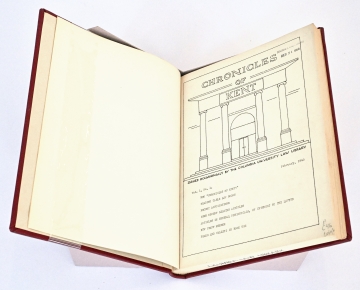
Chronicles of Kent, Volume 1, Number 1
February 1940
In 1940, Law Librarian Miles O. Price launched this publication, aimed at improving communication with the faculty. Its mimeographed pages feature highlights of recent acquisitions, as seen in the example on display, as well as lists of the most used law books, notes from moot court proceedings, and library news.

Law Library Forms Book
“Library Manners,” undated
This original document, produced by the Committee on Law Library Ethics, likely in the 1920s or 1930s, outlines the proper behavior and decorum expected from students while using the Law Library. It is included in the Law Library Forms Book, a scrapbook of cards, envelopes, handouts, and flyers related to the Law Library.
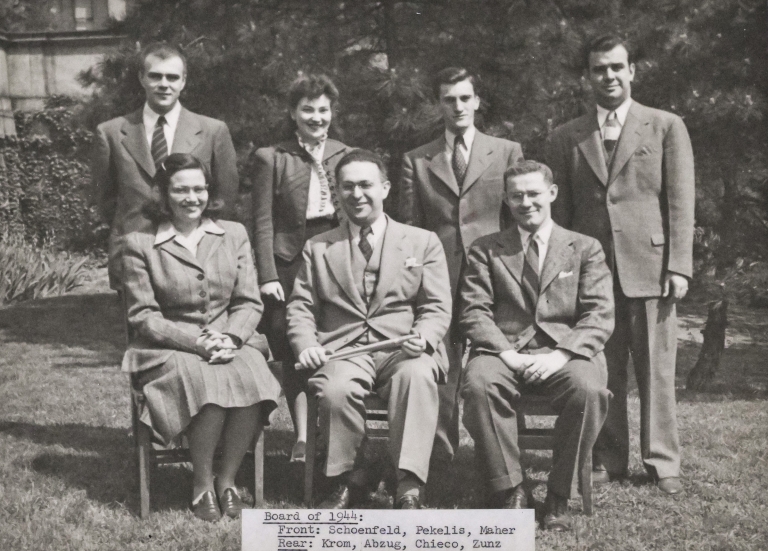
1944 Board of the Columbia Law Review
Photograph, 1944
In Law School, Bella Abzug, Class of 1945 (back row, second from left), served as editor of the Columbia Law Review. She was a student at Columbia Law during World War II—a time when many young men were serving in the military and more women were able to enroll. Abzug would later become a renowned civil rights lawyer and serve as a New York representative in Congress from 1971 to 1977. The Law Library’s special collections include an array of Law Review board photos from the early 1900s through the 1980s.

“A Student’s Plan for Peace,” by Elreta Melton Alexander
1945
Elreta Melton Alexander, Class of 1945, was the first Black woman to graduate from Columbia Law School and the first Black woman in North Carolina to be licensed and practice as a lawyer, to argue before its Supreme Court, and to be elected a judge. In this essay, written shortly before the end of World War II for a course in labor law, she offers a proposal for addressing “conflicting points of view” of various countries, groups, and individuals on socioeconomic and human rights issues “for incorporation in the peace treaty that is formed at the end of the present conflict.”
1961–Present: Morningside Heights, Jerome L. Greene Hall
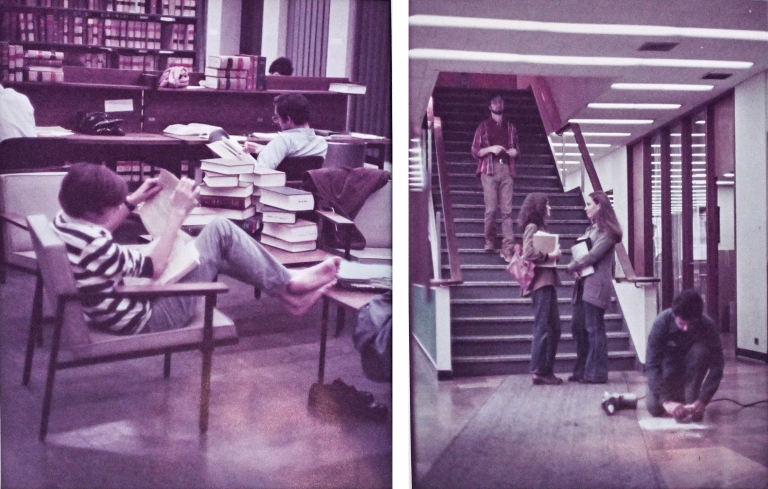
Students in the Law Library
Photographs, circa 1976
When the Law School moved to its new building (now Jerome L. Greene Hall) in 1961, the Law Library occupied four whole floors in the building; in addition, parts of three other floors provided shelving for approximately 600,000 volumes. The library’s open stacks provided users with easy access to books. Special reading rooms included the most-used materials, such as reports, statutes, digests, and law reviews, to facilitate study in particular fields of interest.
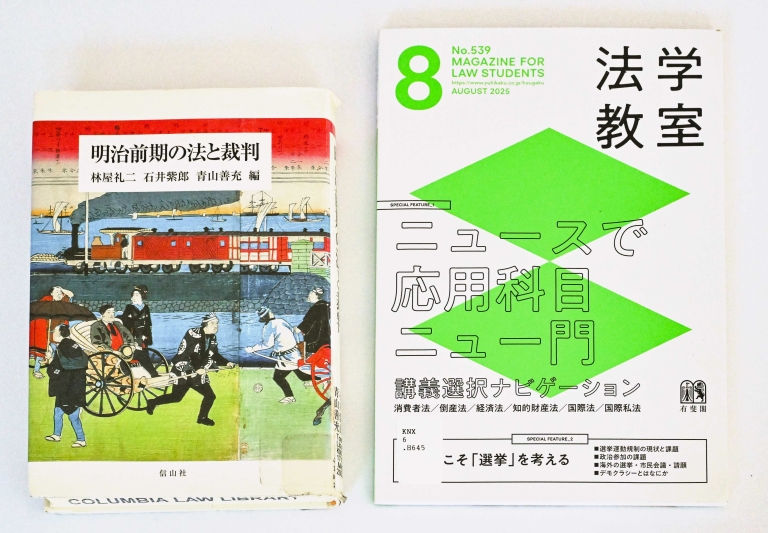
明治前期の法と裁判 (The Law and Judicial System in the Early Meiji Period)
Tokyo: Shinzansha, 2003
法学教室 (The Legal Workshop)
Tōkyō: Yūhikaku, 1980–Present August 2025 issue
In 1991, the Law Library received a substantial gift from the Toshiba Corp. to establish the Toshiba Library for Japanese Legal Research. 明治前期の法と裁判 (The Law and Judicial System in the Early Meiji Period), above left, from the Toshiba Library is an example of a monograph on the history of Japanese law. The largest Japanese law library among U.S. academic institutions, the Toshiba Library includes the private collection of former Supreme Court Justice of Japan Jiro Tanaka. The current periodical, 法学教室 (The Legal Workshop), above right, is another example from the Toshiba Library for Japanese Legal Research; subscriptions are kept up-to-date.
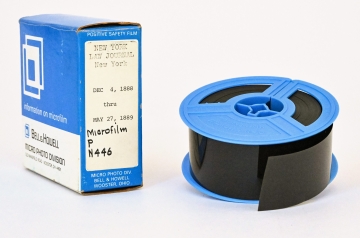
New York Law Journal
Microfilm
March 26, 1888–December 3, 1888
During the 1960s and 1970s, the Law Library began acquiring research materials on microfilm, which was threaded onto a microfilm reader, a device that uses a lens and a source of light to magnify miniaturized text and images printed on a roll of 16 mm film or 35 mm film. The Law Library’s microfilm collection includes the New York Law Journal from its first issue, March 26, 1888 (on display), through present. The Law Library contains a substantial collection of microforms of every sort, from microfilm (e.g. League of Nations Treaties) to microcards (e.g. Organization of American States documents) to microfiche (e.g. New York Court of Appeals records and briefs).
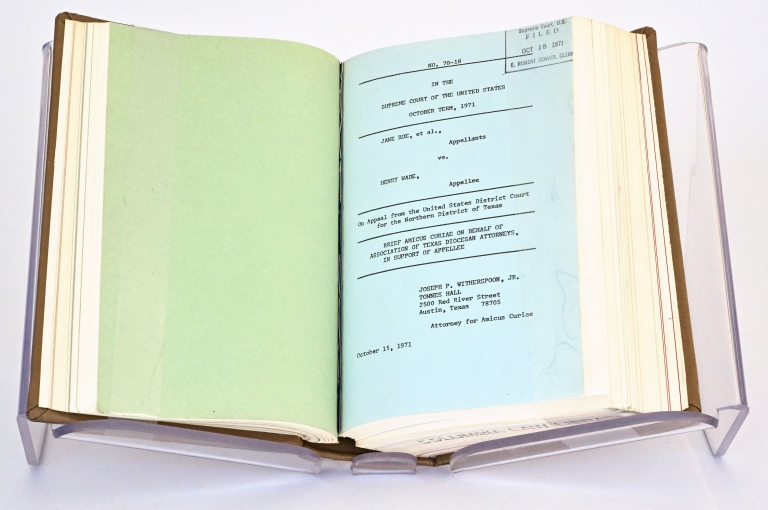
U.S. Supreme Court Records and Briefs
October Terms, 1970 and 1971
The Law Library began serving as a repository for records and briefs from the U.S. Supreme Court when former Law School Dean Harlan Fiske Stone, Class of 1898, was appointed to the court in 1925. (Stone served as chief justice of the United States from 1941 until his death in 1946.) On display is one of the Roe v. Wade briefs from the first argument in 1971. The Law Library ceased being a repository for printed U.S. Supreme Court materials in the 1990s.
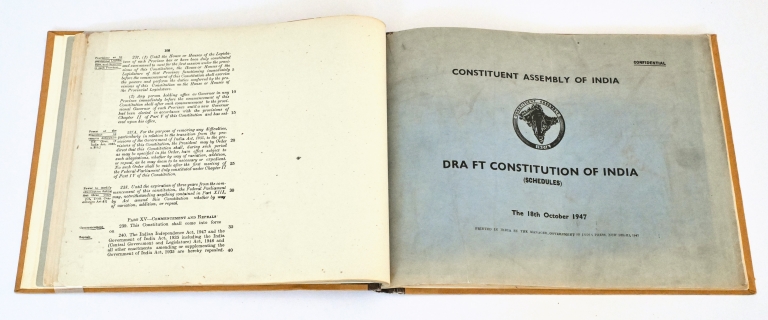
Draft Constitution of India
New Delhi: Printed by the Manager, Govt. of India Press, 1947
One of the particular strengths of the Law Library’s foreign law collection is its focus on constitutional law. Among the library’s more than 200,000 foreign law titles is this rare edition of the Draft Constitution of India by the Constituent Assembly of India, one of only 15 copies in existence. The Law Library gathers primary and secondary legal materials from nearly every country, enabling scholars to conduct detailed research into most foreign legal systems.
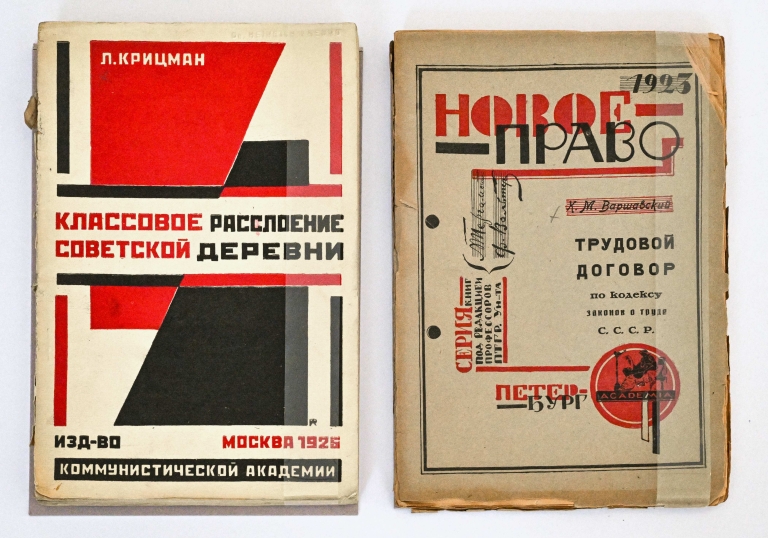
Классовое расслоение в советской деревне. / Л.Н. Крицман (Class Stratification in the Soviet Village. / L.N. Kri(tsman)
Moskva, Izdatel’stvo kommunistichesko˘ı akademii, 1926
Трудовой договор: по кодексу законов о труде 1922 г. / К.М. Варшавский (Employment Contract: According to the Labor Code of 1922. / K.M. Varshavskiĭ)
Peterburg, Academia, 1923
In the 1970s and 1980s, the Law Library acquired an extensive collection of early, rare Soviet law publications that belonged to John N. Hazard, a leading American scholar of Soviet law and one of the pioneers in the field of Sovietology. Hazard joined the Law School faculty in 1946, and he was also a founder of the Russian Institute at Columbia University, now the Harriman Institute, the first academic center in the United States dedicated to Russian-Soviet studies.
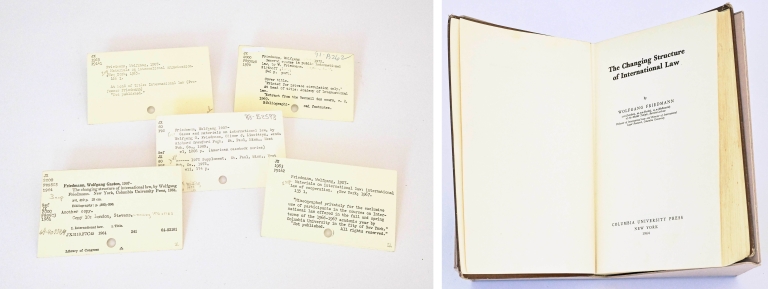
Card Catalog Cards and The Changing Structure of International Law, by Wolfgang Friedmann
New York, Columbia University Press, 1964
For generations, Columbia Law students found resources using the Law Library’s card catalog. Displayed are typed catalog cards for books by Professor Wolfgang Friedmann, who founded the Columbia Journal of Transnational Law, as well as one of his books. The Law Library launched its own online catalog in 1987, but the transition from card catalogs to the online catalog happened gradually over the years. In 2025, the Law Library joined the university’s CLIO online catalog.
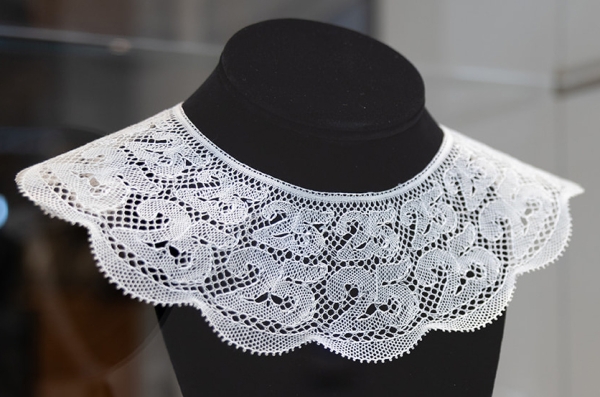
Collar of U.S. Supreme Court Justice Ruth Bader Ginsburg
Lace, 2018
In honor of the 25th anniversary of the investiture of Ruth Bader Ginsburg, Class of 1959, to the U.S. Supreme Court, Columbia Law School commissioned Elena Kanagy-Loux of the Brooklyn Lace Guild to create a one-of-a-kind lace collar with a custom pattern of interlocking 25s. Following the death of Justice Ginsburg, the collar was gifted to the Law Library by her daughter, Jane C. Ginsburg, Morton L. Janklow Professor of Literary and Artistic Property Law. It is among the RBG objects and ephemera in the Law Library’s Special Collections.
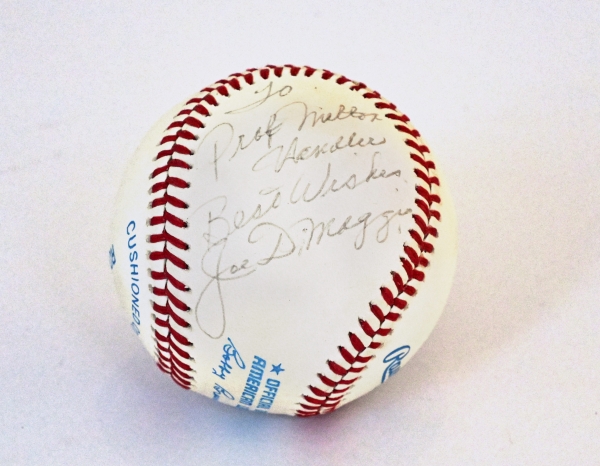
Baseball inscribed to Professor Milton Handler by Joe DiMaggio
Date unknown
Professor Milton Handler, a member of Columbia College’s Class of 1923 and the Law School’s Class of 1926, received this signed baseball from Yankees great Joe DiMaggio. They were both awarded honorary degrees from Columbia University in May 1990. Handler was a prominent antitrust scholar and litigator who taught at the Law School for 45 years. He was President Franklin D. Roosevelt’s leading antitrust adviser and served as the first general counsel to the National Labor Relations Board. The Law Library’s Milton Handler Rare Books and Manuscripts Room, which houses this exhibition, is named for him.
