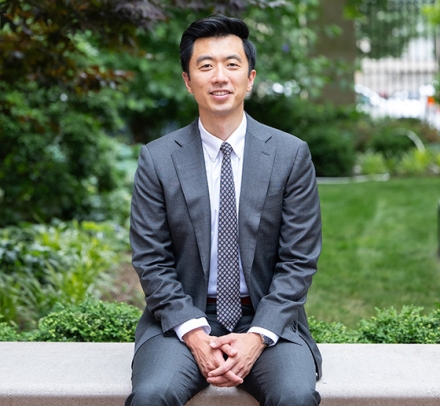
Nicole Smith Futrell: Addressing Post-Incarceration Challenges
Smith Futrell, an expert in criminal law and mass incarceration, joins the Columbia Law School faculty to lead a new clinic focused on post-conviction and reentry advocacy.

As a public defender fresh out of law school, Nicole Smith Futrell represented many clients experiencing initial contact with the criminal legal system. Now, as a Columbia Law School clinical professor of law, she will lead students through the other end of the odyssey: the challenges clients face after conviction and incarceration.
Smith Futrell, who joined the Law School faculty January 1, sees the clinic as a new chapter in the Law School’s long and distinguished history of clinical work within the criminal legal system. “Columbia Law School is a space where this work has been pioneered and continues to flourish,” she says. “There is a deep and rich commitment to ensuring that incarcerated and formerly incarcerated people have meaningful access to rights, dignity, and opportunity.”
Finding a Sense of Purpose
As an undergraduate at Rutgers University, Smith Futrell studied political science, and, after a semester in South Africa, she entered Georgetown University Law Center thinking she would focus on human rights or international development. Her participation in two different law school clinics changed her path. The first, the Street Law clinic, introduced her to teaching: She taught high school students in Washington, D.C’s, Anacostia neighborhood about their legal rights and led them through a city-wide mock trial tournament. The second, a criminal defense clinic, helped her develop her litigation skills and gave her an up-close look at the impact of the criminal legal system on the lives of low-income individuals.
The work with criminal defense clients was a revelation, she says. “You are intervening at what is often the most devastating moment of someone’s life, and also trying to understand all of the pieces of the puzzle—the forces and experiences that led them to that particular moment,” she says. “Participating in clinics completely transformed my thinking about how I wanted to use the law to serve others, and I walked away with a profound sense of clarity and professional purpose.”
Smith Futrell went from law school to working as a staff attorney at The Bronx Defenders, an interdisciplinary public defender office, where she currently serves as vice-chair of the board of directors. She also spent a year at Columbia Law School in 2007–2008 as a part-time career counselor for public interest law students. The “incredibly focused, curious, and enthusiastic” Columbia students she met helped inspire her transition to academia, Smith Futrell says. “That experience reminded me of how much joy I find in mentoring and collaborating with students.”
At CUNY School of Law, where she taught from 2009 until her appointment at Columbia Law, Smith Futrell served as co-director of the Defenders Clinic, director of the Center for Diversity in the Legal Profession, and faculty director of the W. Haywood Burns Chair in Human and Civil Rights Program. Reflecting on her work in the clinic, she says, “Many of our clients, people who entered prison decades ago on life sentences, had undergone extraordinary transformations, and our students used creative legal strategies to successfully help them return to their communities.”
Smith Futrell’s scholarship draws from her practice and teaching experience to explore how organizing and advocacy on behalf of socially subordinated groups shape the rules, policies, and institutional practices of the criminal legal system. She has written and spoken extensively on the legal profession’s responsibility to address post-incarceration racial inequity, the role of prosecutorial conduct in wrongful convictions, and the intersections between systemic advocacy, professional ethics, and clinical pedagogy. She has published articles in North Carolina Law Review, N.Y.U. Review of Law & Social Change, and Ohio State Journal of Criminal Law, among others.
Addressing the ‘Long Pathway’
In Smith Futrell’s new clinic, she plans to expand on her previous post-conviction practice by adding reentry advocacy. Students will work with incarcerated people seeking post-conviction relief, such as sentence reductions, and with formerly incarcerated individuals who are facing obstacles in obtaining employment, housing, health care, or government benefits as a result of their criminal legal history. “The clinic is designed to help people whose access to freedom and opportunity, broadly defined, has been diminished or even completely extinguished because of a criminal conviction,” Smith Futrell says.
Smith Futrell describes the clinic as a natural complement to the Criminal Defense Clinic directed by Amber Baylor, clinical professor of law. “The Criminal Defense Clinic plays an essential role in preparing students to deliver outstanding frontline, trial court representation, and the addition of a post-conviction clinical offering allows students to see the long pathway of the criminal legal process from arrest to sentence to community reentry,” Smith Futrell says. “Reentry work, in particular, bridges criminal and civil practice, which creates opportunities for collaboration with all of Columbia’s exceptional clinics.”
Students will work with some individuals while they are incarcerated, helping them through the process of applying for parole, resentencing, or other relief—“people who have served lengthy sentences and have demonstrated real evidence of progress and rehabilitation, who are now working against impossible odds to get released and reconnect with their families and communities,” she says. “Clinic students are the last hope for many of these clients.”
The clinic’s work with those who are out of prison will be responsive to client and community needs. Smith Futrell says that “there is an access-to-justice gap for people who are on probation, parole, or other community supervision and facing challenges with housing, employment, public benefits, or even just with the terms of their supervision.” She also sees potential advocacy for “people who are eligible for sealing of past convictions or correction of criminal record errors.” Cases handled through the clinic will often involve direct representation, advocacy, and public education. Students will reinvestigate cases, draft legal filings, counsel clients, participate in community-based workshops, and visit jails and prisons. Smith Futrell plans to have students work with organizations to do the “affirmative work of reentry” by broadening views about what people who were previously incarcerated can add to society, particularly through entrepreneurship and leadership. “There are lots of exciting projects that are cultivating formerly incarcerated people as leaders in their respective areas of interest and expertise,” she says.
The clinic will exist alongside other Law School and university initiatives that bring together students and formerly incarcerated individuals, including the Paralegal Pathways Initiative, the project to revise A Jailhouse Lawyer’s Manual, and the Center for Justice. It also follows in the footsteps of past clinical offerings, such as the Incarceration and the Family Clinic, and the Challenging the Consequences of Mass Incarceration Clinic, which were taught by Professors Philip Genty and Brett Dignam, respectively.
From Public Defender to Clinical Professor
The arc of Smith Futrell’s academic work has echoed her professional trajectory from public defense to clinical teaching in post-conviction and reentry. “I moved from focusing on the front end of the system to the back end of the system,” she says. “The connecting piece is trying to understand how legal advocates and social justice movements can create changes in the practice and the administration of criminal law to effectively serve the most vulnerable.”
She describes a “pendulum” in changing attitudes toward incarceration and criminal legal reform. “The ways we are thinking about how and why we punish people, the role of lawyers and advocates, and how we demand systemic change for marginalized people has long been characterized by progress and retrenchment,” she says. “My work seeks to engage with that history, to reflect on it thoughtfully, and make meaningful contributions and interventions.”
Smith Futrell is a founding member of Accountability NY, a group of academics and civil rights lawyers pushing for greater transparency and responsiveness in cases of prosecutorial misconduct. In 2022, she was awarded a Writing as Activism Fellowship by the NYC Literary Action Coalition and PEN America, a nonprofit organization dedicated to free expression worldwide.
Activism and advocacy, Smith Futrell says, are part of her brief as a practitioner and a teacher. “One of the most beautiful parts of being a clinical professor is that you have a responsibility to take what you witness in practice, and reflect it back to others,” she says, “so that they have a better understanding of where our system is falling short, and where improvements can be made.”