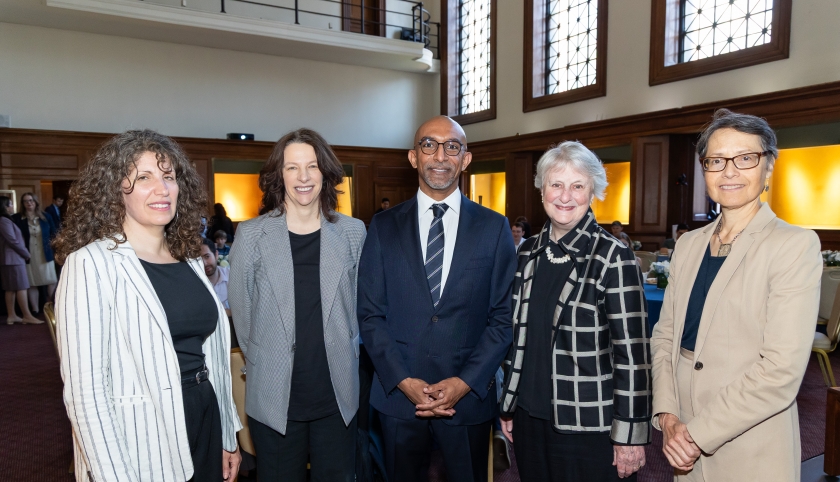
Columbia Law School’s Weil, Gotshal & Manges Distinguished Jurist Speaker Series Launches With Judge Brian E. Murphy ’06
The judge for the U.S. District Court for the District of Massachusetts joined Dean Daniel Abebe for a fireside chat and spoke about his path to the law, the nuances of sentencing, and the value of clerking.
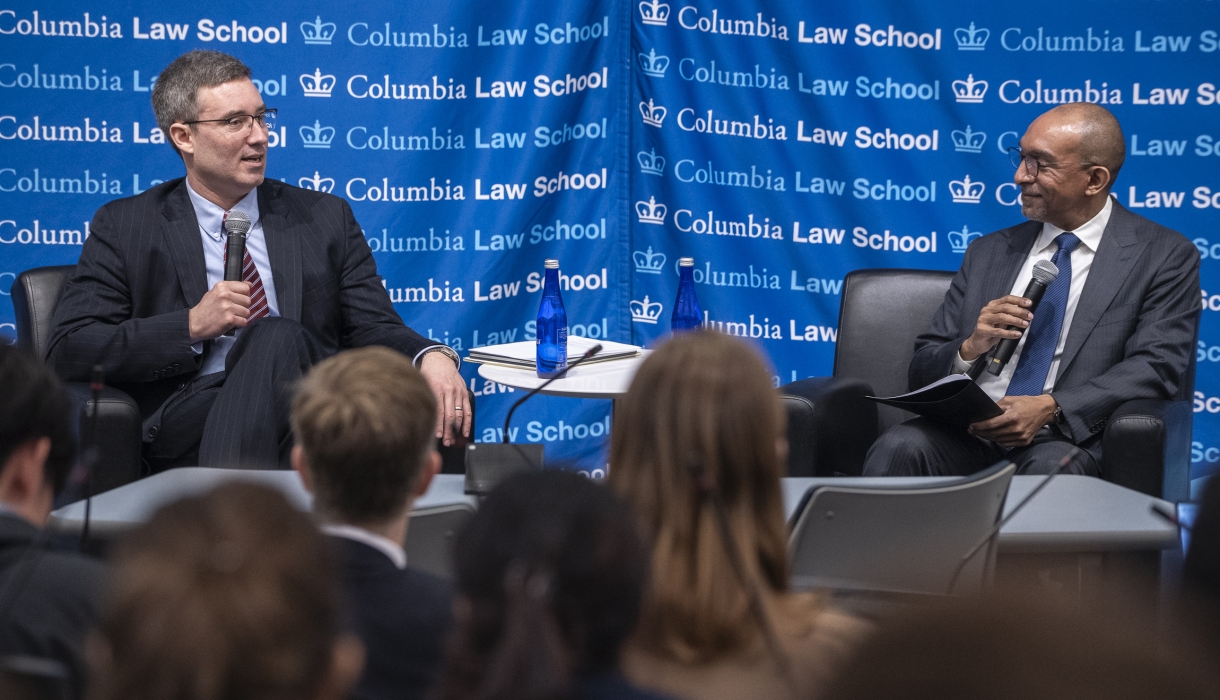
As a longtime defense lawyer with dozens of criminal trials on his résumé, Brian E. Murphy ’06 figured the toughest part of his new job as a federal district court judge would be adjudicating civil cases. While the firm he founded handled civil work, Murphy said, he was more drawn to work that involved charges of first-degree murder.
Sentencing, he thought, “is going to be easy.” It turned out to be the opposite: “I have lost sleep over whether to give someone 10 years or 10 years and six months,” he said. “I’ve carried that piece around with me for a week and a half, wrestling with that decision.”
Murphy, who was appointed to the U.S. District Court for the District of Massachusetts in December 2024, talked about the difficulties of sentencing decisions as part of his conversation with Daniel Abebe, Dean and Lucy G. Moses Professor of Law, during the inaugural event of the Law School’s Weil, Gotshal & Manges Distinguished Jurist Speaker Series, held April 22.
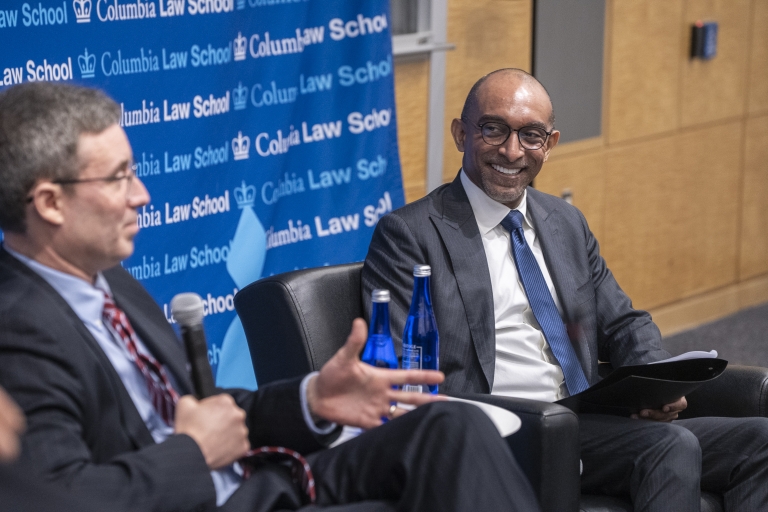
The new program brings accomplished jurists from across the country to campus each year for a full-day visit. In conjunction with the Law School’s Weil, Gotshal & Manges Judicial Clerkship Training Institute, the events are designed “to foster deeper engagement and dialogue between Columbia Law School and the judiciary,” Dean Abebe said at the event, and “to strengthen the pipeline from Columbia Law School to clerkship opportunities at various courts across the country.”
Sentencing: The Difficult Middle
During his conversation with the Dean, Murphy described the challenges of sentencing, especially when mandatory minimum sentences take away flexibility. A sentence should be “appropriate to accomplish the goals of sentencing, but no more than that,” Murphy said, and in most cases, it’s hard to determine whether extra months or years on a sentence are useful as a deterrent against future crimes for the individual or for society at large.
“My judicial philosophy is to try to follow that rule: Give no more of a sentence than is necessary. But it is tremendously difficult to come up with the right answer for that,” Murphy said. “If I, as a judge, believe there is no way to stop this person from committing another offense than to lock them up forever, OK, that’s easy enough. And in the same respect, if I think there’s no way this person will ever commit a crime again, that is also easy enough to say, OK, supervised release or probation. But everything in the middle is hard.”
Finding a Path to the Law
Murphy applied to law school when, during his first post-college job at a nonprofit agency working to help people without housing, he was impressed by the staff attorney’s efficacy. “I was a 21-year-old college graduate who couldn’t do much more than beg with people to try to do things better,” he said. “This lawyer could really do things for people. And so she’s the reason I went to law school.”
At Columbia Law, Murphy was inspired to pursue criminal defense by his work on A Jailhouse Lawyer’s Manual—he was editor-in-chief of the Columbia Human Rights Law Review, which publishes the manual—and by his experience in the Incarceration and the Family Clinic taught by Philip Genty, Everett B. Birch Innovative Teaching Clinical Professor Emeritus in Professional Responsibility.
Murphy began his career as a public defender for the Massachusetts Committee for Public Counsel Services. “Working with people who are dealing with the consequences of the worst day of their life ended up being really attractive to me,” he said. He also quickly gained courtroom experience.
“If you want to be a litigator, you’ve got to go do criminal work, right? Nobody else is going to try 15 cases in the first year that they’re in the world,” he said. “You can’t even begin to try to be a good trial attorney until you’ve done it a dozen times. You have to get over the nerves of standing up in front of a jury, and the nerves of cross-examining someone … Then, when you do a deposition and someone’s not answering your question, you know how to do it because you’ve done this in front of a jury with someone who’s a professional witness like a police officer. That set of skills is really hard to develop outside of that area.”
Five years later, Murphy started his own practice, despite the fact that his wife was working as a public defender and the couple had two children. “It was terrifying. I had cluster headaches every night,” he said. “But it was the best decision I’ve ever made.”
He said that running a law firm “is a very different set of skills” than practicing criminal law, and it led him to think perhaps he should have pursued a joint J.D./MBA degree. Murphy focused on court-appointed work for the defense, often in murder cases—“my favorite cases”—which, he explained, usually go to trial because Massachusetts does not have a death penalty option to prompt a plea bargain. “Say what you will about the death penalty, it does provoke a compromise,” Murphy said.
Advice: Say Yes to Clerking
Murphy encouraged the students attending his talk to pursue clerkships, regardless of where the job is located. He said he regrets having pursued clerkships only in Boston and, since he didn’t get one, not having a clerkship experience at all. Regardless of location, he said, clerks “basically all do the same stuff. And clerking is an unbelievably good experience.”
Asked by Dean Abebe what qualities he seeks in clerks, Murphy said that he looks for those who will fit in with “this odd community” of his chambers: “I very much expect my clerks to critique each other and to critique me,” he said. “And that can be a hard thing to do.”
The broad experience gained by clerking is invaluable, Murphy said. “One of my colleagues described clerking as all the benefits of being a judge but without having to take responsibility. And I think that that’s fairly true,” he said. “Clerks are intimately involved in the decision-making, and they’re talking about the legal thinking, and they talk about the case. … It is a year where you will put in a lot of time, and you will perseverate a lot—as you should. But it’s an incredible experience.”