
Two Distinguished Jurists Discuss Civil Discourse Across Difference
Columbia Law School’s Distinguished Jurist Speaker Series welcomed Judges Benjamin Beaton ’09 and Richard F. Boulware II ’02 for a conversation with Dean Daniel Abebe.
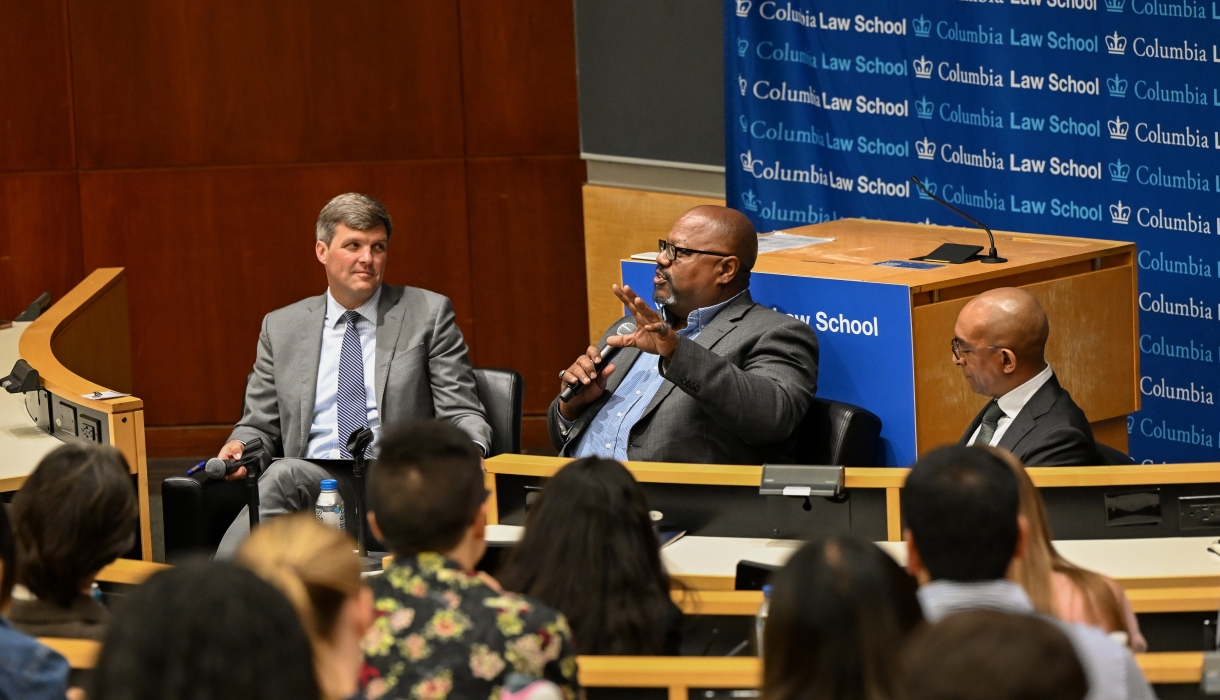
In September, Benjamin Beaton ’09, U.S. District Court Judge for the Western District of Kentucky, and Richard F. Boulware II ’02, U.S. District Court Judge for the District of Nevada, joined Daniel Abebe, Dean and Lucy G. Moses Professor of Law, for “Civil Discourse & Dialogue Across Difference,” a Weil, Gotshal & Manges Distinguished Jurist Speaker Series event. During the lunchtime conversation, held on Constitution Day, the judges discussed their journeys to the judiciary, the value of clerking, and their strategies to encourage civil discourse across philosophical and political divides. Beaton was appointed in 2020 by President Donald Trump; Boulware was appointed in 2014 by President Barack Obama.
“I think we live in a world where the discourse is more and more corrosive. People are pulled to their sides, if you will, and the debate doesn’t really happen in a way that advances knowledge,” said Dean Abebe. By contrast, he said, the Law School “is an environment in which we engage constructively, and we do so in a way that’s grounded in respect. … There is a productive discomfort that comes from learning, from broadening your understanding and perspective, from exiting the bubble of the friends that you know and exploring the opportunity for relationships with those that you don’t. That risk … is well worth the payoff. And I think you can see an example of exactly that in Judges Boulware and Beaton.”
The event was the second in the series, which brings accomplished jurists from across the country to campus for full-day visits designed to deepen the Law School’s engagement with the judiciary and strengthen the pipeline to judicial clerkships.
Byways to the Bench
During the wide-ranging conversation, the judges discussed their career paths. Describing himself as “a bit of a gunner” in law school, Beaton recalled harboring an aspiration even then to become a federal judge: “I caught that bug early on and never really shook it,” he said.
He initially practiced appellate law, then worked as a regulatory and trial lawyer. “I liked being an appellate lawyer and a regulatory lawyer or trial lawyer. I think that is a sweet spot if you really enjoy playing right-handed—so to speak—as a legal issues and advocacy guy, but also left-handed, as someone who can stand up and put your money where your mouth is in front of the jury or a judge.”
It was during trial work, when he was asked by his firm to take on a pro bono civil rights case for a man who had been beaten by police after a high-speed car chase, that he said he realized he could one day become a judge.
“Being a, yes, Sidley Austin senior associate on a fancy partnership track in D.C., but then assigned a civil rights case in Danville, Virginia, and deposing sheriff’s deputies who were very unhappy to be sitting across from the Columbia lawyer—that is what gave me the belief that, hey, maybe I won’t grow up to just be a fancy appellate lawyer. Maybe, one day, [I’ll be] a judge,” he said. “You can do this stuff, too. And man, is it meaningful, and man, can it be fun.”
Boulware’s great-uncle, civil rights lawyer Harold Boulware, who was co-counsel in the landmark Brown v. Board of Education case, inspired him to join the legal profession, but he said his decision crystallized watching Deputy White House Counsel Cheryl Mills, a young, Black attorney, defend President Bill Clinton during his 1999 impeachment trial. “What I realized in that moment is that the law touches everything and all that we do. And I said, ‘I want to be a part of that,’” he said. “I want to be in a profession where I can have impact. And I knew that the law was going to lead me there.”
Boulware was initially reluctant to become a federal judge because he loved being a federal public defender—but the opportunity to become the first public defender, and the first Black man, on the federal bench in Nevada convinced him to take the judgeship. “I had spent too many years as a federal defender, gracefully groveling before judges who I thought were not respecting my clients,” he said. “I took the bench to be intentionally disruptive from the standpoint of saying, ‘I want this place to look different for people who don’t have resources and people who look like me.’ … I wanted [people] to feel like no matter what happened in that courtroom, they would know that someone looked them in the eye and said, ‘I see you, and I hear you.’”
Making Space for Dialogue Across Difference
The two judges, who often undertake joint speaking engagements, met and became friends at a retreat designed to foster relationships and communication among different levels of the judiciary. They said that recognizing the other’s fundamentally good intentions and finding areas of commonality despite their differences was key to their camaraderie.
“You will not grow intellectually and emotionally unless you take the risk to spend time with people who are completely different from you,” Boulware said. “And you can sit with this discomfort and work through that together and develop a deeper and closer bond. [Beaton and I] are closer as friends because we recognize the risk that we took to open up to each other.”
Boulware continued that the process “starts with saying, ‘I recognize that he is coming from a position of well intentions and trying to do good as well as I am.’ And I’m not going to start from the assumption that he doesn’t really care about the things that I care about. … We are good friends because we respect that fundamental part about each other, and we cultivate that in our friendship.”
Developing opportunities for civil discourse across differences takes effort on both personal and institutional levels, Beaton said. “These sorts of relationships, these sorts of events, conversations in our frictionless, largely digital world, you can’t count on them to happen automatically. You can live a full and rich life not running into people who disagree with you or have radically different backgrounds from you, don’t look like you, at the grocery store or church in the way our parents had on a regular basis.”
Speaking to the students in the audience, Beaton said that “now, even compared to when we were sitting right where you are, it’s important to acknowledge that interacting with others with different backgrounds, with different interests … is still equally, if not more, important. But it’s not going to happen on its own,” he said. “A greater degree of intentionality is demanded from the academic leaders, the professors, and indeed from you all to have conversations that get you out of your own headspace, your own lane, your own locker room, and make you more sensitive and other-centered in a way that will help you both in choosing the way and ensuring that you’re in the right direction for your career.”
To accomplish this, Beaton added that it also requires learning to listen. “You’re here to learn, and even in the next phases of your career, when you’re working, when you are negotiating, when you’re litigating, I would encourage you to continue working that muscle to listen first, find an area of common ground, and then speak.”
The Value of Clerking
The judges also discussed their post-law school clerkships, which were formative for their future careers. Boulware, who clerked for Judge Denise Cote ’75 of the U.S. District Court for the Southern District of New York, said he was inspired to become a federal public defender after watching a federal defender argue a case in Judge Cote’s courtroom during his clerkship. “In that moment, watching my [now] friend represent this young Black man facing the system, was a turning point in my life,” he said. “I watched my future colleague argue on behalf of [his client] and raise his voice up so that it could be heard. And in that moment, I knew that’s what I wanted to do.”
Beaton, who clerked for Judge A. Raymond Randolph of the U.S. Court of Appeals for the District of Columbia and Supreme Court Justice Ruth Bader Ginsburg ’59, called an appellate clerkship “a very worthy sort of 4L year.” If attending law school is like playing a video game, he added, then “an appellate clerkship is like going to the paintball range. It’s like you can do a little bit of damage, but everything’s still very regimented, and it’s really similar to what you’ve been doing—analysis, reading, argumentation—and you all are very well trained to do that.”
In hiring their own law clerks now, the judges said they look for skills rather than philosophies. Beaton admitted he was considered something of a “counter-clerk” when he was hired by Justice Ginsburg. “I knew my job was to give her my best advice, and she was going to make a decision, and I was going to help her execute,” he said. A clerk’s judicial philosophy isn’t relevant, he said, adding that his clerks should be “generally on mission with me in terms of faithfully applying laws and precedents. There are good and bad arguments, and I need you to help me suss those out. But it really doesn’t matter what you think about the privileges and immunities clause.”
For Boulware, clerks need to have the “intestinal fortitude” to represent a point of view and the ability “to tell me when they think that there should be a different perspective that I should consider,” he said.
“And they need to be able to do karaoke,” he added. “Karaoke is a regular part of our chambers.”