Neel Guha: Exploring the Intersection of Law and AI
The innovative legal scholar with expertise in computer science joins the Columbia Law School faculty as an associate professor.
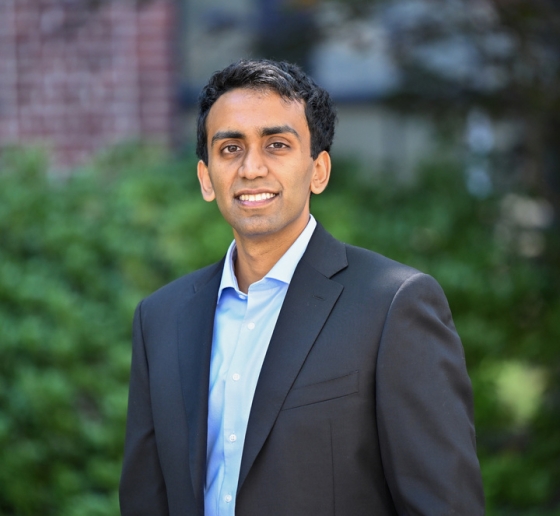
Neel Guha’s interest in law and AI stems from a fascination with computer science. “I’m from Silicon Valley, grew up around technology, and had a front-row seat to its incredible development over the past 25 years,” he says. “I always knew I wanted to do something involving computer science with my life.”
But while earning a B.S. in computer science at Stanford University and a master’s degree in machine learning at Carnegie Mellon University, he also became engrossed by the broader social implications of technology. These interests led him to the joint J.D./Ph.D. in computer science program at Stanford University, where he earned his law degree and will finish his doctorate in September.
Guha’s scholarship combines deep technical expertise in machine learning with sophisticated legal analysis, focusing both on how AI systems are transforming legal institutions and on how the law should respond to the rapid development of AI technologies.
Now, Guha brings his unique perspective and skill set to Columbia Law, where he joined the faculty on July 1; he will help the Law School shape the future of legal scholarship, pedagogy, and practice in relation to AI.
In Love With Law
As an undergraduate, Guha spent a semester in Washington, D.C., where he took a course in civil rights law to fulfill a requirement. “There are no lawyers in my family; I had no idea what to expect, and I just fell in love with it,” he says.
Guha had a eureka moment while taking the class. “One of the things that shocked me was the extent to which law and computer science share deep similarities,” he says. “Both fields are fundamentally about designing systems under constraints. In law, you’re designing rules and institutions; in computer science, you’re designing algorithms and software.”
Still, he had no plans to pursue law as a career. “I thought I’d return when I’m 45 and become a lawyer then,” he says. And then while at Carnegie Mellon, Guha had another revelation during a professor’s lecture on algorithmic fairness—the study of how to define, measure, and mitigate unfairness in automated decision-making systems. When the professor posted side-by-side slides of a machine learning equation on one and the words “disparate impact” on another, Guha says he was “blown away” when he realized his enthusiasm for computer science and law could be integrated. The discovery led him back to Stanford and its J.D./Ph.D. program.
At Home in Academia
Guha says he has always been attracted to scholarly life. “Academia affords you the incredible freedom to pursue the problems that you think are interesting. You can take large swings at daunting problems and embrace unconventional approaches,” he says. “Academics frequently have a unique opportunity to create intellectual communities that engage both practitioners and policymakers.”
One area he concentrates on is public policy. “How do we design regulation that effectively balances AI’s risks against its tremendous potential social benefits?” he says. “How should courts think about AI in the context of, say, tort liability, when we’re dealing with AI health tools where the risks and benefits are substantial? A medical AI system could democratize access to health care, but could also harm patients through misdiagnosis.”
Another area that concerns Guha is how lawyers think about and utilize AI as a technology within the profession. Developing AI platforms that recognize the nuances of law is a challenge, he says, and so is evaluating and ensuring their quality. “The analogy is to clinical trials for pharmaceuticals or crash tests for automobiles or stress tests for banks,” he says.
Guha also studies how AI and machine learning can be used as breakthrough tools by students and scholars in their empirical work, allowing them to measure an entire body of law instead of a representative sample of cases. “We can ask what has happened across every single statute in this country at the state or federal level or every single published decision,” he says. “AI and machine learning can give us new ways to see the law in action and see how it is unfolding.”
Joining Columbia Law
For Guha, joining Columbia Law School is an opportunity to collaborate with his intellectual heroes. “I was reading papers by faculty at Columbia Law School from the beginning of grad school,” he says. “That I now have the chance to be their colleague—after years of trying to emulate their approach to writing and research—is the privilege of a lifetime.”
In particular, he looks forward to investigating the legal dimensions and applications of AI—both in the classroom and in the profession—from an institutional perspective. “There’s an opportunity to build our philosophy about AI as a Columbia community,” Guha says, and to develop innovative techniques to “train law students who can effectively negotiate and traverse a professional terrain with this technology.”
He will begin his time at Columbia Law teaching Torts to first-year students. “Torts takes a simple idea—what does it mean to be personally responsible for your actions—and pulls at it one string at a time. Every piece of doctrine a 1L learns is the result of unraveling some thread. And then you realize, by the end of the semester, you’ve been chasing one simple question that on its face seems so straightforward,” he says. Guha says he is also excited because tort law is the cutting edge of modern AI governance. “Whether it’s chatbot litigation, whether it’s in the health care context or about self-driving cars, these cases are going to stretch the doctrine in new and interesting ways, as all or most technologies do.”
Guha is excited to work on the many issues that AI implicates with the Columbia Law community. “One of my favorite things about collaborating with people is discovering their superpower,” he says. “Columbia is full of superstars, so wherever I turn, I’ll find someone I can learn from.”