
Decolonizing and Shifting Power in Human Rights
In Decolonial Human Rights Practice: Tactics, Obstacles, and Futures, Professor Sarah Knuckey and two alumni co-authors—Professors Anjli Parrin ’17 and Gulika Reddy ’16 LL.M.—seek to illuminate and transform human rights advocacy.
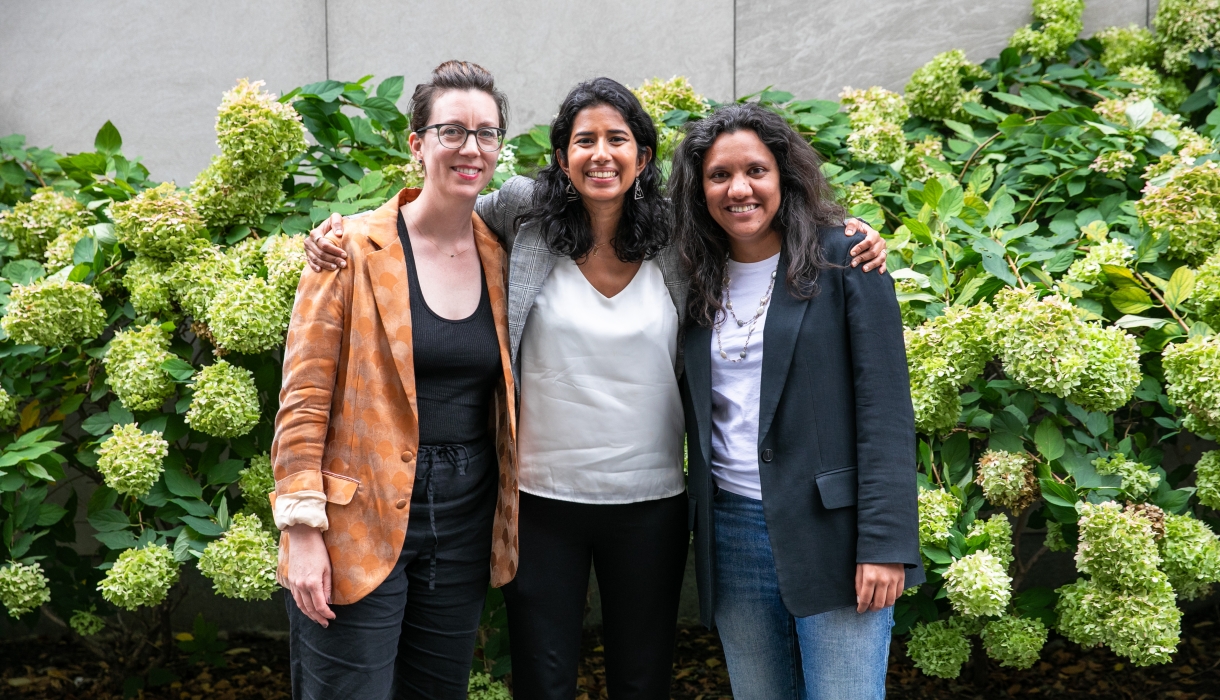
In the book Decolonial Human Rights Practice: Tactics, Obstacles, and Futures, which was launched this fall at an event held at Columbia Law School, Professors Sarah Knuckey, Anjli Parrin ’17, and Gulika Reddy ’16 LL.M. explore what they call “the ongoing struggle of human rights organizations to confront and dismantle the coloniality of human rights advocacy and to build more equitable human rights movements.”
“We began the book with a quote from a Guatemalan Indigenous human rights defender who shares their experience of working with Global North international NGOs,” says Knuckey. “The activist said, ‘We are being imposed on and our ideas are being extracted.’ Decolonial Human Rights Practice explores how and why such imposition happens, the unequal power dynamics between Global North and Global South human rights groups, and charts a path toward transformation.”
Knuckey, Parrin, and Reddy are all human rights practitioners, scholars, and teachers. Knuckey is the Lieff, Cabraser, Heimann and Bernstein Clinical Professor of Human Rights, director of the Smith Family Human Rights Clinic, and faculty director of the Human Rights Institute (HRI) at Columbia Law School. She and her co-authors—Parrin, associate clinical professor of law and director of the Global Human Rights Clinic at the University of Chicago Law School, and Reddy, associate professor and director of the International Human Rights and Conflict Resolution Clinic at Stanford Law School—began working on the book when they co-taught human rights at Columbia Law School seven years ago.
The book “offers constructive critique of contemporary human rights practice and imagines what the field could look like instead,” says Reddy, and it draws from critical theory and the authors’ own advocacy experiences. (The three have worked as human rights advocates in many countries, including Yemen, India, Kenya, the Central African Republic, Uganda, and elsewhere.)
It also includes extensive excerpts from interviews the authors conducted with more than 150 human rights practitioners from around the world. “We wanted our methodology and also our writing style to reflect the values the book argues the field should embody and our findings to be informed by the expertise of activists worldwide,” Reddy says.
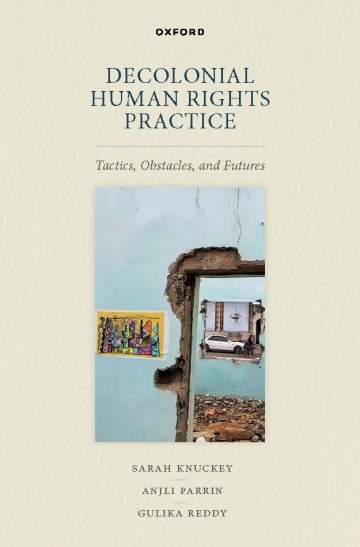
Through the authors’ in-depth interviews, the book also includes examples of attitudes and funding structures that they say give priority to well-established human rights organizations in the Global North over advocates in the Global South, including inequities regarding who gets to draw up advocacy agendas, who the international media contacts for interviews, and who gets credit for a human rights investigation.
For example, Reddy recalls attending human rights conferences focusing on the Global South, where human rights representatives from those countries were not in attendance. “There were a lot of people speaking on their behalf,” she says, “despite the fact that there were brilliant advocates that I knew from those countries who could speak about those issues themselves.”
While Parrin says these examples may seem easy to brush off—“It’s just an event. It’s just a meeting. It’s just one briefing.”—she explains that “there is a knock-on effect. The person speaking is seen as the expert. That person then gets the funding to do the next project. These small practices collectively are creating this hierarchy of whose knowledge, whose expertise, and whose power matters.”
“Much of the book is about how human rights organizations are seeking to reform colonial practices, the structural barriers to change, and what further reform is needed,” says Parrin.
The authors note that human rights organizations in the Global South have been strongly resisting practices that promote inequality, and Global North NGOs have been increasingly joining as allies in decolonization. “We really wanted to highlight that in the book,” says Parrin, “because there was a lot of literature on the problem and less about what you do about it.”
From Classrooms to Colleagues to Co-Authors
Knuckey, who has taught at Columbia Law since 2014, met Parrin and Reddy when they were students in the Human Rights Clinic. After the two graduated from the Law School, Knuckey recruited them to join HRI and the clinic as research scholars and clinical instructors. “I knew that they were exceptional teachers and advocates,” Knuckey says, “and that we shared this set of values and practices that we were trying to impart onto new generations of activists.”
During their time working together at the clinic, the three began having conversations about the power imbalances they were seeing as practitioners in the field, gaps in academic literature, and how to best prepare students for the future of human rights. It was then that they decided to write the book.
When Parrin and Reddy took on academic leadership roles at other law schools, the three co-authors continued to explore the issue together in their research, with their students, and through their conversations with on-the-ground advocates. They conducted interviews with activists around the world, then worked jointly to analyze the data and develop the ideas for the book. Instead of dividing up the chapters, they wrote them together, and they say that their ideas evolved through lengthy discussions and the input of many other activists as well.
Collaborating as a trio on a project of this scope required a lot of coordination, “but you also get three times the ideas, three times the perspectives,” Parrin says. “Writing a book is stressful and can be challenging, but it was also just a lot of fun.”
The authors also enlisted current Columbia Law students, many of whom came from outside the U.S., as researchers. The students shared their own experiences of interacting with human rights organizations and provided important feedback on early drafts of the book.
“There’s so much student expertise in this book,” Knuckey says. “Columbia Law School is a place where students can come and have their expertise acknowledged and valued.”
Looking forward, Knuckey says that the book is “one piece in a larger project.” During interviews, many of the practitioners asked if the authors could share their findings with on-the-ground advocates so that those workers could learn from the tactics and experiences of others and, Knuckey adds, “Build power by building broader coalitions.”
To help accomplish that, the authors are developing companion materials, tool kits, and workbooks with exercises and reflection questions that other teachers and NGOs can use in their day-to-day work. “We want the book to contribute to scholarship but also prompt the reflection needed to foster field-wide transformation,” says Reddy.
The three see the book as a contribution to such transformation, rather than an end point. “We hope that the book sparks broader conversations and further learning across organizations,” says Parrin, “and that this contributes to broader efforts toward more equitable human rights advocacy practices.”